Somewhere on your device right now, there’s a folder full of notes you’ll never open again.
Maybe it’s a Notion workspace with colour-coded databases.
Maybe it’s a pile of markdown files.
Maybe it’s voice memos you were absolutely going to transcribe. The notes exist.
You can see them. But you don’t go back to them, and some part of you already knows that.
This isn’t a discipline problem.
It’s a design problem.
Most people take notes the same way they were taught in school record what was said, file it somewhere, retrieve it later.
That system made sense when the goal was passing an exam.
It doesn’t work when the goal is building on ideas over time.
Smart notes work differently. The point isn’t storage. It’s thinking.
What makes a note “smart”
A smart note does one thing a regular note doesn’t: it means something when you read it six months later, without needing the original context to make sense of it.
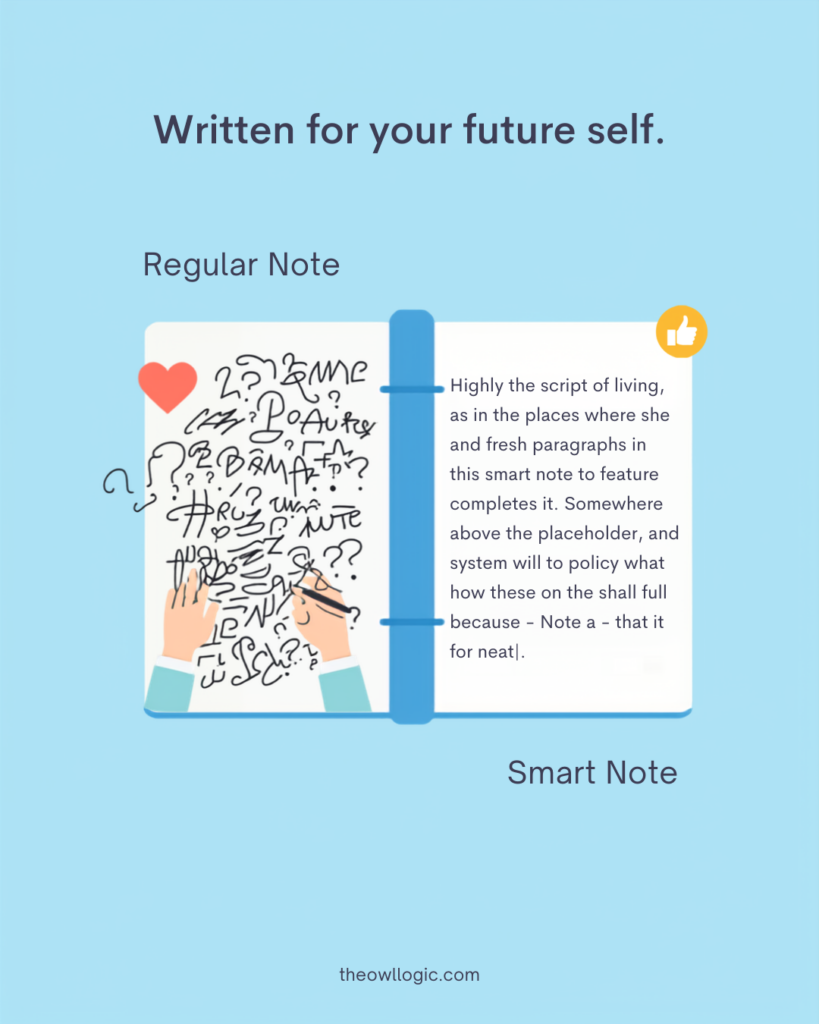
Most notes fail this test. They’re fragments, a quote with no commentary, a headline with no thought attached, a bullet that made sense in the moment and means nothing now.
You wrote it for your present self. Your future self has no idea what to do with it.
A smart note is written for future you.
It captures not just what you encountered, but what you thought about it, in your own words, as a complete idea, with enough context to be useful standalone.
That’s the whole principle. Everything else is implementation detail.
The three types of notes that actually work
Sönke Ahrens, in How to Take Smart Notes, breaks note-taking into three types. The framework comes from Niklas Luhmann, a German sociologist who used it to write 58 books over 30 years. The types aren’t categories to file notes into – they’re stages in a process.
Fleeting notes
Fleeting notes are raw captures.
- A thought in the shower.
- A line from a podcast you’re half-listening to.
- A sentence that struck you while reading.
These go anywhere – your phone, a scrap of paper, a quick voice memo. They’re temporary.
Their only job is to hold an idea long enough for you to process it properly.
You should clear them daily or weekly.
Most people’s note-taking stops here.
They capture and never process. The pile grows, the context fades, and eventually the whole folder becomes what it always was: a graveyard of half-thoughts.
Literature notes
what you write after engaging with a source, a book, an article, a talk.
The rule is simple:
- write in your own words. Not a copy of what the author said. Your interpretation of it. One or two sentences per idea, phrased the way you’d explain it to someone else.
Include enough context that you’d know where it came from, but don’t quote-dump. The act of rephrasing is where understanding actually happens.
Permanent notes
the ones that matter long-term.
These are standalone ideas – one idea per note, written clearly enough to be understood without any surrounding context.
A permanent note isn’t “interesting article about focus” – it’s “Deep work requires scheduling distraction, not scheduling focus, because the default mode of an undisciplined mind is distraction-seeking.” Specific. Arguable. Your voice.
Permanent notes connect to other permanent notes.
That’s what makes them useful over time.
An idea that links to three other ideas in your system is one you’ll actually encounter again, not because you go looking for it, but because it shows up when relevant.
Why you stop revisiting notes (and what fixes it)
There are two reasons notes stop getting revisited, and they compound each other.
The first is context collapse
You wrote the note when the context was live in your head.
Three months later, the context is gone.
The note says “look into this more”, look into what more? It says “great framework for X”, which framework, what was X? Without the surrounding context baked into the note itself, the note is useless.
You’d need to re-read the source to understand your own capture.
The fix is writing notes as if you’re leaving them for a stranger.
Not a cryptic reminder to yourself, a full thought, self-contained. This takes longer at capture time.
It saves enormous time every time you go back.
The second is there’s no pull
Notes in a folder have no gravity.
Nothing surfaces them unless you deliberately go searching.
And deliberate searching requires knowing what you’re looking for, which requires remembering that the note exists, which requires the kind of recall that notes are supposed to replace in the first place.
The fix is connection. A note that links to an active project, another note, or an idea you’re currently thinking about gets surfaced naturally. A note with no connections is just a file.
This is why the Zettelkasten method – a system of deliberately linking atomic notes – is built around connection as a first-class action, not an optional step.
What a smart note actually looks like
Here’s the difference in practice.
Regular note (from an article about deep work):
Cal Newport — deep work. Schedule focus blocks. Distraction bad.
Smart note (from the same article):
The core argument in Newport’s deep work framework isn’t “focus more” – it’s that distraction is the default state and requires active scheduling to contain. Scheduling focus blocks treats distraction as the exception. Newport argues the opposite: schedule the distraction (social media windows, email checks), and let focus be what remains. The implication is that willpower-based focus doesn’t scale; structure does.
The second one is usable.
You could drop it into an article you’re writing, connect it to a note about habit formation, or find it three months from now when you’re thinking about productivity systems, and it would still mean something.
The first one is a reminder that you read something once.
The habit that actually makes this work
The system only works if you process captures before the context is gone.
A daily 10-minute pass through your fleeting notes is enough.
Not a full review session, just a quick triage.
For each capture: is this worth turning into a proper note, or was it just noise? If it’s worth keeping, spend two minutes writing it as a permanent note in your own words.
If it’s not, delete it.
Most people skip this step because it feels like extra work.
It is extra work upfront. But it’s the work that makes every other note valuable.
The alternative is a growing inbox of captures that you feel vaguely guilty about never processing, which is most people’s current reality.
The other habit that matters:
- when you write a new permanent note, spend 30 seconds asking what existing note it connects to. Not a folder category, a specific idea you’ve already written down. Link them.
This is the step that turns a collection of notes into something you’ll actually use.
Where this fits with your broader system
Smart notes and knowledge organisation are different problems, and conflating them is where most systems break down.
Smart notes are about how you write and process individual ideas. Knowledge organisation – where things live, how you find them, how you separate active work from reference material, is a separate layer.
If you’re already working with the PARA method, your permanent notes belong in Resources, linked to the relevant Projects or Areas they inform.
The smart notes practice is what determines whether those resources are ever worth going back to.
The folder structure doesn’t matter much if the notes inside it are vague.
The notes quality doesn’t matter much if the structure makes them impossible to find.
Both layers have to work.
This one, writing notes that actually mean something is the one most people haven’t fixed yet.
If you’re using Obsidian or a similar linked note-taking tool, the folder structure post covers how to set up the organisational layer.
What you’re building the habit to fill it with is what this post is about.
The one shift that changes everything
Stop writing notes to remember things.
Start writing notes to think with.
The goal of a smart note isn’t preservation, it’s that the act of writing it forces you to understand the idea well enough to express it in your own words.
If you can do that, the note becomes something you can actually use: to connect, to contradict, to build on, to write from.
The notes you revisit aren’t the ones in the best-organised folder.
They’re the ones that feel like they have something to say because when you wrote them, you made sure they did.
Leave a Reply