Tag: n8n

  • n8n Merge Node: Every Mode Explained (With Real Examples)

    n8n Merge Node: Every Mode Explained (With Real Examples)

    Most n8n workflows eventually branch. An IF node splits data into two paths. Two parallel API calls run simultaneously. A loop finishes and you need its output alongside something fetched
    earlier. The Merge node is what brings those separate paths back together.

    merge node workflow

    Without it, parallel branches stay separate all the way to the end. There’s no automatic recombination. If you want downstream nodes to work with data from multiple branches simultaneously, you need to explicitly tell n8n how to combine them.

    New to n8n? Review these core concepts first to get the most of this guide. They’ll help you make sense of the rest of this technical guide.

    What the Merge Node Actually Does?

    The Merge node is a synchronization point. When you connect two or more branches to it, it pauses and waits until it receives data from all connected inputs before executing. This is its
    primary function not just combining data, but controlling when execution continues.

    This matters because without a Merge node, if two branches feed into the same downstream node, that node fires once per branch potentially sending duplicate emails, making redundant
    API calls, or writing the same record twice. The Merge node collects everything first, then releases a single consolidated output.

    Two things to know before choosing a mode:

    • Input 1 vs Input 2 the distinction matters for asymmetric modes (Choose Branch, Position). Input 1 is the connection on the top input socket, Input 2 is the bottom. If your merge logic depends on which side is the “primary” dataset, connect accordingly.
    • Version requirement modes other than Append and the original Combine options require n8n v1.49.0 or later. SQL Query mode and support for more than two inputs were both added in that version. If those options don’t appear in your Merge node, check your n8n version.

    Understanding how data flows between nodes before reaching a Merge is useful context if any of the examples below look unfamiliar.

    Append Stack All Items Into One List

    Append takes every item from Input 1 and every item from Input 2 and outputs them as a single list Input 1 items first, then Input 2 items. No matching, no pairing. Just concatenation.

    Use it when you have two independent sets of items that need to flow through the same downstream nodes. The total output count equals the sum of both inputs.

    Example: You fetch active subscribers from Mailchimp (Input 1) and active subscribers from HubSpot (Input 2). You want to send all of them the same Slack notification. Connect both API
    nodes to a Merge node in Append mode, then connect the Merge to your Slack node. The Slack node receives a single list of all subscribers.

    // Input 1 (3 items from Mailchimp)
    [
    { "email": "alice@example.com", "source": "mailchimp" },
    { "email": "bob@example.com", "source": "mailchimp" },
    { "email": "carol@example.com", "source": "mailchimp" }
    ]
    
    // Input 2 (2 items from HubSpot)
    [
    { "email": "dave@example.com", "source": "hubspot" },
    { "email": "eve@example.com", "source": "hubspot" }
    ]
    
    // Output (5 items)
    [
    { "email": "alice@example.com", "source": "mailchimp" },
    { "email": "bob@example.com", "source": "mailchimp" },
    { "email": "carol@example.com", "source": "mailchimp" },
    { "email": "dave@example.com", "source": "hubspot" },
    { "email": "eve@example.com", "source": "hubspot" }
    ]

    On n8n v1.49.0+, Append supports more than two inputs. Click the + button on the Merge node to add a third, fourth input. This replaces the old pattern of chaining multiple Merge nodes
    together.

    Combine by Matching Fields – The n8n Join

    This is the most powerful Combine sub-mode and the one most workflows actually need. It matches items from Input 1 against items from Input 2 based on a shared field value like a SQL
    JOIN then merges the matched items into single output items.

    Configure it by setting Input 1 Field and Input 2 Field to the field names you want to match on. The values in those fields must be identical for a match to occur (case-sensitive).

    Example: You fetch customer records from your CRM (Input 1) and order totals from your ecommerce platform (Input 2). Both contain a customer_id field. You want one merged item per
    customer that includes both their profile and their spending data.

    // Input 1 (CRM records)
    [
    { "customer_id": "C001", "name": "Alice Chen", "email": "alice@example.com" },
    { "customer_id": "C002", "name": "Bob Okafor", "email": "bob@example.com" },
    { "customer_id": "C003", "name": "Carol Wu", "email": "carol@example.com" }
    ]
    
    // Input 2 (order totals)
    [
    { "customer_id": "C001", "total_spend": 4200 },
    { "customer_id": "C003", "total_spend": 890 }
    ]

    The Output Type setting controls what you get:

    Keep Matches (inner join) only items with a match in both inputs. Output: Alice + C001 data, Carol + C003 data. Bob is excluded because there’s no matching order record.

    Keep Non-Matches only items that don’t have a match. Output: Bob, because he has no order record. Useful for finding gaps customers with no orders, orders with no customer profile.

    Keep Everything (full outer join) all items from both inputs, matched where possible. Output: Alice merged, Bob (no match, CRM data only), Carol merged. C002 appears without order data.

    Two additional settings worth knowing:

    • Multiple Matches if Input 1 has one customer but Input 2 has three orders for that customer, what happens? Include All Matches outputs three separate items (one per order). Include First Match Only keeps one item and discards the rest.
    • Dot notation for nested fields if your match field is nested (e.g., user.id ), enter it exactly as user.id in the field box. n8n interprets the dot as a path separator by default.

    Combine by Position Pair Items by Index

    Position mode pairs items from Input 1 and Input 2 by their order in the list. Item 1 from Input 1 merges with Item 1 from Input 2. Item 2 with Item 2. And so on.

    Use it when your two inputs are naturally ordered and correspond to each other by position for example, two parallel API calls that each return results in the same sequence.

    Example: You fetch product names from one API (Input 1) and current prices from another(Input 2). Both APIs return results in the same product order.

    // Input 1 (product names)
    [
    { "product_id": "P1", "name": "Widget A" },
    { "product_id": "P2", "name": "Widget B" },
    { "product_id": "P3", "name": "Widget C" }
    ]
    
    // Input 2 (prices)
    [
    { "price": 9.99 },
    { "price": 14.99 },
    { "price": 7.49 }
    ]
    
    // Output
    [
    { "product_id": "P1", "name": "Widget A", "price": 9.99 },
    { "product_id": "P2", "name": "Widget B", "price": 14.99 },
    { "product_id": "P3", "name": "Widget C", "price": 7.49 }
    ]

    The critical gotcha: if your inputs have different item counts, Position mode silently drops the extras. 5 items in Input 1 + 8 items in Input 2 = 5 output items. The last 3 from Input 2 disappear
    without warning.

    Fix this by enabling Include Any Unpaired Items under Add Option. With this on, the same 5 + 8 scenario produces 8 output items the first 5 fully merged, the last 3 from Input 2 with empty values where Input 1 fields would have been.

    If your inputs don’t naturally correspond by position, use Matching Fields instead. Position mode is reliable only when you’re certain both inputs return items in the same order.

    Combine by All Possible Combinations Cartesian Product

    This mode generates every possible pairing of items from Input 1 with items from Input 2. 3 items × 5 items = 15 output items, each containing one item from Input 1 combined with one item from
    Input 2.

    Example: You have 3 email subject line variants (Input 1) and 4 audience segments (Input 2). You want to test every subject line against every segment.

    json
    
    // Input 1 (subject lines)
    [
    { "subject": "Your order is ready" },
    { "subject": "Don't miss out" },
    { "subject": "Quick update for you" }
    ]
    
    // Input 2 (segments)
    [
    { "segment": "new_users" },
    { "segment": "returning" },
    { "segment": "vip" },
    { "segment": "inactive" }
    ]
    
    // Output: 12 items (3 × 4)
    [
    { "subject": "Your order is ready", "segment": "new_users" },
    { "subject": "Your order is ready", "segment": "returning" },
    // ... 10 more combinations
    ]

    Output count grows fast. 10 × 10 = 100 items. 20 × 20 = 400. Keep that in mind before feeding the output into an HTTP Request node that makes one API call per item.

    SQL Query Mode Full Control With AlaSQL

    SQL Query mode treats each input as a named table input1 , input2 , input3 and lets you write a SQL query to define exactly what the output looks like. It uses AlaSQL, a JavaScript SQL engine that supports most standard SQL syntax including SELECT, JOIN, WHERE, GROUP BY, and UNION.

    This mode is for situations where the other Combine options don’t give you enough control: you need to filter while joining, rename fields, aggregate, or write logic that doesn’t map cleanly to the visual options.

    Example: Join CRM customers with order data, but only output customers who have spent more than $500, and rename the fields for your downstream node.

    SELECT
     input1.name AS customer_name,
     input1.email AS customer_email,
     input2.total_spend AS lifetime_value
    FROM input1
    JOIN input2 ON input1.customer_id = input2.customer_id
    WHERE input2.total_spend > 500

    With inputs:

    // input1 (customers)
    [
    { "customer_id": "C001", "name": "Alice Chen", "email": "alice@example.com" },
    { "customer_id": "C002", "name": "Bob Okafor", "email": "bob@example.com" },
    { "customer_id": "C003", "name": "Carol Wu", "email": "carol@example.com" }
    ]
    
    // input2 (orders)
    [
    { "customer_id": "C001", "total_spend": 4200 },
    { "customer_id": "C002", "total_spend": 320 },
    { "customer_id": "C003", "total_spend": 890 }
    ]

    Output onlyAlice and Carol, with renamed fields:

    [
    { "customer_name": "Alice Chen", "customer_email": "alice@example.com", "lifetime_
    { "customer_name": "Carol Wu", "customer_email": "carol@example.com", "lifetime_va
    ]

    One known limitation: there are community reports of SQL Query mode intermittently returning no output with unchanged inputs, particularly on certain n8n cloud versions.

    If your SQL query stops working without an obvious reason, try re-saving the node or checking whether a recent n8n update affected the AlaSQL version.

    This is worth being aware of before building critical production workflows around SQL mode.

    AlaSQL doesn’t support every SQL feature window functions, stored procedures, and some advanced JOIN types aren’t available.

    For anything that hits those limits, the Code node with
    JavaScript array methods is the alternative.

    Choose Branch Wait Without Merging Data

    Choose Branch is the least intuitive mode because it doesn’t combine data at all. It waits for both inputs to have data, then outputs only the items from whichever input you select unchanged.

    The synchronization behavior is the point. Use Choose Branch when you need one branch to finish before execution continues, but you only want the data from one of them.

    Example: Branch A makes a slow AI summarization call (takes 10–30 seconds). Branch B does a fast database lookup (under a second). Your downstream node needs Branch B’s data, but it also needs Branch A to have completed before it runs maybe to ensure a log entry was written or a status was updated. Connect both to a Merge node in Choose Branch mode, select Input 2
    (Branch B), and the downstream node receives Branch B’s data only after Branch A has also finished.

    The Input 1 precedence rule: if you select Input 1 and Input 1 has 5 items while Input 2 has 10 items, only 5 items are processed. The node uses Input 1’s item count as the ceiling. This is rarely what you want if your goal is just synchronization in that case, select whichever input has the complete dataset you actually need downstream.

    Common Problems and Fixes

    Three failure patterns show up repeatedly in Merge node usage. All of them produce wrong item counts or missing data, but each has a different root cause.

    Empty or unexpected output after an IF node

    If you connect a Merge node downstream of an IF node, you’ll often see both the true and false branches execute even when the IF node only routes data down one path.

    The Merge node needs data from all its connected inputs before it can fire. When Input 1 receives data and triggers the Merge, n8n goes back and executes the branch connected to Input 2 to satisfy that requirement. If that branch starts with the false output of an IF node, it runs even though the IF node sent no data there during normal execution.

    The result is usually empty items appearing in your output, or downstream nodes running when they shouldn’t.

    Fixes:

    • Add a Filter node immediately after the Merge to remove empty items before they reach downstream nodes
    • Use Choose Branch mode instead if you only need data from one path
    • Restructure the workflow so the Merge node isn’t fed directly by IF node outputs process each branch further before merging

    For more on IF node behavior, the conditional logic in n8n guide covers branching patterns in detail.

    Position mode silently drops items

    If your Merge output has fewer items than you expect, and you’re using Combine by Position, your inputs have different item counts. The shorter input determines the output count extras
    from the longer input are dropped silently.

    Fix: Enable Include Any Unpaired Items under Add Option in the Merge node settings. This keeps all items from both inputs, filling missing fields with empty values where no pair existed.

    Combine by Matching Fields returns nothing

    If Keep Matches produces zero output despite both inputs having data, the field values aren’t matching. Common causes:

    • Field name mismatch customerId vs customer_id . Check the exact field names in the input panel.
    • Case sensitivity "Alice" won’t match "alice" .
    • Whitespace a trailing space in one field that isn’t visible in the panel.
    • Nested field if your match field is inside an object (e.g., user.id ), you must enter it in dot-notation format as plain text, not as an expression.

    Open the input panel of the Merge node and check the actual raw values of the fields you’re matching on before adjusting settings.

    For workflows where matching failures lead to silent downstream errors, setting up error notification as covered in the error handling guide will catch these before they become production problems.

    Which Mode to Use Quick Reference

    What you’re trying to doMode
    Stack two (or more) lists into oneAppend
    Match records from two sources by a shared field (like a JOIN)Combine → Matching Fields
    Pair items by their order in each listCombine → Position
    Generate every combination of two listsCombine → All Possible Combinations
    Join, filter, rename, or aggregate with full SQL controlSQL Query
    Wait for both branches, but only keep one input’s dataChoose Branch
    Wait for both branches, but only keep one input’s dataCombine → Matching Fields → Keep NonMatches
    Wait for both branches, but only keep one input’s dataCombine → Matching Fields → Keep Everything

    If you’re working with data that loops processing batches and collecting results the Loop Over Items guide covers how to structure that alongside merging the accumulated output.

  • n8n vs Make: Which Automation Tool Should You Pick in 2026?

    n8n vs Make: Which Automation Tool Should You Pick in 2026?

    My first automation tool was Make.com. I didn’t go looking for it after research or a recommendation. It was simply the first thing I came across when I wanted to automate something in my workflow.

    I spent week on it. Learning how modules connect, how data flows from one step to the next, how integrations talk to each other. At the time I didn’t realize it, but Make was quietly teaching me how to think in automations.

    Then I heard about n8n.

    I expected a steep learning curve. Instead, something clicked me faster than I anticipated because Make had already built the mental model. The nodes, the connection, the logic. n8n just looked different on the surface. Underneath, I already spoke the automation language.

    That experience is actually why I think I’m in a decent position to compare these two. Not because I read the documentation for both, but because I’ve lived inside them at different points in my automation journey. What I’m sharing here isn’t a feature matrix repackaged as an article – it’s like, I genuinely wish someone had told me before I had to figure it out myself.

    So let me give you that shortcut first.

    If you already know your situation, the table below ends the decision in under a minute. If you’re not sure which row fits you, keep reading and the rest of this post gives you the context behind each choice.

    Short Answers

    Your situationPick this
    Non-technical team, visual-first, fast setup, no compliance concernsMake
    Developer or technical team, complex logic, high-volume workflows,
    AI agents
    n8n
    Mid-technical ops team, some scripting needed, no self-hosting
    required
    Either. Read the pricing section
    first

    If you’re not sure which row fits you, that third row is more common than people admit. The rest of this post gives you the information to decide.

    Why This Is a Harder Call Than n8n vs Zapier

    If you’ve already compared n8n to Zapier, you know that comparison has a clear winner for most technical users. This one is different.

    Make sits between Zapier and n8n on the technical spectrum. It has a visual canvas (like n8n), a free tier, integrations for 3,000+ apps, and this is what most comparisons miss JavaScript
    and Python support on paid plans.
    Make is not a purely no-code tool. Once you’re on a paid tier, you can add a Code module to a scenario and write real scripting logic.

    That changes the decision. If you assumed n8n was your only option for any scripting work, it isn’t.

    The gaps between Make and n8n are real, but they’re narrower than the marketing on both sides suggests. What actually separates them is the pricing model, the AI architecture, and whether you need to self-host.

    Pricing. Operations vs Executions (With Real Numbers)

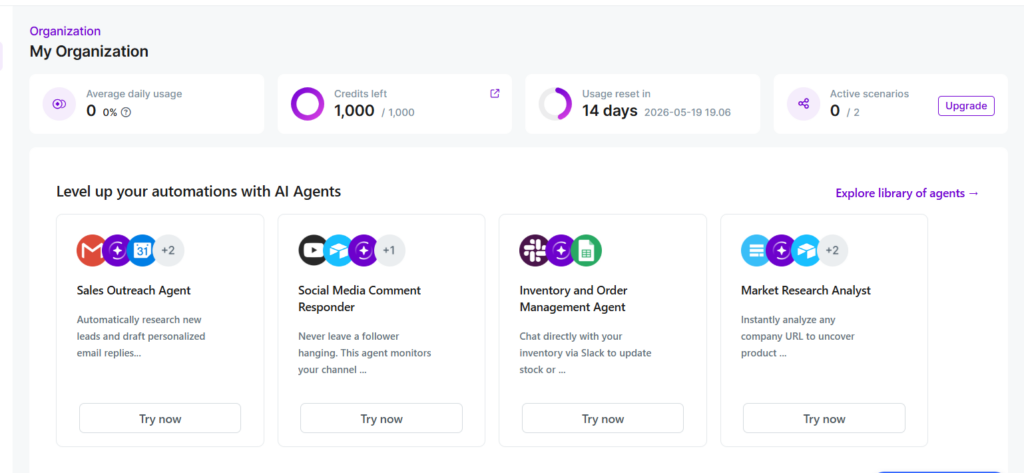
    credits in make.com

    This is the single most important thing to understand before committing to either platform.

    How Make charges

    Make bills per operation. Every individual module step in a scenario counts as one operation.

    A scenario with 8 modules that runs 500 times consumes 4,000 operations (8 × 500). Make’s Free plan includes 1,000 operations per month. Their Core plan starts at around $9/month for
    10,000 operations.

    That sounds like a lot until your scenarios get complex. A 15-step scenario processing 1,000 items per month = 15,000 operations. You’ve already outgrown the base paid tier on that one workflow alone.

    How n8n charges

    n8n bills per execution one complete workflow run, regardless of how many nodes it passes through.

    That same 8-node workflow running 500 times = 500 executions. n8n’s Starter cloud plan includes 2,500 executions/month at around $20/month.

    The same workflow, priced on both platforms

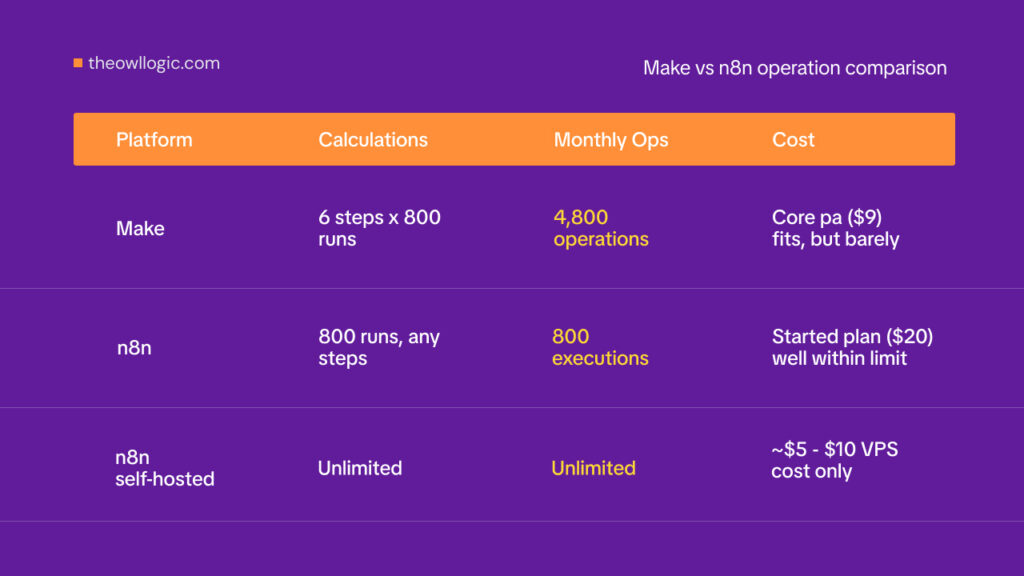
    make vs n8n operation comparison

    Here’s a real scenario: a workflow that triggers on a new HubSpot contact, enriches the data with Clearbit, formats the record, adds a row to Google Sheets, sends a Slack notification, and creates a
    follow-up task in Asana. That’s 6 steps. It runs 800 times per month.

    PlatformCalculationMonthly
    operations/executions
    Approximate cost
    Make6 steps × 800 runs4,800 operationsCore plan ($9) fits, but barely
    n8n800 runs, any
    steps
    800 executionsStarter plan ($20) well within
    limit
    n8n self-hostedUnlimitedUnlimited~$5–10 VPS cost only

    Now add complexity. Double the steps to 12, or run it 2,000 times/month, and Make’s operation count climbs to 24,000. You’re adding operation packs. On n8n self-hosted, nothing changes.

    The breakeven point depends on your workflow complexity and run frequency. For simple, low-step scenarios running infrequently, Make’s free tier is genuinely useful. For anything running at scale with multiple steps, n8n’s execution model is often significantly cheaper.

    Setting up self-hosted n8n takes about 30 minutes with Docker. The full setup is covered in n8n self-hosted setup if you want to skip the cloud cost entirely.

    Visual Interface. Where Make Genuinely Wins

    Make’s scenario builder is more polished than n8n’s canvas. The icons are cleaner, the module connections are visually intuitive, and the onboarding flow gets non-technical users to a working
    automation faster. If you hand Make to a marketing manager who’s never touched automation software, they’ll figure it out in an afternoon.

    n8n’s canvas is more powerful but more demanding. The node-based layout resembles developer tooling like Node-RED more than a consumer app. JSON data structures are visible throughout. Expressions use their own syntax.

    These aren’t problems for developers, but they’re a real friction point for anyone who just wants to connect Typeform to Mailchimp without thinking about data payloads.

    There’s one area where n8n’s interface is concretely better debugging.

    n8n lets you deactivate individual nodes with a single click while keeping the rest of the workflow intact useful when
    you’re isolating a problem in a 15-step workflow.

    In Make, you’d need to manually disconnect modules to achieve the same result, which is slower and more disruptive to your workflow structure.

    For planning and structuring workflows before you build, n8n’s canvas also scales better as complexity grows branching paths and parallel flows are easier to follow visually at larger sizes.

    Integrations and Code. Correcting a Common Misconception

    The integration count comparison: Make has 3,000+ native modules, n8n has around 1,200 native nodes.

    Make wins on raw breadth, particularly for niche SaaS tools your marketing or finance team uses. If the app you need has a Make module, setup takes minutes. If it only has an n8n HTTP Request node option, you’re doing some API configuration work.

    Make on paid plans supports JavaScript and Python via the Code app. You’re not locked into purely visual logic once you upgrade. Enterprise plans add Custom Functions. This is a genuine
    middle ground that ops teams with some scripting ability should factor in.

    n8n’s Code node is unrestricted on all plans cloud and self-hosted. There’s no tier gating on scripting. You can write arbitrary JavaScript or Python in any workflow from day one, with full
    access to the node’s input/output data.

    Where n8n goes further: community nodes, self-hostable custom node development, and the HTTP Request node cover virtually any REST or GraphQL API. If an app has a public API at all, n8n can connect to it. The development overhead is real, but the ceiling is higher.

    For teams evaluating whether either platform covers a specific integration, n8n alternatives cover the broader tool landscape if you hit a gap.

    AI Capabilities 2026 Update

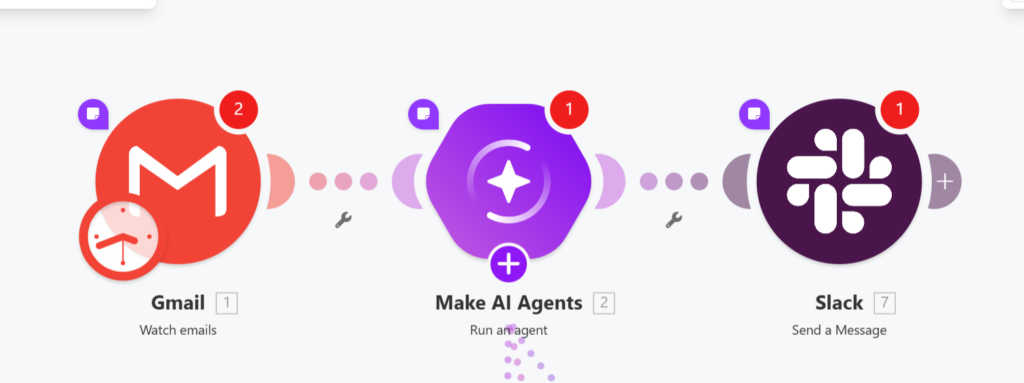
    Make has added AI capabilities that weren’t there 18 months ago. You can now trigger OpenAI and Anthropic calls as standard modules, and Make AI Agents provides a proprietary module for
    multi-step AI automation.

    For teams that want to add AI steps to existing workflows, like summarize this document, classify this email, extract these fields from this text Make works fine.

    The architectural difference shows up when you need AI that makes decisions, not just processes text.

    n8n’s AI Agent node lets an LLM choose which tools to call based on incoming data.

    The agent can decide to query a database, call an API, send a Slack message, or loop back based on what the data says, not based on a fixed sequence you defined.

    LangChain integration adds memory nodes (conversation context across runs), vector stores for RAG pipelines, and model flexibility across OpenAI, Anthropic, Mistral, and local Ollama models.

    Make’s AI modules are fixed steps in a sequence. You define when the AI runs and what it receives. n8n’s agent architecture means the AI is part of the routing logic itself.

    If you’re building an AI-powered support workflow, a document intelligence pipeline, or any automation where the AI needs to decide what happens next, that’s n8n. If you’re adding AI as
    one step in an otherwise rule-based workflow, Make handles it.

    A real n8n AI agent workflow with the actual node setup is covered in the n8n AI agent workflow.

    Self-Hosting and Data Residency

    n8n can be self-hosted. Make cannot.

    For teams with data sovereignty requirements, healthcare, finance, legal, any org with strict GDPR obligations around where data is processed, self-hosted n8n means workflow data,
    credentials, and execution history never leave your infrastructure.

    Make is cloud-only, but there’s a detail worth knowing: Make is a European company (Czech-based, part of Celonis since 2022), and its cloud infrastructure runs in European data centers. For
    EU businesses that need data to stay within the EU but can’t manage self-hosted infrastructure, Make is meaningfully different from US-hosted platforms like Zapier. This isn’t the same as self-hosting, but it matters for GDPR compliance discussions where US data transfers are the specific concern.

    The practical breakdown:

    • Full data sovereignty, any compliance requirement → n8n self-hosted
    • EU data residency without infrastructure overhead → Make (EU cloud)
    • US-based team with no residency requirements → either platform, choose on other criteria

    The Decision Framework. 4 Questions

    Answer in order. First “yes” ends the decision.

    • Do you need to self-host or keep all data within your own infrastructure?
      n8n. Make has no self-hosting option.
    • Is your team primarily non-technical, and do they need a polished visual interface with minimal configuration for common SaaS tools?
      Make. The UI onboarding is faster, the module library covers more apps out of the box, and the operation-based pricing is reasonable at low volumes.
    • Will your workflows regularly exceed 10 steps, or run at high volume (thousands of times per month)?
      n8n. The execution model becomes substantially cheaper than operation-based billing at any meaningful scale.
    • Are you building workflows where AI makes routing decisions, not just processing text as one fixed step?
      n8n. The AI Agent architecture and LangChain integration have no direct equivalent in Make.

    If none of these apply, small team, simple integrations, low volume, EU cloud is fine. Make and n8n are genuinely interchangeable for your use case. Pick whichever interface feels more natural after a free trial on both.

    To get started with n8n, installing it locally is the fastest way to test without any cloud commitment. If you’re still evaluating whether either platform fits, n8n alternatives cover the
    full landscape.

  • n8n and Supabase: Complete Integration Guide

    n8n and Supabase: Complete Integration Guide

    Connecting n8n to Supabase is straightforward once you know which connection method to use. There are three options, and picking the wrong one is the most common reason people end up
    reading troubleshooting docs instead of building workflows.

    Three Ways to Connect n8n to Supabase

    Before touching credentials, decide which connection method fits for your workflow or usecase.

    MethodWhen to use it
    Native Supabase
    node
    CRUD on public schema tables simplest setup, no SQL required
    Postgres nodeComplex queries, JOINs, stored procedures, or direct database access with custom
    schemas
    HTTP Request
    node
    Supabase Edge Functions, Auth API, Storage API, or Realtime REST endpoints the
    native node doesn’t cover

    Most workflows use the native Supabase node. It handles the common operations create, read, update, delete rows through a visual interface without writing SQL.

    The Postgres node gives you more power but requires a direct database connection string instead ofAPI key auth.

    The HTTP Request node is for anything outside the database itself.

    The rest of this guide focuses on the native Supabase node and Vector Store node, with a section at the end on when to reach for Postgres instead.

    Credentials Setup Supabase Node

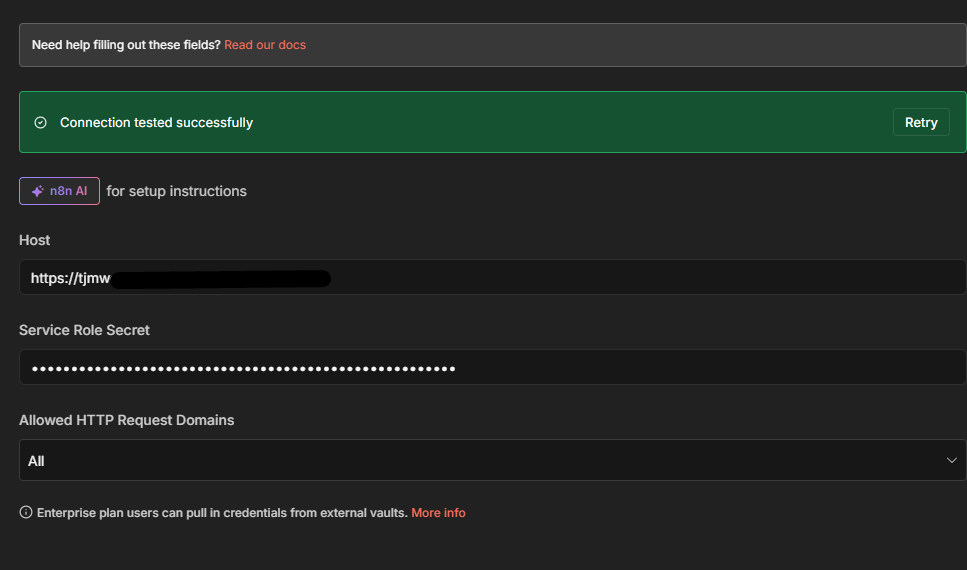
    The Supabase node authenticates with two pieces of information: your project URL and your service role secret key. These come from two different places in Supabase.

    Host (Project URL): On your project’s main dashboard, the URL appears directly below the project name — something like https://asfddssdexz.supabase.co. Hit Copy to grab it.

    Service Role Secret: Go to Project SettingsAPI. Scroll to the API Keys section, click Reveal next to the service_role key, and copy it.

    In n8n: open Credentials → New → search for Supabase → paste both values → Save.

    One thing to understand before saving: the service_role key bypasses all Row Level Security (RLS) policies. That means your n8n workflows have unrestricted read and write access to every
    table in the database. For internal automation syncing data, processing records, building pipelines this is usually fine. If you’re building workflows that act on behalf of specific users or
    handle multi-tenant data, review whether service_role is appropriate before using it in production.

    For help with n8n credential management more broadly, the n8n credentials and service guide covers the patterns in detail.

    CRUD Operations What the Supabase Node Actually Does

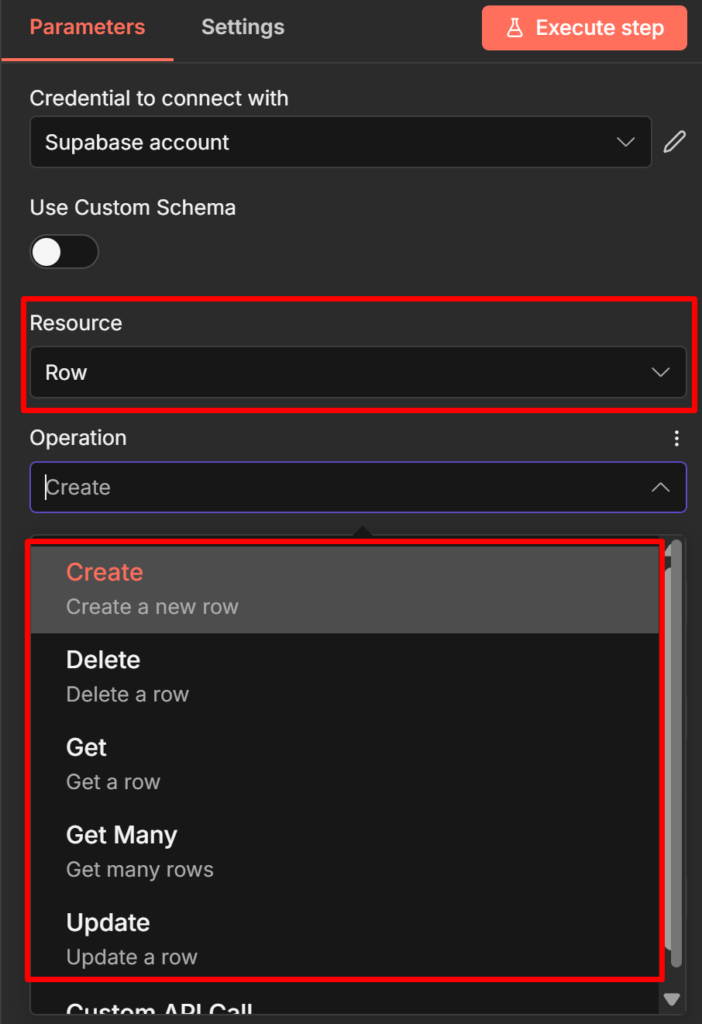
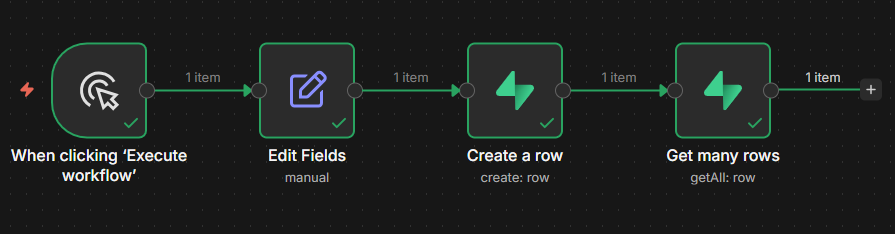
    The Supabase node supports five operations: Get Row, Get All Rows, Create Row, Update Row, and Delete Row. Here’s what each does in practice.

    Create Row

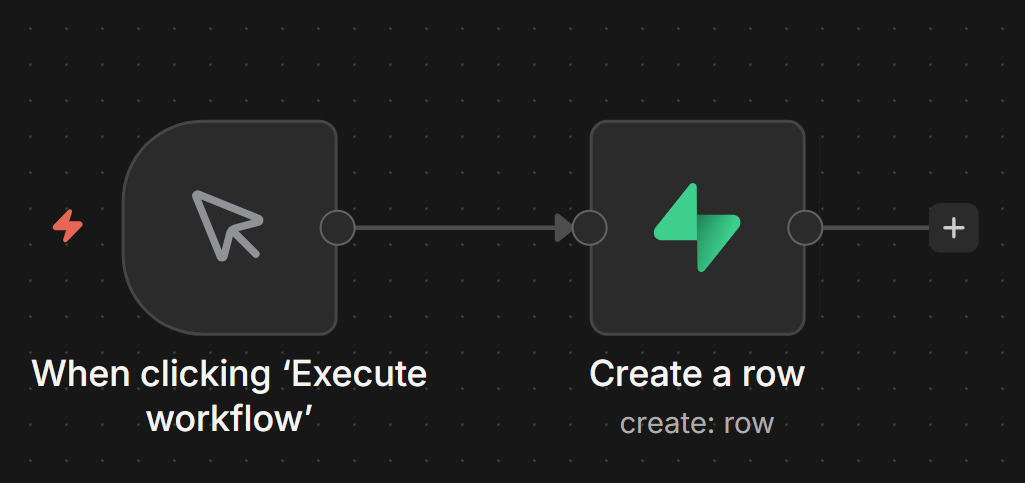
    Use this to insert a new record into a table. Set Table to your table name, then map the fields you want to write.

    A typical use case: a form submission webhook triggers an n8n workflow, and you write the submission data to a leads table.

    // What the node writes to Supabase
    
    {
    "name": "Alice Chen",
    "email": "alice@example.com",
    "source": "contact_form",
    "created_at": "2026-04-23T09:15:00Z"
    }

    Map each field in the node’s Fields to Send section using expressions like {{ $json.name }} to pull values from the previous node.

    Get All Rows (with filters)

    This is the most-used read operation. It retrieves multiple records and supports filtering, AND/OR logic, and a limit on return count.

    Example: a scheduled workflow that runs every hour and fetches all leads where status is pending :

    • Table: leads
    • Return All: off (leave the default limit unless you need all records)
    • Filter: status equals pending

    For large tables, keep Return All off and set a reasonable Limit. Returning 10,000 rows into a workflow that processes each one will slow execution and may hit memory limits.

    Custom schema support: By default, the Supabase node only reads from the public schema. If your tables live in a custom schema, enable Use Custom Schema in the node settings and enter your schema name. This option is easy to miss and causes silent failures if you forget it.

    Why Your Supabase Node Returns No Data (The RLS Problem)

    This is the most common failure pattern when connecting n8n to Supabase for the first time. The node runs without error, the execution shows green, but the output is empty.

    The cause is Row Level Security.

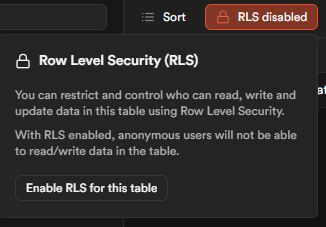
    Here’s the mechanism: When you create a table using the Supabase Table Editor (the UI), Supabase enables RLS on that table automatically. With RLS active and no policies defined, the
    anon (public) key returns zero rows not an error message, just nothing. The service_role key bypasses RLS entirely, which is why switching to service_role in your credentials immediately fixes the empty output.

    The confusing part is that there’s no error to tell you what’s happening. Your query ran, it just returned no data because RLS blocked it.

    Two valid fixes:

    Fix 1 Use the service_role key (recommended for internal automations). This is what the credentials setup section above configures. If your n8n workflows are internal, not acting on
    behalf of end users, service_role is the right choice.

    Fix 2 Create an RLS policy. If you need the anon key for a specific reason, go to Authentication → Policies in your Supabase dashboard, select your table, and create a policy that grants the access pattern you need. For example, to allow all reads:

    CREATE POLICY "Allow public read access"
    ON leads
    FOR SELECT
    USING (true);

    A third failure mode applies only to self-hosted setups: if both n8n and Supabase run in separate Docker containers, don’t use localhost as the host. Use supabase-kong (the Supabase API
    gateway container name
    ) instead.

    Check it out How to Install n8n locally (Docker + NPM Method)

    For setting up error alerts so silent failures like this get caught automatically, the error handling guide covers the error trigger workflow pattern.

    Triggering n8n Workflows From Supabase Events

    The connection works in both directions. Supabase can push events to n8n when database records change. There are two methods.

    Database Webhooks (simpler)

    Supabase Database Webhooks send an HTTP POST request to a URL whenever a row is inserted, updated, or deleted. In n8n, a Webhook node receives this POST and triggers your workflow.

    Setup in Supabase: Database → Webhooks → Create a new hook. Select your table, choose the events (INSERT, UPDATE, DELETE), and paste your n8n Webhook node URL as the endpoint.

    The payload n8n receives looks like this:

    {
    "type": "INSERT",
    "table": "leads",
    "schema": "public",
    "record": {
    "id": 42,
    "name": "Bob Okafor",
    "email": "bob@example.com",
    "status": "pending",
    "created_at": "2026-04-23T10:30:00Z"
    },
    "old_record": null
    }

    For UPDATE events, old_record contains the row’s state before the change. This lets you compare before and after without an extra database query useful for detecting which specific
    fields changed.

    The webhook guide covers how to configure the n8n Webhook node.

    Supabase Realtime (more complex)

    Supabase Realtime broadcasts database changes over WebSocket connections. n8n doesn’t have a native Realtime listener node, so you can’t subscribe to Realtime directly from a workflow canvas.

    The practical pattern is to bridge Realtime using a Supabase Edge Function: the Edge Function subscribes to Realtime events and POSTs to an n8n Webhook node when events arrive. This adds
    a layer of infrastructure, so most teams stick with Database Webhooks unless they need the lower latency Realtime provides.

    Using Supabase as a Vector Store for AI Workflows

    If you’re building AI workflows, RAG systems, document Q&A, and AI agents that search a knowledge base, the Supabase Vector Store node is a completely separate node from the CRUD Supabase node. It’s found in the AI section of the node panel, not the regular integrations section.

    It requires two things in Supabase that the CRUD node doesn’t need – the pgvector extension enabled, and a documents table structured for vector storage. The n8n docs include a SQL script
    in the Vector Store node’s quickstart section run it in Supabase’s SQL editor to create the right table structure.

    -- Run this in Supabase SQL editor to create the vector store table
    -- (use the exact script from n8n's Supabase Vector Store node docs,
    -- as the schema may vary with pgvector version)
    create extension if not exists vector;
    
    create table documents (
    id bigserial primary key,
    content text,
    metadata jsonb,
    embedding vector(1536) -- adjust dimension to match your embedding model
    );

    The dimension (1536 above) must match your embedding model’s output. OpenAI’s text embedding-3-small uses 1536. If you use a different model, update this value or you’ll get a dimension mismatch error on insert.

    Two main workflow patterns:

    Insert Documents (ingestion pipeline): Document Loader → Text Splitter → Embeddings model → Supabase Vector Store (Insert Documents mode)

    Use this to load PDFs, web pages, or text files into your vector store. Each chunk of text gets embedded and stored with its vector representation.

    Retrieve Documents (RAG chain or AI agent tool): Connect the Supabase Vector Store in Retrieve Documents (As Tool for AI Agent) mode directly to your AI Agent node’s tools connector. The agent calls it when it needs to search your knowledge base.

    When to Use the Postgres Node Instead

    The native Supabase node covers most CRUD use cases, but two scenarios push you toward the Postgres node.

    Complex queries. The Supabase node’s filter UI handles simple conditions well equality, greater than, less than. If you need JOINs across tables, aggregate functions, subqueries, or anything that requires writing actual SQL, use the Postgres node. It accepts raw SQL queries and returns results the same way any other n8n node does.

    Custom schemas and stored procedures. While the Supabase node supports custom schemas via the Use Custom Schema toggle, the Postgres node gives you direct database access without going through Supabase’s API layer. For stored procedures or database functions that aren’t exposed through the RESTAPI, the Postgres node is your only option.

    The trade-off: the Postgres node requires a direct database connection string (host, port, database name, username, password) rather than API key auth. Supabase provides these under Project Settings → Database → Connection string. Credential rotation is slightly more involved than rotating an API key.

    For teams running both n8n and Supabase self-hosted, the n8n self-hosted setup guide covers the infrastructure considerations for connecting services in the same environment.

  • How to Back Up n8n Workflows to GitHub (Step by Step)

    How to Back Up n8n Workflows to GitHub (Step by Step)

    If you’re self-hosting n8n, nothing is versioned by default. What if delete things accidentally – It’s gone. There’s no undo, no history or the rollback.

    Github fixes this. Every backup is a commit with a timestamp, which means you get a full version history and can restore any workflow to any point in time. It’s free for private repos and takes about 15 minutes to set up.

    This guide walks you through building an automated backup workflow that runs on a schedule, pulls all your n8n workflow via the API, and commits each one as a JSON file to your GitHub repo.

    Why GitHub For Backup

    GitHub is the best default choice for most self-hosted users. Every backup is a commit with timestamp. You get full version history. You can restore any workflow to any point in time. And it’s free for private repos.

    What you need,

    • A self-hosted n8n instance with API access enabled
    • A GitHub account
    • A new private GitHub repository created for backups (public repos expose your workflow logic)
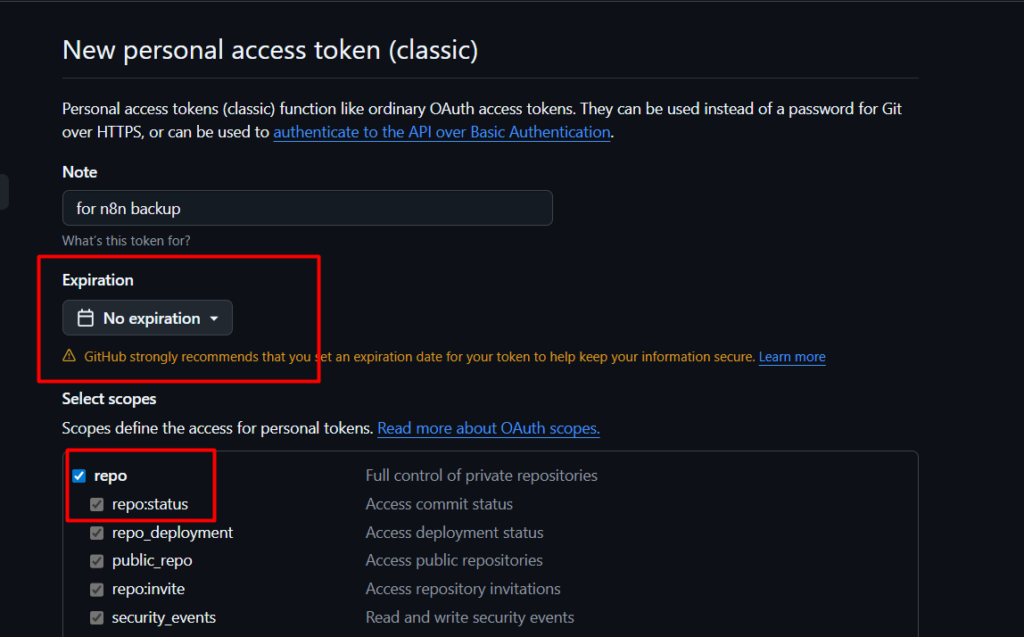
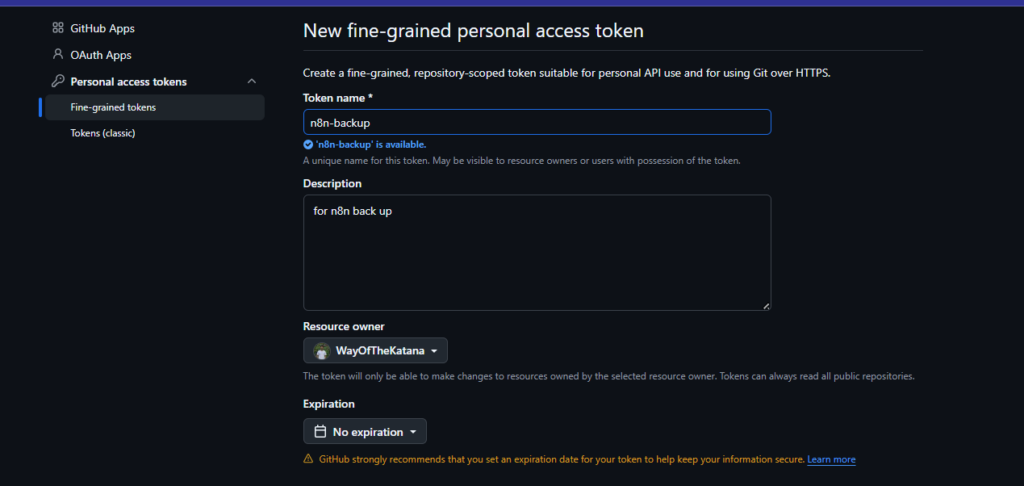
    • A GitHub Personal Access Token with repo scope

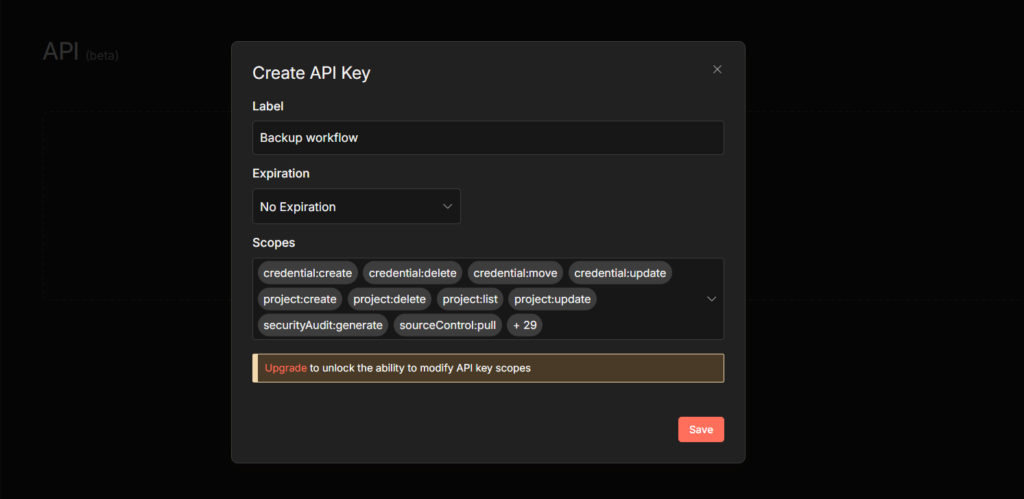
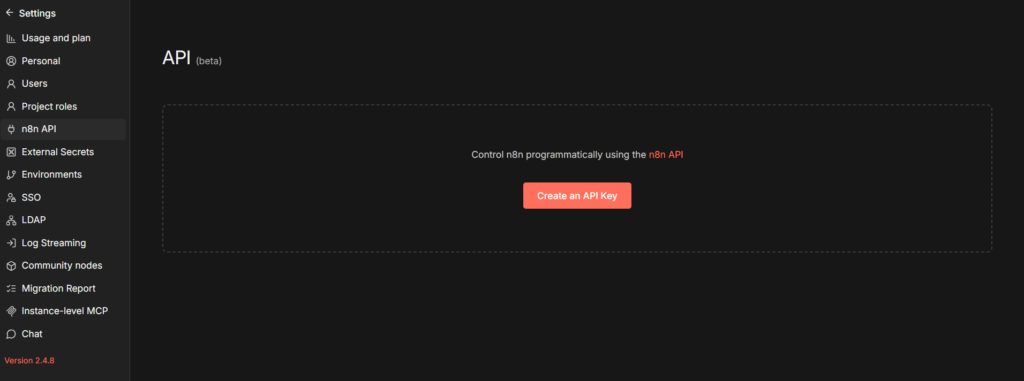
    To create your n8n API Key: In n8n, go to Settings > API > Create API Key (Copy this and keep it safe)

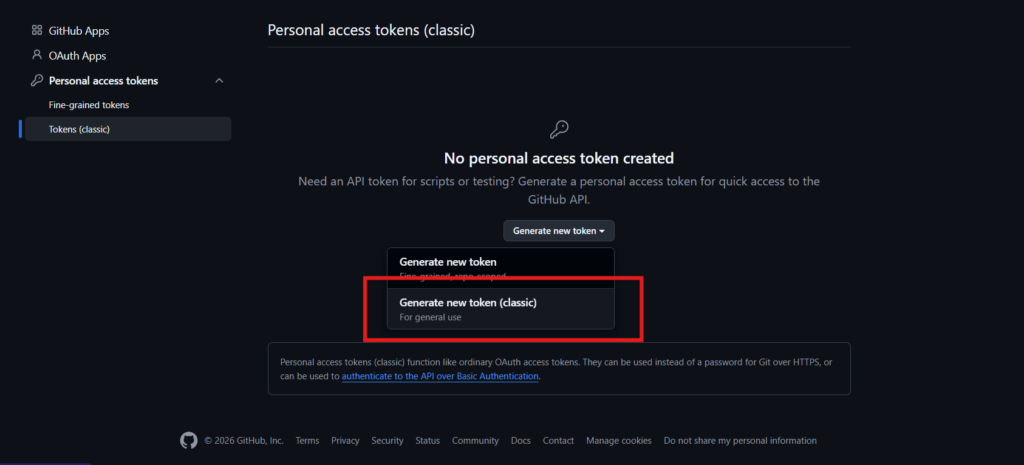
    To generate GitHub token

    • Go to GitHub > Settings > Developer Settings
    • Personal Access Token > Tokens (classic) > Generate new token
    • Check the repo scope. Copy the token immediately – You won’t see it again. same goes for n8n as well.

    Building the Backup Workflow

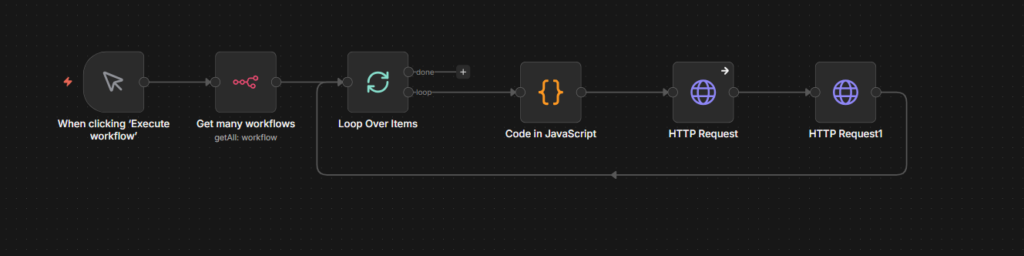
    Step 1: Add a Scheduled trigger or Manual trigger

    Since this is a tutorial, so I go with the manual trigger, for production, I’d go with Scheduled trigger. Set it run daily midnight or whenever your instance is least active. You can adjust the frequency later.

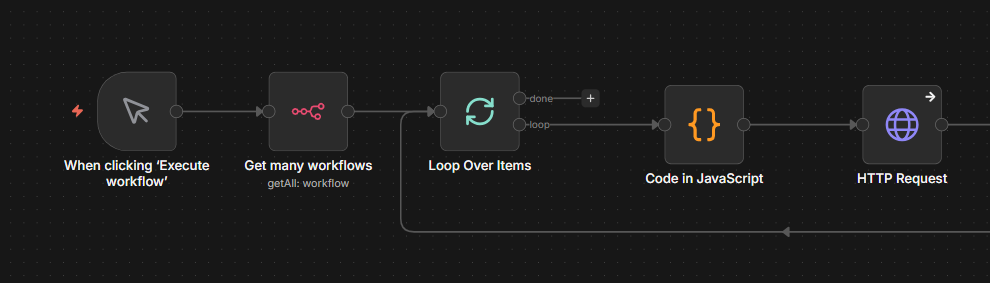
    Step 2: Fetch All Workflows

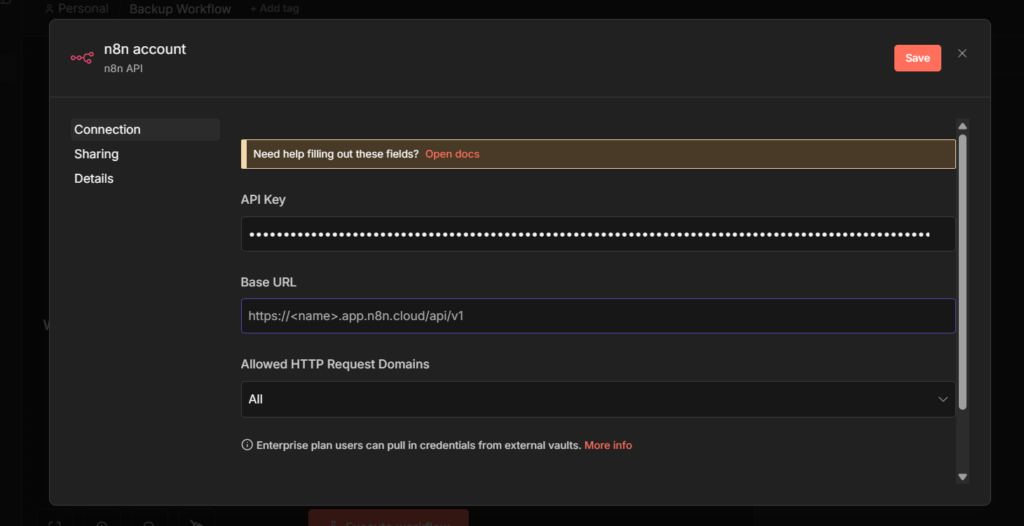
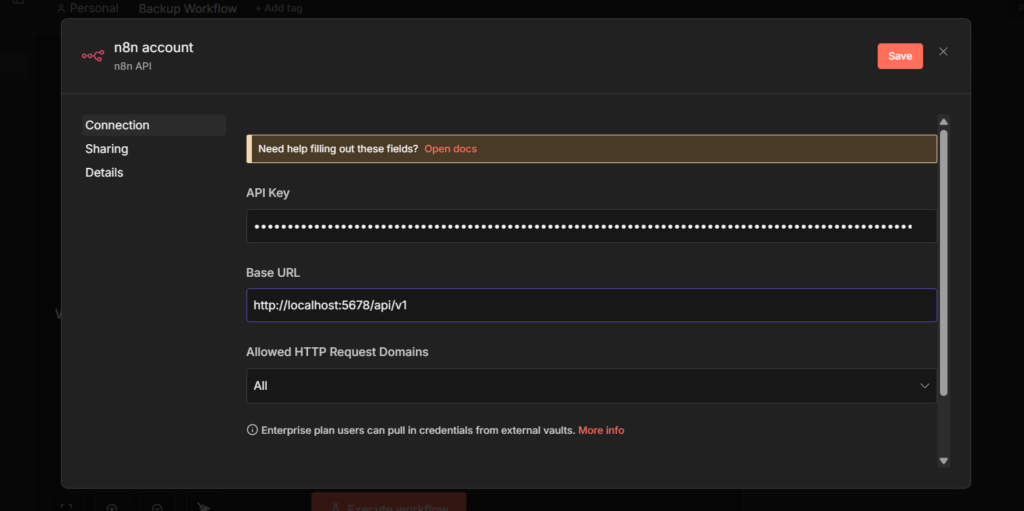
    Add a n8n node. Set resources to workflow and operation to Get many. Connect your n8n API credentials here.

    In the base URL add your name or else if your using self-hosted locally then add this http://localhost:5678/api/v1 – If it’s self-hosted on a VPS then it should be like this http://YOUR_VPS_IP:5678/api/v1

    Basically, In whatever URL you type in your browser to open n8n, just add /api/v1 at the end. That’s your base URL.

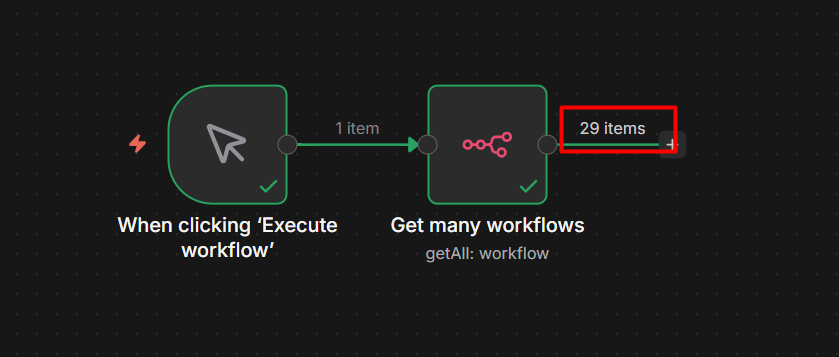
    This node hits your instance’s REST API and returns every workflow, Active, Inactive, literally all of them. Nothing gets missed.

    I retrieved 29 items, which means connection is working.

    Step 3: Loop Over Each Workflow

    Add a Loop Over Items node. This processes one workflow at a time, which matters because you’ll be making individual GitHub API calls per workflow (If you’re new to loops in n8n, here’s how the loop node works)

    Step 4: Prepare the File Content

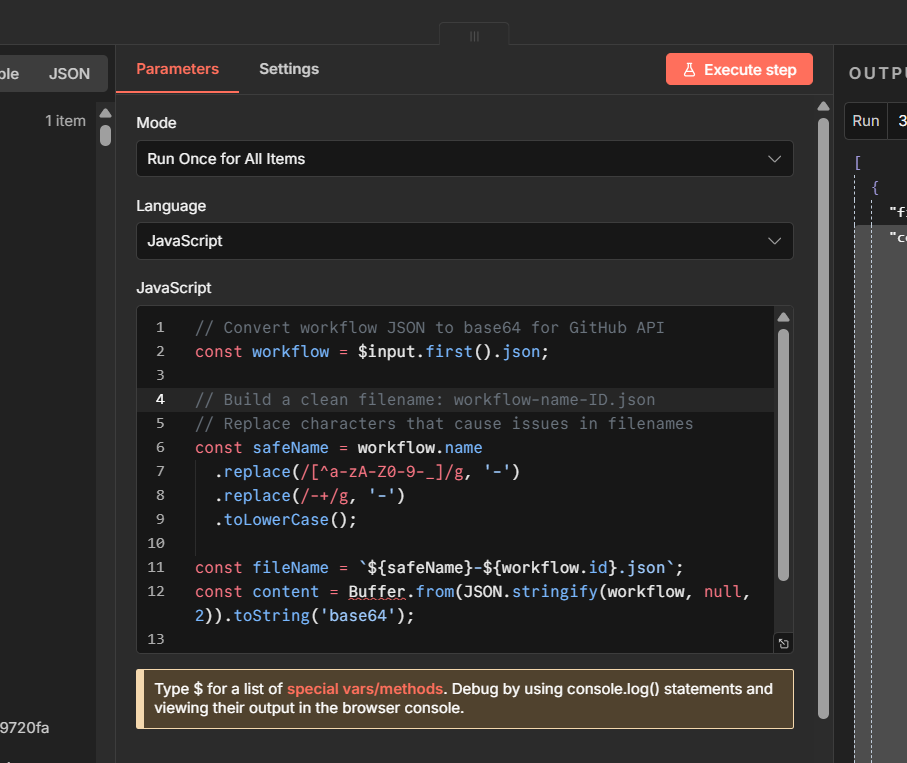
    Add a Code node. You need to convert the workflow JSON to base64, because the GitHub API requires base-64 encoded content when creating or updating files.

    // Convert workflow JSON to base64 for GitHub API
    const workflow = $input.first().json;
    
    // Build a clean filename: workflow-name-ID.json
    // Replace characters that cause issues in filenames
    const safeName = workflow.name
      .replace(/[^a-zA-Z0-9-_]/g, '-')
      .replace(/-+/g, '-')
      .toLowerCase();
    
    const fileName = `${safeName}-${workflow.id}.json`;
    const content = Buffer.from(JSON.stringify(workflow, null, 2)).toString('base64');
    
    return [{ json: { fileName, content, workflowId: workflow.id } }];

    This output two things you’ll need in the next steps fileName and content

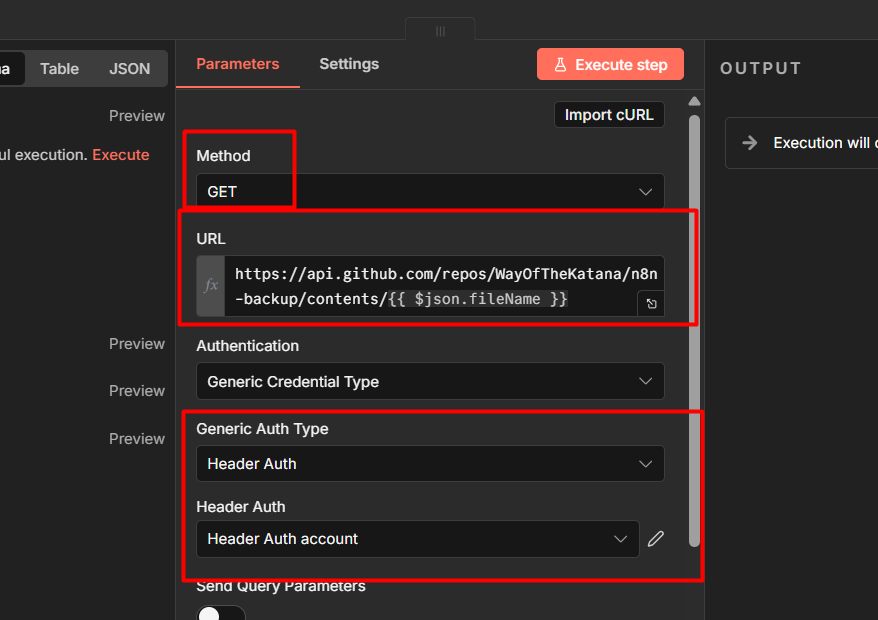
    Step 5: Check if the File Already Exists on GitHub

    Add an HTTP request node with these settings

    • Method: Get
    • URL
    https://api.github.com/repos/YOUR_USERNAME/YOUR_REPO/contents/{{ $json.fileName }}
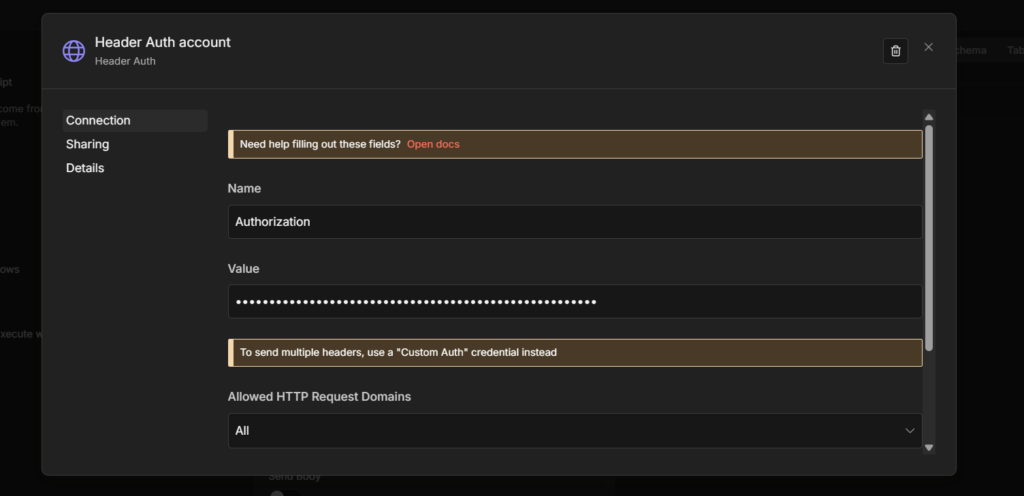
    • Authentication: Header Auth > Name: Authorization, Value: Bearer YOUR_GITHUB_TOKEN
    • Go to setting tab > On Error > Continue

    A 404 response here means the file doesn’t exist yet – that’s expected on first run. Setting on Error to Continue means the workflow keeps going instead of stopping.

    Step 6: Create or Update a File

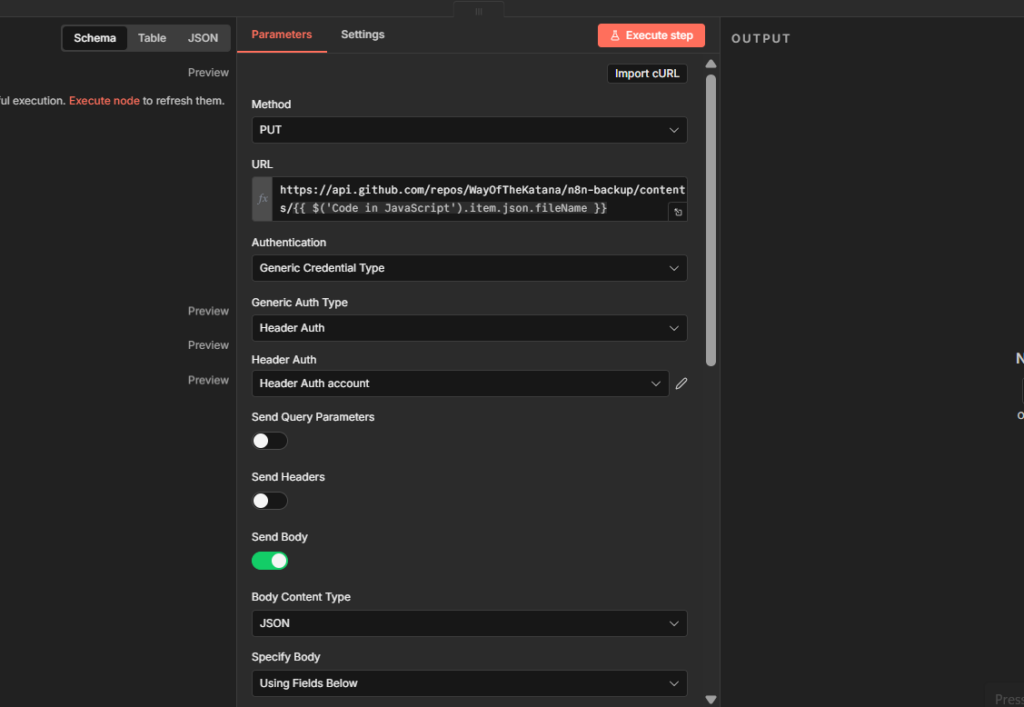
    Add another HTTP request node next to the previous one.
    • Method: Put
    • URL:
    https://api.github.com/repos/YOUR_USERNAME/YOUR_REPO/contents/{{ $('Code in JavaScript').item.json.fileName }}
    • Authentication: same Header Auth Credentials as Step 5, no change.
    • Body Content Type: JSON
    • Specify Body: Using Fields below

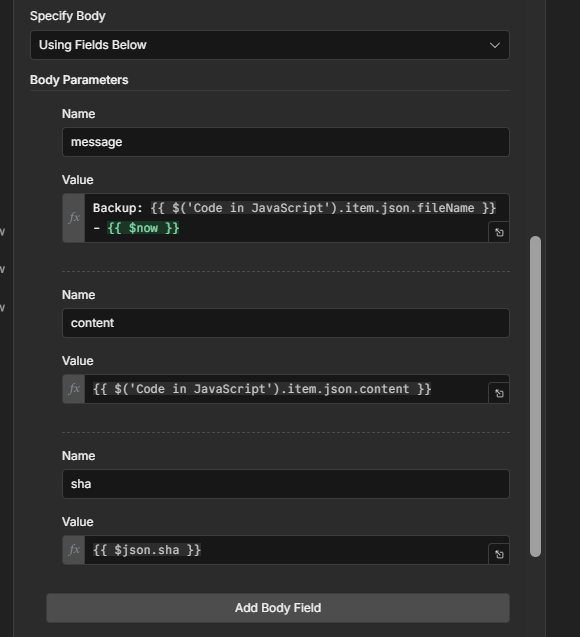
    Add these fields individually.

    • name: message
    • value:
    Backup: {{ $('Code in JavaScript').item.json.fileName }} - {{ $now }}
    • name: content
    • value
    {{ $('Code in JavaScript').item.json.content }}
    • name: sha
    • value: {{ $json.sha }}

    The sha field handles both cases automatically. When the file already exists, the previous GET request returns the sha and it gets passed here. When the file is new, the GET returns nothing and $json.sha is simply empty – which is exactly what GitHub expects for file creation. No IF node needed eventually, no extra complexity.

    Step 7: Publish the Workflow

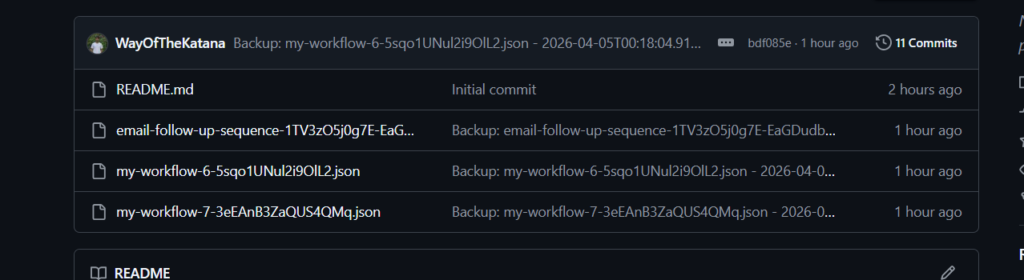
    Publish the workflow. From now on, every day your n8n instance will back itself up to your GitHub repo – one JSON file per workflow, with a full commit history you can restore from at any point.

    My Final Thoughts

    The backup workflow itself is straightforward once it’s running – but there are two things worth keeping in mind.

    First, this protect you from workflow-level mistakes. Accidental edits, deletions, broken changes – covered. It doesn’t protect against a full server or database failure. If you’re self-hosting, a database-level backup of your SQLite or Postgres instance is a separate thing worth setting up alongside this.

    Second, check your GitHub repo after the first run to confirm files are actually there. A workflow that runs without errors isn’t the same as a workflow that’s actually backing up correctly. Verify once, then trust the schedule.

    That’s it. One workflow, runs daily, commits everything to GitHub. You’ll forget it exists until the day you actually need it – which is exactly how it should work.

  • How to Use Summarization Chain in n8n

    How to Use Summarization Chain in n8n

    Most people find the Summarization Chain node the same way – they’re building an AI workflow, they see it in the node panel, and they have no idea what it actually does or how it connects to anything.

    The official docs tell you what the parameters are. They don’t tell you when to use Map Reduce vs Stuff, what the output looks like when it comes out, or why your text isn’t getting summarized even though the node ran without errors.

    That’s what this covers.

    What is Summarization Chain

    A Summarization Chain is a pre-built sequence of operations from Langchain – a popular AI framework – where each step passes its output to the next, all wired together to accomplish one specific task. In this case, that task is taking long text, breaking it into manageable pieces, sending those pieces to a language model, and returning a condensed summary.

    What the Summarization Chain Node Actually Does

    The Summarization Chain is an AI node – part of n8n’s LangChain integration. It takes text as input, sends it to a language model, and returns a natural language summary.

    Before anything else, get clear on what it is not: there’s also a core node in n8n simply called “Summarize”. That one has nothing to do with AI. It aggregates data like a pivot table, counting rows, summing values, grouping fields. Completely different tool.

    The Summarization Chain is also not an Agent. Chains in n8n have no memory. Each execution is stateless – the node takes text in, returns a summary out, and forgets everything. If you need the model to remember previous messages or carry on a conversation, you need an AI Agentic workflow instead.

    For one-shot summarization tasks – “take this article and give me a 3-sentence summary” – the chain is exactly the right tool.

    The Three Ways to Feed It Data

    When you open the Summarization Chain node, the first setting you’ll see is Data to Summarize. This dropdown has three options, and everything else in the node changes based on which one you pick. This is where most people get confused.

    Node Input (JSON) – Use this when the text you want to summarize is already flowing through your workflow as a JSON field. If you pulled content from an HTTP Request, read rows from Google Sheets, or received data from a webhook, this is your option. You point the node at the field that contains the text, and it handles the rest.

    Node Input (Binary) – Use this when the previous node passed along a binary file – a PDF, a Word document, an uploaded file. The node reads the binary data directly. You don’t need to extract the text first.

    Document Loader – Use this when you want to connect a sub-node (like the Default Data Loader) that pulls in documents from an external source. This option unlocks the sub-node connection point at the bottom of the Summarization Chain node.

    Here’s a quick reference for common situations:

    What you’re summarizingInput mode you use
    Text from an HTTP Request or webhookNode Input (JSON)
    Rows from Google SheetsNode Input (JSON)
    PDF file from Google DriveNode Input (Binary)
    Multiple documents via a loader sub-nodeDocument Loader

    Once you pick Node Input (JSON), you’ll see a Chunking Strategy setting appear. This controls how the node splits your text before sending it to the model. Simple is fine for most cases. set Character per chunks to around 3000 and Chunk Overlap to 200. The overlap means consecutive chunks share some content at the boundaries, which helps the model produce coherent summaries across chunks.

    Map Reduce, Stuff, or Refine – Which One to Use

    By default, the Summarization Chain uses Map Reduce. To see or change the method, click Add Option and select Summarization Method and prompts.

    Here’s what each method actually does and when to use it:

    MethodHow it worksBest forWatch out for
    Map ReduceSummarizes each chunk separately, then combines the summaries into a final resultLong documents, articles, multi-page contentFires parallel API calls – can cause timeouts with local models like Ollama
    StuffSends all the text in one single API callShort text, single emails, brief contentFails silently if the text exceeds the model’s context window
    RefineSummarizes the first chunk, then iteratively passes each new chunk alongside the running summaryWhen you need coherence across a long documentSlowest method – makes sequential API calls, one per chunk

    Map Reduce is the right default for anything longer than a few hundred words. It’s what n8n recommends and what handles chunking most reliably.

    Use Stuff when you’re certain the text is short enough to fit in one LLM call – a single email, a short review, a product description. It’s faster and cheaper.

    Use Refine only when you’ve tried Map Reduce and the output feels disconnected. It’s the most token-intensive option.

    One Known UI issue with Map Reduce: When you enable Summarization Method and Prompts in Map Reduce mode, the two prompt fields shown in the UI are displayed in the wrong order. The first field you see is actually the Final Prompt to Combine (the prompt used to merge all chuk summaries into the final output), and the second is the Individual Summary Prompt (the prompt used on each chunk). The labels say the opposite. If you’re customizing these prompts, double-check which field you’re editing – It’s the reverse of what the UI shows.

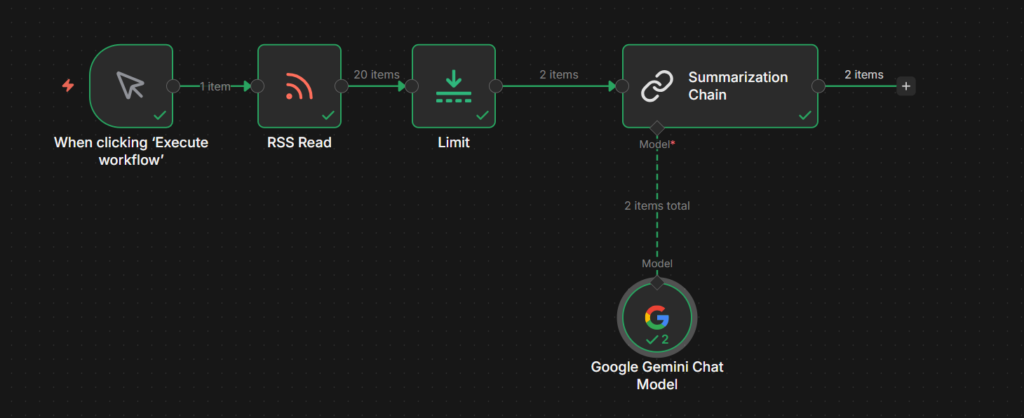
    Let’s Build It: Summarize Articles from an RSS Feed

    This workflow reads the latest articles from an RSS feed, summarizes each one, and gives you the output you can route into Slack, Notion, or anywhere else. It uses Node Input (JSON) – the most common setup.

    You’ll need an AI credentials connected in n8n. If you haven’t set that up yet, then make sure to check the credentials and service guide here.

    Step 1: Add a Manual or Schedule Trigger

    If you’re setting up a schedule trigger, Set it to run once daily. This keeps API costs predictable during the testing, you’re not burning tokens every time you manually trigger the workflow.

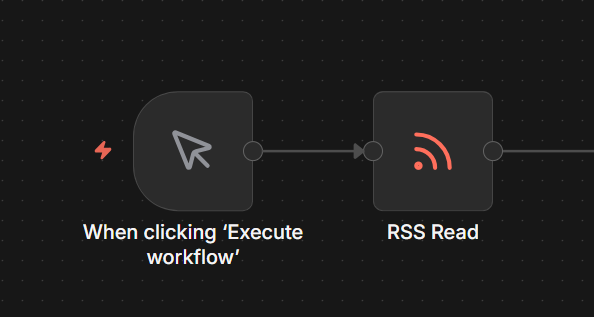
    Step 2: Add an RSS Read Node

    Adding RSS Read node to the n8n

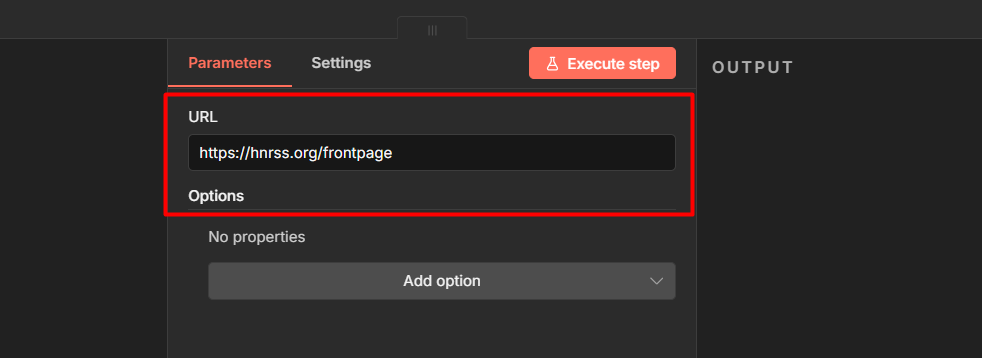
    Connect it to the trigger. Set the URL to any feed you want – for testing, https://hnrss.org/frontpage (Hacker News) works well.

    configuring RSS read node

    Configure it as:

    • Feed URL: your RSS source
    • Limit: leave at default for now

    This outputs one item per article, each with fields like title, link, and content.

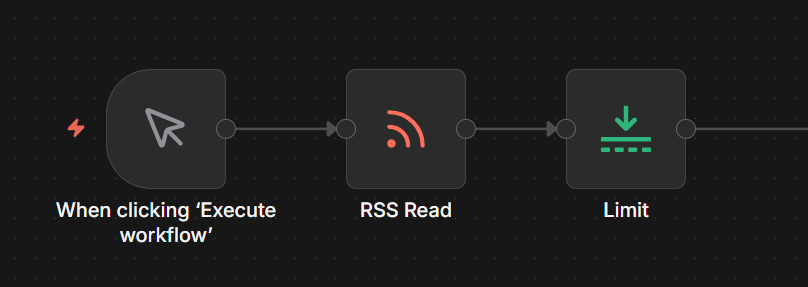
    Step 3: Add a Limit Node

    Adding limit node next to the RSS read to limit the links

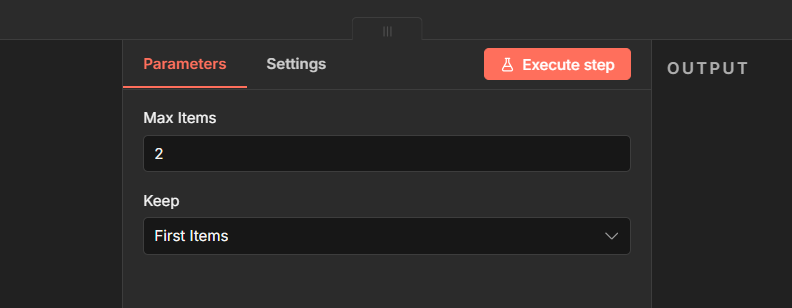
    Connect it after the RSS Read node. Set keep items to 2

    configuring limit node

    During testing, don’t summarize 50 articles at once. Test with 2, confirm everything works, then remove the limit when you’re ready to go live.

    Step 4: Add the Summarization Chain Node

    Adding Summarization Chain in n8n

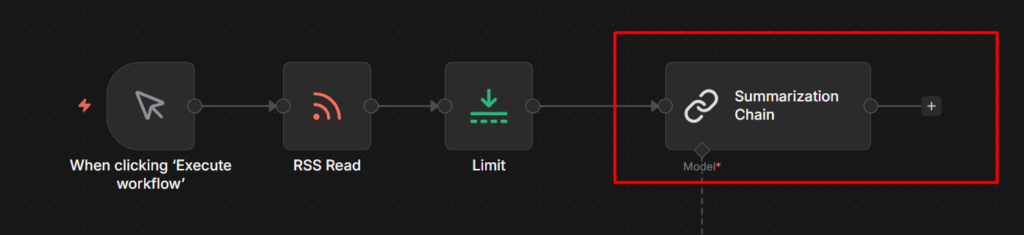
    This is the main node. Connect it after the Limit node.

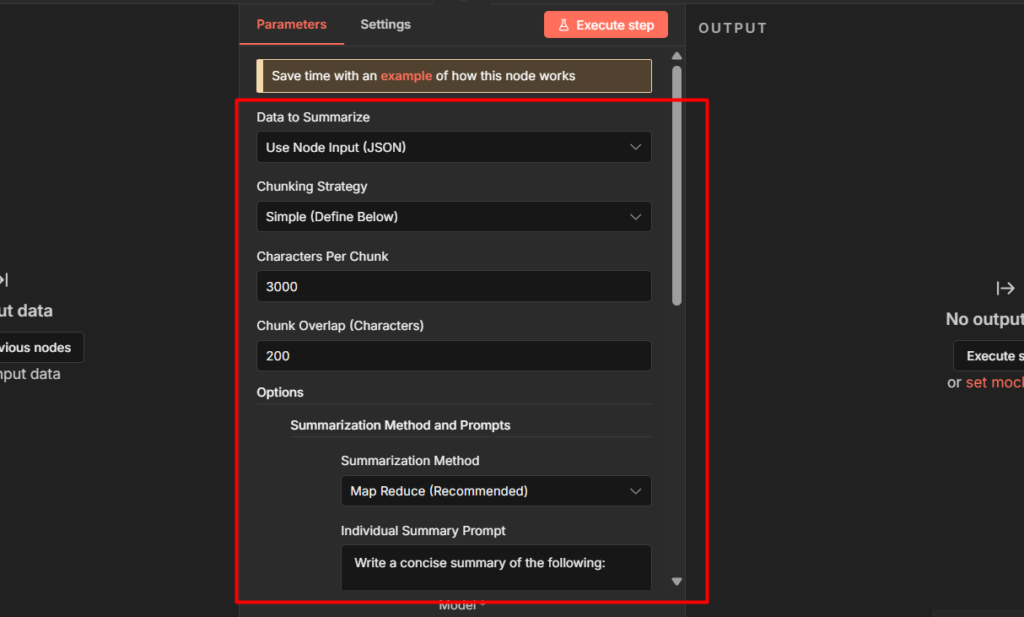
    Summarization Chain configuration

    Configuration:

    • Data to Summarize: Node Input (JSON)
    • Input: Click the expression editor and map it to the content field from the RSS node. for Hacker News this is {{ $json.content }}. For other feeds it might be {{ $json.description }} or {{ $json['content:encoded'] }} – check your RSS node output to confirm the field name.
    • Chunking Strategy: Simple
      • Character Per Chunk: 3000
      • Chunk Overlap: 200
    • Click Add Option – Summarization Method and Prompts
    • Summarization Method: Map Reduce
    • Leave the prompt fields at their default to start. Once it’s working you can customize them. Just remember the UI Swaps the label order – the top field is the Final Prompt, the bottom is the Individual Summary Prompt.

    Step 5: Connect the Chat Model Sub-Node

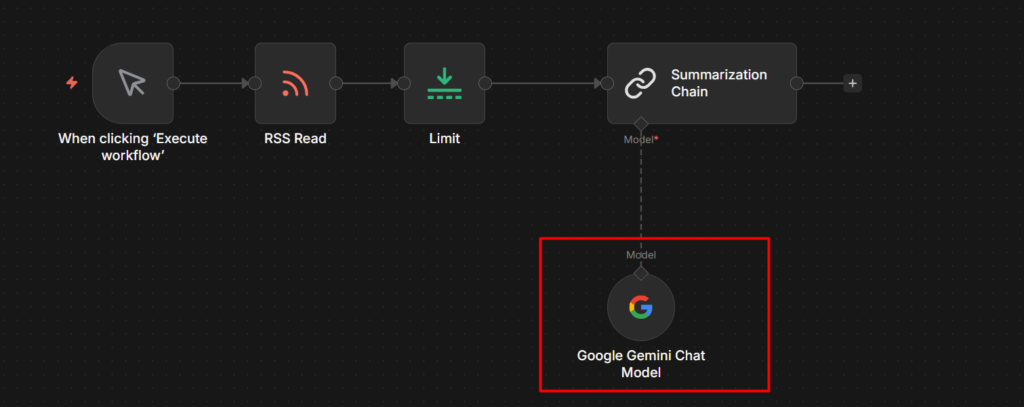
    Adding chat model to Summarization Chain

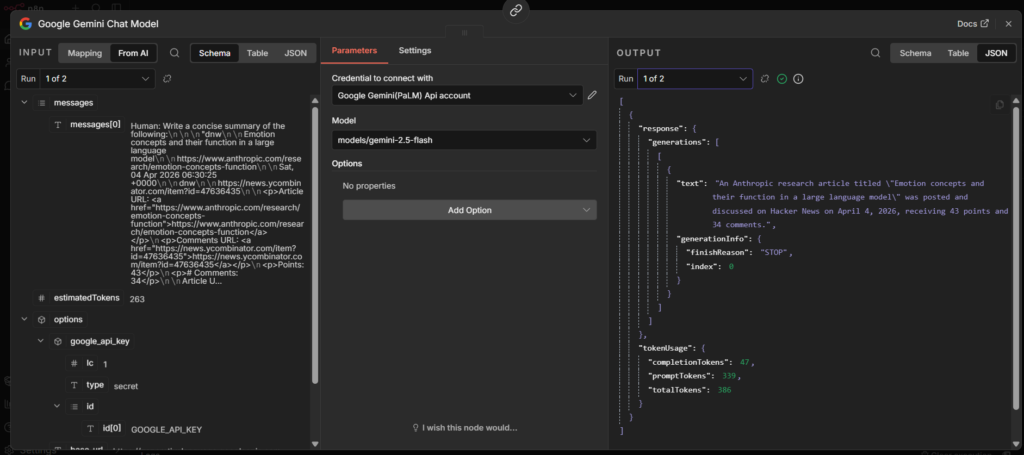
    Click the + icon on the Model connection point at the bottom of the Summarization Chain node. Search for Gemini and add Gemini Chat Model.

    In the Gemini Chat Model settings:

    • Credential: select your gemini credential
    • Model: 2.5 flash works well here – it’s fast, cheap, and more than capable for summarization.

    Step 6: Run it and Check the Output

    Summarization Chain output

    Execute the workflow. Click the Summarization Chain node after it runs.

    The output will look like this:

    Summarization Chain final output

    The summary lives inside response.text. This trips people up the first time – the output isn’t just a plain string, it’s nested inside the response object.

    To use the summary in the next node, reference it with

    {{ $json.response.text }}

    So if you’re sending to Slack, you message field would be

    {{ $json.title }}: {{ $json.response.text }}

    That’s the complete workflow. Manual trigger > RSS Read > Limit > Summarization Chain > Wherever you want the summaries to go.

    To understand more about how data flows between nodes like this, the n8n workflow nodes and data flow guide has a solid breakdown.

    When to Use This Instead of AI Agent

    The rule is simple. If the task is “text goes in, summary comes out” use the Summarization Chain. It’s purpose-built for that, it’s straightforward to configure, and it costs fewer tokens than routing through an agent.

    Use an AI Agent when you need any of the following like memory across multiple interactions, the ability to call external tools or APIs during the tasks, or multi-step reasoning where the model decides what to do next. Agents handle complexity. Chains handle one defined task.

    For batch summarization, processing a list of articles, emails, or documents in a workflow – The Summarization chain is the right choice every time.

  • How to Use Telegram Bot in n8n (Send Messages Receive Them)

    How to Use Telegram Bot in n8n (Send Messages Receive Them)

    Telegram is one of the best notification layers you can add to an n8n workflow. It’s Free, instant, and works on every device, and the bot API is genuinely simple to work with.

    There are two ways people use it. Pushing messages out to Telegram from a workflow (alerts, reports, notifications), and receiving messages from Telegram to trigger a workflow. This post covers both + practical implementations that saves your time.

    Before we dive into the workflows, you’ll need two things. a Telegram account, and n8n instance, If your just getting started, n8n cloud is the easiest choice and recommended – no server setup, and webhook work out of the box. If you’re self hosting locally, it takes a bit time to configuration, but don’t worry – I’ve covered those steps as well.

    Step 1: Create Your Bot With BotFather

    configuring botfather for the first time

    Every Telegram bot starts here. BotFather is Telegram’s official bot for creating and managing other bots.

    Open Telegram and search for @BotFather. Start a conversation and send /newbot or you can just click on Open App to Create a new bot.

    BotFather will ask you two things

    creating a new telegram bot
    • A display name – This is what users see in the chat header. Can be anything. Example: My n8n bot
    • A username – must be unique across all of Telegram and must end in bot. Example: my_n8n_alerts_bot
    verifying bot username

    Once you confirm both, BotFather sends you a bot token that looks like this

    Generating the telegram bot token

    7512938401:AAFx9Kd2mNpQrTvWxYzAbCdEfGhIjKlMnO – This is for just an example.

    Copy that token and keep it somewhere safe. You’ll paste it into n8n in the next step.

    If you’re building a bot for group chat, do one more thing before leaving BotFather. Send /setprivacy, select your bot, then choose Disable. By default, Telegram bots in groups only receive messages that directly mention them. Disabling privacy mode lets the bot see all messages in the group, which is almost always what you want when building automation workflow.

    Or else, you can directly to the Thread settings and just toggle it. Simple as pie. We cover all the methods 🙂

    Editing bot group privacy in telegram

    Step 2: Connect Telegram to n8n

    In n8n, Go to credentials, and add credentials – search for Telegram API.

    Connecting telegram to n8n

    Paste your bot token into Access Token field. Give the credentials a clear name like My Telegram Bot so you can identify it later across multiple workflows. Save it, n8n tests the connection automatically.

    Getting Your Chat ID

    Almost every telegram node configuration requires a Chat ID. This is the unique identifier for the conversation your bot will send messages to. Your personal chat with the bot, a group or a channel.

    The easiest way to get it, send your bot any message in Telegram, then open this URL in your browser (replace with your actual token)

    https://api.telegram.org/bot<YOUR_TOKEN>/getUpdates

    Look for the chat object in JSON response. The id field inside it is your Chat ID. For personal chats it’s positive number. For groups, prefix it with a - when you use it in n8n.

    retrieving the chat ID from the telegram chat in n8n

    The other way is use the Telegram trigger node in n8n (Already covered in the Use Case 2) When a message comes in, it automatically provides the Chat ID in the output – no manual lookup needed though.

    For more on setting up credential across different services. The n8n credentials guide covers the full process.

    Use Case 1 – Sending Notification to Telegram

    This is the most common setup. Something happens in another app, n8n sends you a Telegram message about it.

    The example here is a Google Sheets row being added > Telegram alert. The trigger doesn’t matter much – you can swap it for a Schedule trigger, a Webhook, a Gmail trigger, anything. The Telegram node at the end works the same way regardless.

    Step 1: Add Your Trigger

    For this example, use simply manual trigger.

    Step 2: Add the Telegram Node

    Click + after the trigger and search for Telegram. Select Send a Text Message.

    connecting a send message telegram node in n8n

    Configuration:

    • Select the Telegram credential you created
    • paste your Chat ID (the number you retrieved above)
    • Write your message or maybe you can just pull the data from anywhere else.

    Now you send messages to your bot.

    showing the telegram output with n8n

    Step 3: Turn Off the n8n Attribution

    By default, n8n appends a small “This message was sent automatically via n8n” line to every telegram message. Most people don’t want that in production.

    removing the attribution for telegram messages

    To remove it: Additional Fields > Add Field > Append n8n Attribution > toggle off.

    removed n8n attribution in n8n

    That’s the full outbound notification workflow. Trigger > Telegram Send message > done. Test it by executing the workflow manually and checking your telegram chat.
    Use case 2 – Receive Messages and Respond

    This flips the direction. Instead of n8n pushing messages out, Telegram messages come in and trigger your workflow. The Telegram trigger node listens for incoming messages via webhook that n8n registers automatically when you activate/publish the workflow.

    One important catch: If you’re using n8n cloud or self-hosting on a VPS, webhook works out of the box. But if you’re running n8n locally, Telegram can’t reach your machine from the internet. To solve this, you need to expose your localhost using a tool like ngrok, which creates a secured public tunnel. Just set the ngrok HTTPS URL as your webhook URL when starting n8n and the Telegram Trigger will work normally.

    Read here: Webhooks in n8n explained

    Here’s the configuration if you’re using locally hosted n8n with docker to expose Telegram Trigger.

    • Make sure to read the Webhooks in n8n explained and understand the context of how Webhooks working in n8n
    • Start ngrok in your terminal ngrok http 5678
    • Copy the HTTPS forwarding URL (e.g., `https://xxxx.ngrok-free.dev`)
    • Stop your current n8n container
    • Restart it with the WEBHOOK_URL environment variable added docker run … --env=WEBHOOK_URL="https://xxxx.ngrok-free.dev" … n8nio/n8n

    Once restarted, your Telegram Trigger webhook will register successfully. The free ngrok plan gives you a new URL every time you restart it. That means you need to update WEBHOOK_URL and restart your container each time.

    Part A – Simple Reply Bot

    This is a foundation workflow. Get this working first before we add any logic to it.

    Step 1: Add the Telegram Trigger

    Create a new workflow. Add a Telegram trigger node as first step.

    listening to telegram trigger webhook

    Configuration:

    • Your telegram credentials
    • Updates to watch, select Message

    Click Listen for Test Event, then open telegram and send your bot any message, something like hello. The Telegram Trigger node will show the incoming payload in the output panel.

    telegram webhook payload in n8n

    the two fields you’ll use constantly

    chat.id – the chat ID of whoever sends the message

    text – the actual message text they typed

    The Chat ID from the trigger is dynamic – it automatically point back to the person who sent the message. You never need to hardcode Chat ID in a reply workflow.

    Step 2: Add the Telegram Send Message Node

    Click + after the trigger and add Telegram > Send message node.

    Configuration:

    • Your telegram credentials.
    • Chat ID
    • Text: whatever you want the bot to reply.

    For a simple echo bot that repeats what user said

    mapping chat ID to telegram node

    You said: {{$json.message.text}}

    or a fixed response maybe, like “Thanks for your message, I’ll reply shortly”

    Execute the workflow, send your bot a message in Telegram, and you should see the reply come back within a second or two. That’s the full loop. Receive, Process, Reply

    Publish the workflow when you’re ready to go live. n8n registers the Telegram webhook automatically at that point.

    testing telegram bot in n8n

    Part B: Command Based Bot

    command based telegram bot in n8n

    Now that part A works, extend it with a Switch node to route different commands to different actions. This is the pattern behind most real Telegram bots.

    The idea: user sends /status or /help, the bot does something different for each.

    Step 1: Add a Switch Node

    Insert a Switch Node between telegram trigger and send message node.

    configuring the expression rule in n8n for telegram bot

    Set Mode to Rules – Add two rules.

    • Rule 1: {{ $json.message.text }} equals /status – Output 1
    • Rule 2: {{ $json.message.text }} equals /help – Output 2
    adding fallback output in switch node

    Add a third output for anything else. Set it as Fallback output. This catches messages that don’t match any command.

    Read more

    Step 2: Build the /status Route

    adding statuses for switch node

    On the /status output, add an HTTP Request node. Point it any public API that returns useful data. A simple example – current bitcoin price.

    testing telegram bot in n8n

    Step 3: Build the /help Route

    On the /help output, skip the HTTP request. Just add the Telegram send message node directly.

    • Chat ID:
    • Parse Mode: HTML
    • Format your text
    <b>Available commands:</b>
    
    /status — get the current BTC price
    /help — show this message
    telegram bot

    Step 4: Build the Fallback Route

    On the fallback route, add a final Telegram send message node.

    • Text: Sorry, I don't recognize that command Send /help to see what I can do

    Publish the workflow now, send /status to your bot – It should definitely respond with the price. Send /help – it should reply with the command list. Send anything else besides these commands, then it will send I don’t recognize it based on what you’re prompted on the fallback route.

    telegram bot command based in n8n

    That’s working command-based bot. From here you can replace HTTP request with anything, a google sheet maybe, a database query or AI agent’s response. The Switch route – reply pattern will be same. If you want to just wire an LLM into one of the routes, check it out our AI Agent guide here – Shows exactly how to set that up

    One Bot, One Active Webhook

    • Telegram only allows one Webhook URL per bot at a time
    • Two workflows using the same bot token = only the latest activated one receives the messages, other silently stops without any errors
    • As a fix: Use a single active Telegram Trigger and route logic inside it using IF or Switch nodes.
    • Need separate workflows? Create separate bots in BotFather, each with it’s token.

    Telegram Trigger Stuck or Not Firing (self-hosted n8n)

    • Telegram Trigger uses webhooks; Telegram’s servers must reach your n8n instance via a public HTTPS URL
    • Running locally or behind a reverse proxy without HTTPS/Websocket support = Trigger silently fails or get stuck
    • This is a network config issue, not Telegram one. Check your webhook setup and ensure HTTPS is properly configured
    Let’s Wrap This Up,

    Telegram and n8n is one of those combinations that just works. You get a free, reliable messaging layer on top of any automation you build, without dealing with email deliverability, app push notification complexity, or paid SMS services.

    Start simple. Get the outbound notification working first, send yourself an alert from a trigger you actually use. Then move to the reply bot once that feels solid.
    The command based pattern in Part B scales further than it looks. Most production bots are just that same Switch node pattern with more routes and smarter logic behind each one.

    The only real friction is the webhook setup on localhost, and now you know exactly how to handle that with ngrok and the Docker environment variable approach.

    From here, the natural next step is wiring an AI agent into one of your bot routes so it can handle freeform questions, not just fixed commands. That turns a simple command bot into something that feels genuinely intelligent to whoever is using it.

  • n8n Airtable Integrations (Connect, Read, Create and Update)

    n8n Airtable Integrations (Connect, Read, Create and Update)

    Airtable sits at an interesting spot – It’s more structured (steroid) than a spreadsheet but more approachable than a proper database. That makes it a natural fit for storing leads, content pipelines, project data and anything else needs columns, filters, and views without spinning up Postgres.

    Connecting it to n8n is straightforward and we will go in-depth

    • Which scopes your credential needs
    • Why Update and Delete require a Record ID you have to fetch first.
    • Why the Airtable trigger isn’t real-time

    skip these would cost you hours of debugging empty records and trigger that never fires.

    Let’s get started, setup the credentials.

    Setting Up Your Airtable Credential

    Airtable removed it’s legacy API in february 2024. If you’re following an older tutorial that shows an API Key field in Airtable’s account settings, that method no longer exists. The only options now are Personal Access Token (recommended) and OAuth 2.

    Step 1

    • Go to airtable.com/create/tokens and click on the Create token

    Step 2

    • Give it a name, for now I’ll add as “The Owl Logic”
    • Add these three scopes
      • data.records:read – read records from tables
      • data.records:write – create, update, and delete records
      • schema.bases:read – read table structure so n8n can list your bases and columns

    That third scope is the one almost everyone misses. Without it, n8n connects successfully but the base dropdown stays empty. You end up with a valid credential that can’t actually do anything useful in the UI.

    Step 3

    Under Access, select which base or bases this token can access. You can grant access to all bases in a workspace or limit it to specific ones.

    I selected the Add all resources to ensure a current and future bases are connected.

    Step 4

    Click Create token, copy it immediately (Airtable only shows it once), so make sure to copy and paste it on a notepad or somewhere safe.

    Step 5

    • Go to n8n > Create credentials > Airtable Personal Access Token
    • Paste the Personal Access Token

    Well, it’s working but this is totally different from Google Spreadsheet.

    Reading Records (List All vs. Filter by Formula)

    Both operations use Resource: Record > Operation: Search.

    The difference is whether you filter at the Airtable level or pull everything and filter in n8n.

    Pulling everything and filtering with an IF node works, but it’s wasteful. If your table has 500 records and you only need 12, you’re passing 500 items through your workflow for no reason. Filter by Formula handles the selection in Airtable before the data reaches n8n.

    To use it: open the Airtable node > add the Filter By Formula option > enter your formula

    Basically, In the Filter By Formula Section, I called the column as {status} that equals to “writing”, This way you can grab all the writing items to the node.

    Field names are case-sensitive and must match exactly. If your column named Email Address, then formula must use {Email Address}. using {email address} or {emailAddress} leads to an error.

    For no filter at all, leave the formula field empty . The node returns every record in the table.

    Creating Records

    Resource: Record > Operation: Create

    The node offers two mapping modes:

    Map Automatically – n8n takes the field names from your incoming data and maps them to Airtable columns with matching names. This only works when your data field name already match your Airtable column names exactly (again, case-sensitive)

    Map Each Field Manually – you specify each Airtable column and map it to an expression. More steps, but explicit. You know exactly what’s going where.

    Records created but fields are empty? This is a field name mismatch. The record was created, but the column names didn’t match so Airtable ignored the data. Open your Airtable table, copy the exact column name character-for-character (including spaces and capitalization), and update your field mapping in n8n.

    Updating and Deleting Records

    This is where most beginners gets stranded.

    You cannot update or delete a record by field value. Both operations requires the Airtable Record ID – a string like recABCDEF12345678 that Airtable assigns to every row internally. You don’t see it in the default grid view, but it exists for every record.

    This means Update and Delete always take two steps: first find the record to get its ID, then act on it.

    Step 1: Search for the Record

    Resource: Record > Operation: Search > Filter By Formula or You can Return All.

    When this executes, each returned record includes an id field alongside your data fields. That id is the Record ID.

    Step 2: Update Using ID

    Resource: Record > Operation: Update > ID

    Now, I’m going to map the ID to ID (using to match) and changes the Post Idea from previous context to a new updated idea which is the “New Complete Beginner”

    It changed.

    Delete works the same way – Search first, then pass the ID to Delete Operation

    One thing to watch: If your search returns multiple records, the update only processes the first one by default. Make your formula specific enough to return a single record. If you genuinely need to update all matching records, you’ll need Loop Over Items to process each one.

    Using the Airtable Trigger

    The Airtable Trigger doesn’t use webhooks. It polls – it checks your table on a schedule and looks for records that have changed since the last check. This means it’s not real-time. Depending on how you configure it, there can be a 1 – 15 minute delay between a record being created or changed in Airtable and your workflow starting.

    If you need instant response to Airtable changes, the trigger isn’t the right tool. Use a form, webhook or another event source to feed data into n8n directly instead of polling Airtable for it.

    For use cases where a small delay is acceptable – daily syncs, batch processing, schedule enrichment then the trigger works well.

    3 Most Common Errors That Break Airtable Workflows in n8n

    1. Bases dropdown is empty after connecting the credential

    The schema.bases:read scope is missing from your Personal Access Token. Fix: go back to Airtable’s token settings, add the missing scope, and save. You don’t need to recreate the token in n8n, just update the scopes in Airtable and the existing credential will pick them up.

    2. 429 Too Many Requests — records stop mid-loop

    Airtable’s rate limit is 5 requests per second per base, and 50 requests per second across all bases per access token. When you loop over records and create or update them one by one, you hit this quickly with larger datasets.

    Fix: add a Wait node set to 200ms inside your loop. That keeps you under 5 requests per second. For larger batches where you need to stay well under the limit, 500ms is safer. See the rate limiting guide for more detailed approach.

    3. Update node fails with “Record ID required”

    You’re passing field data to the Update operation without an id value. Fix: add a Search step before the Update, filter to the specific record you want, and use {{ $json.id }} as the ID field in the Update node. The two-step pattern (Search → Update) is required, there’s no way around it.

    My Final Thoughts

    Airtable and n8n make a strong pair once you understand how they actually communicate. The credential scopes determine what n8n can see.

    The Record ID determines what you can change. The trigger polls on a schedule, not in real-time. Get those three things right and most of the confusion disappears.

    To recap what matters most: always include schema.bases:read when creating your Personal Access Token, use Filter By Formula to keep your workflows lean, treat Update and Delete as two-step operations, and add a Wait node inside loops before you hit rate limits rather than after.

    From here you can start layering Airtable into real workflows, routing new leads from a form, syncing a content pipeline, updating project statuses from Slack. The patterns you learned here scale directly to those use cases.

  • How to Use the Simple Memory Node in n8n (Beginner’s Guide)

    How to Use the Simple Memory Node in n8n (Beginner’s Guide)

    You built your first AI Agent in n8n. It responded well, sounds smart, and handles questions exactly how you configured it.

    Then you type “What did I just tell you?

    And it says “I don’t have information about that

    That’s not a prompt problem. Your agent has no memory of it. Every single message it receives feels like the first one, a completely fresh conversation with no context of what came before.

    The Simple Memory fixes this. Here’s how to set it up correctly, what the settings actually mean, and the two mistakes that will silently break your workflow if you skip this post.

    What the Simple Memory Actually Does?

    When you send a message to an AI Agent in n8n, the request goes to an LLM like Claude or Gemini. The LLM processes that one message and sends back a response. That’s it. No memory of previous turns each API call is completely independent by design.

    The Simple Memory sites between your chat trigger and your AI Agent and solves this by keeping a rolling of log of recent conversation exchanges.

    Before each new message goes to the LLM, n8n injects the recent chat history into the request automatically. The LLM now has context.

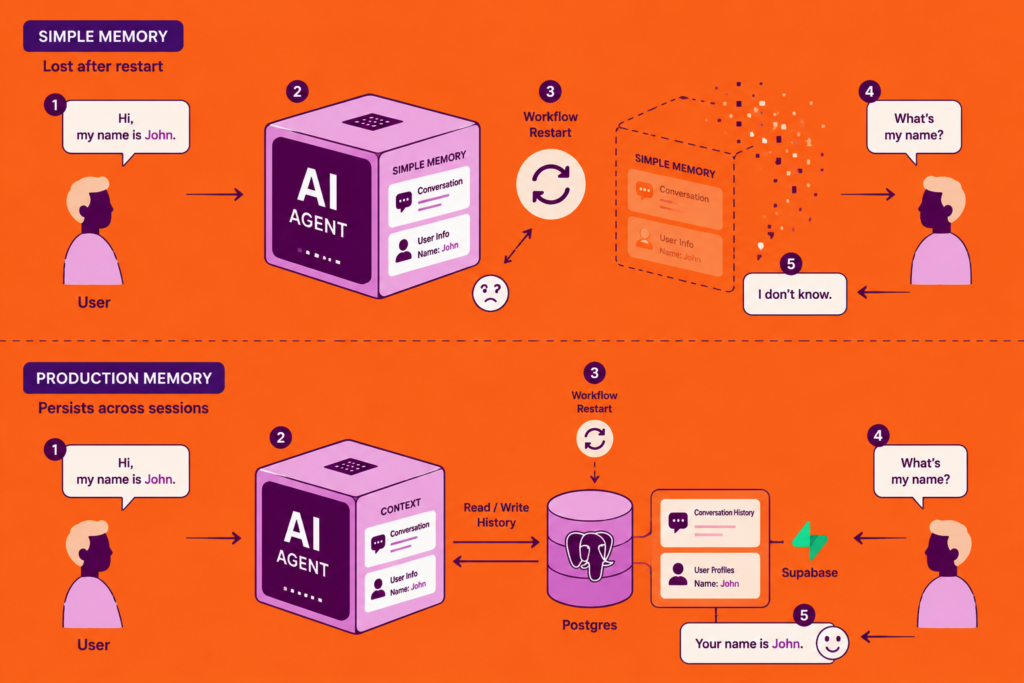
    One important thing to understand upfront is, This memory lives inside your n8n instance’s process. It’s not saved to a database. If your n8n instance restarts, all conversation history clears. For prototyping and internal tools, that’s usually fine. For production chatbots with real uses, I’ll cover that at the end.

    How to Add Simple Memory to an AI Agent

    If you already have a workflow with an AI Agent node set up, adding memory takes less than 5 seconds.

    Step 1

    connecting AI Agent to n8n

    Open your workflow on the canvas. Find your AI Agent node.

    Step 2

    Connecting simple memory node to n8n workflow

    At the bottom of the AI Agent node, you’ll see a connector labeled Memory. Click it.

    Step 3

    A panel opens with available memory nodes. Select Simple Memory

    A new node appears connected to your AI Agent via the memory connector.

    Step 4

    Configuring simple node in n8n

    Click into the Simple Memory node to configure it. You’ll see two things

    • Session Key: The identifier that groups messages into a conversation. When you’re using the On Chat Message trigger, n8n fills this automatically from the sessionId passed in the request. You don’t need to touch it.
    • Context Window Length: How many recent exchanges to keep in memory. The default is 5.

    Step 5

    Save your workflow and test it. Open the chat, tell the agent your name, send a few more messages, then ask it to recall something you said earlier.

    It will remember.

    If you don’t have an AI Agent workflow yet. Start here: How to Build an AI Agent in n8n

    What “Context Window Length” Actually Means?

    This setting trips up almost everyone at the first time.

    Context Window Length counts exchanges, not individual messages. One exchange = one message from you + one reply from the AI. That’s two messages stored.

    If you set it to 5, the agent keeps the last 5 exchanges – 10 messages total in the memory.

    Context Window LengthExchanges RememberedMessages in Context
    112 (1 user + 1 AI)
    5 (default)510
    101020

    Why does this matter? Because every message in the context window gets sent to the LLM on each new request. A window of 10 means 20 messages worth of tokens on every call. At scale, that adds up fast in both cost and response latency.

    For most use cases, the default of 5 works well. If your conversations are short and task-focused (book an appointment, answer a product related questions), you can drop it to 3. If you’re building something more conversational where users reference things from much earlier, bump it up to 8 or 10 – just know you’re trading off token cost for context depth.

    2 Common Errors and How to Fix Them

    “No sessionId” error

    This one shows up when you’re triggering your AI Agent from something other than On Chat Message trigger, a Webhook, a Scheduled trigger, or a manual test run.

    This Simple Memory node expects a session identifier to know which conversation it’s working with. The On Chat Message trigger provides this automatically. Everything else doesn’t.

    How to fix it for testing? Open the Simple Memory node and manually type a static value into the Session Key field – something like my_test_session. This tells the node to treat all requests as part of one conversation. It works fine for building and debugging.

    How to fix it for production? If you’re triggering your agent from a webhook, you need to pass session identifier in the request and map it to the Session Key field. For a customer support bot, that might be the user’s email address or account ID. For a telegram bot, It’s the chat ID. Whatever uniquely identifies a conversation for your use case.

    {{ $('Webhook').item.json.body.userId }}

    Map that expression to the Session Key field and every user gets their own isolated memory. See how to handle errors in n8n if you want to add proper error handling around sessions that fail to resolve.

    Two memory nodes reading from the same session

    If you add more than one Simple Memory node to the same workflow without changing their Session Keys, they both read from and write to the exact same memory. This causes weird behavior, one part of your workflow may overwrite context that another part needs.

    The fix is simple, give each Simple Memory node its own unique Session Key. Something like workflow_a_session and workflow_b_session keeps them separate.

    One Limitation You Must Know Before Going Live

    Simple Memory does not work if your n8n instance runs in queue mode.

    Queue mode is a self-hosted setup where multiple worker processes share the load. When a workflow executes, n8n routes it to whichever worker is free. The Simple Memory node stores data inside the worker’s process memory, not in a shared database. If two consecutive messages from the same user land on different workers, the second worker has no idea what the first one stored.

    The result isn’t an error. The agent just loses memory mid-conversation, silently with no warning.

    Who this affects: If you’re running self-hosted n8n with Redis and multiple workers enabled, this is your setup. If you’re on n8n Cloud or a Single-instance self-hosted setup, you’re fine.

    What to do instead: Switch to the Postgres Chat Memory node. It stores conversation history in a database that every worker can access.

    When to Replace The Simple Memory

    Simple Memory is the right starting point. Zero configs, nothing to provision, works immediately.

    But there are two situations where you’ll need to replace it.

    You’re going to production with real users. Simple Memory clears on restart. If your n8n instance ever updates, redeploys, or crashes, every active conversation loses it’s history. Users will notice. For anything facing real users, migrate to the Postgres Chat Memory node before you launch.

    You’re running in queue mode. As covered above, Simple Memory and queue mode don’t work together. Postgres is the standard replacement here too (or Redis Chat Memory).

    The migration is straightforward. Set up a Postgres database, add your credentials to n8n, and swap the Simple Memory node for the Postgres Chat Memory node. n8n creates the required table structure automatically on first run.

    Redis Chat Memory is also an option if you need very fast read/write performance for high-traffic real-time applications. For most teams, Postgres is the simpler and durable choice though.

    Once you have memory working correctly, the next thing worth exploring is what happens when you need the agent to manage that memory – Injecting system context, clearing history on demand, or inspecting what’s currently stored. That’s what the Chat Memory Manager node is for, and it connects to whichever memory node you’re already using.

    Check it out here: Building a Rate Limiter in n8n with Upstash Redis

    Final Thoughts

    None of this requires being an expert. It requires being willing to build something, break it, understand why, and built it better.

    The developers who create genuinely useful AI agents aren’t the ones who read the most about AI. They’re the one who ship something working, notice where it falls short, and keep iterating.

    You now know how memory works in n8n. You know the tradeoffs, the failure modes, and when to upgrade. That puts you ahead of most people who just drop a node and assume it works.

    Go build something worth remembering

  • How to Use Slack in n8n – Send Messages and Trigger Workflows

    How to Use Slack in n8n – Send Messages and Trigger Workflows

    There are two ways to authenticate with Slack in n8n, and they behave completely different. Pick the wrong one and your messages will come from your personal account instead of a bot, or your Slack Trigger will stop firing in production without any obvious error.

    This post covers both use cases , sending messages from n8n to Slack, and triggering workflows from Slack events along with the four errors that catch almost everyone. The most common ones.

    But you need to understand how these credentials works.

    Bot Token or OAuth2? Pick Your Credential Before You Start

    This is the decision that determines everything else. Most tutorials skip it and explain it only after something goes wrong.

    What you’re trying to doCredential typeToken
    Send messages as a botAccess Tokenxoxb- (Bot User OAuth Token)
    Trigger workflows from Slack eventsOAuth2 APIClient ID + Client Secret
    Send messages as yourselfOAuth2 APIxoxp- (User OAuth Token)

    For most automation setups, you want the Access Token method with a bot token. This sends messages from a named bot, not from your personal Slack profile.

    OAuth2 is required for the Slack Trigger node. It doesn’t work with the Access Token method. If you want both, a workflow that listens for Slack events AND sends replies – you’ll need two separate n8n credentials: one OAuth2 for the trigger, one Access Token for the send node.

    Setting Up Your Slack App (Do This Once)

    Both credential types require a Slack app. You create it once and then pull different tokens from it depending on what you need.

    creating an app in slack

    Step 1: Go to api.slack.com/apps and click Create New AppFrom scratch.

    selecting from scratch in slack apps

    Step 2: Give your app a name (something like “n8n Bot”) and select the workspace where you want it to work. Click Create App.

    Selecting a new app name and picking the workspace

    Step 3: In the left sidebar, go to OAuth & Permissions. Scroll to the Scopes section and add your Bot Token Scopes.

    OAuth permission in slack
    Selecting the bot token scopes

    Minimum scopes to send messages:

    • chat:write – post messages to channels
    • channels:read – list channels so you can pick one in n8n
    Adding more scopes to bot token scopes

    If you’re also setting up the Slack Trigger, add these too:

    • channels:history – read messages in channels
    • reactions:read – detect emoji reactions
    • users:read – resolve user IDs to names

    Step 4: Scroll up to OAuth Tokens for Your Workspace and click Install to Workspace. You need to be a workspace admin to do this.

    Installing the OAuth Token to the Workspace

    Step 5: After installing, copy the Bot User OAuth Token. It starts with xoxb-. Keep this — it’s your Access Token credential.

    Allowing the app permissions to the slack workspace

    Token rotation warning. Slack may present a “Token Rotation” option when you create the app. Do not enable it. Token rotation makes your xoxb- token expire every 12 hours. Workflows that were running fine will start failing silently in production. The critical part: once you enable token rotation, you cannot turn it off. You’d need to create an entirely new Slack app. Leave this off.

    Bot User OAuth Token

    Sending Messages from n8n to Slack

    With your xoxb- token copied, here’s how to wire it up in n8n.

    In n8n Credentials, create a new Slack credential. When it asks for the authentication method, choose Access Token. Paste your xoxb- bot token. Save it.

    Pasting the Bot Auth Token to Slack API credentials

    In your workflow, add a Slack node. Open it and configure:

    Adding Send a message slack node in n8n
    Explaining the configs of Send a message node
    • Resource: Message
    • Operation: Send
    • Credential: the Access Token credential you just created
    • Channel: #your-channel-name or paste a channel ID
    • Text: your message content

    A realistic message with dynamic data from a previous node looks like this:

    New lead from {{ $json.name }}
    Email: {{ $json.email }}
    Source: {{ $json.source }}
    Submitted: {{ $now.format('MMMM D, YYYY') }}
    
    Or Else, Just say
    
    HELLO WORLD! 

    Click Execute Node. If it works, great. If you get not_in_channel, see the troubleshooting section below — the fix takes 10 seconds.

    Read this,

    The bot must be invited to the channel. A Slack bot cannot post to any channel it hasn’t been explicitly added to. Go to the channel in Slack and type /invite @YourBotName. (e.g., mine is /invite @The Owl Logic Bot) This is a Slack permission rule, not an n8n limitation. Once invited, rerun the node and the message will go through.

    Slack Bot :)

    Triggering Workflows from Slack Events

    This direction is more involved. You’re telling Slack to call n8n whenever something happens, a message arrives, someone mentions your bot, a reaction is added.

    But here’s the hiccup. To make this trigger workflow work, You need to have a Self-hosted n8n or n8n Cloud. I recommending the n8n cloud since you won’t be having any issue and less prone to configurations.

    Even though If you’re working in localhost, then you have to expose your localhost webhook URL to ngrok by tunneling. You can check it out here Webhook in n8n for Beginners

    Step 1: Create an OAuth2 Credential in n8n

    In n8n Credentials, create a new Slack OAuth2 API credential. It will ask for a Client ID and Client Secret. Get these from your Slack app:

    Select Slack OAuth 2 API
    Add Client ID and Secret for Slack Trigger in n8n

    In your Slack app settings → Basic InformationApp Credentials section. Copy the Client ID and Client Secret into n8n.

    Basic information, Client ID and SEcret

    n8n will show you an OAuth Callback URL. Copy it.

    Pasting the credentials of Slack ID and Secret

    Step 2: Register the Callback URL in Slack

    Back in your Slack app → OAuth & PermissionsRedirect URLsAdd New Redirect URL. Paste the callback URL from n8n. Click Add, then Save URLs.

    Redirect URL, Prefer the production URL

    Step 3: Add the Slack Trigger to Your Workflow

    Add a Slack Trigger node to a new workflow. Select the OAuth2 credential. Choose which event to listen for:

    • Bot / App Mention — fires when someone types @YourBotName in a channel
    • New Message Posted to Channel — fires on every message in a channel
    • Reaction Added — fires when someone adds an emoji reaction

    For most bots, Bot / App Mention is the right choice. It’s targeted — the trigger only fires when your bot is explicitly called, not on every message in the channel.

    Step 4: Connect the Webhook URL to Slack

    With the Slack Trigger node open, copy the Webhook URL shown in n8n. There are two versions.

    • Test URL (contains /webhook-test/) — only works when you’re actively listening in n8n editor
    • Production URL (contains /webhook/) — works only when the workflow is Active

    In your Slack app → Event Subscriptions → toggle Enable Events to on → paste the webhook URL in the Request URL field. Slack will immediately try to verify it.

    Enabling the Event Subscriptions in Slack for n8n Webhook

    One webhook URL per Slack app. Slack allows only a single Request URL registered per app. You cannot have the test URL and the production URL active at the same time. While building and testing: use the Test URL, with n8n listening. Before going live: swap to the Production URL in Slack’s Event Subscriptions, then activate your workflow.

    Once the URL verifies, subscribe to the bot events you want. For Bot/App Mention, add app_mention under Subscribe to bot events.

    Step 5: Add the Signing Secret

    This is optional but strongly recommended. It ensures n8n only processes requests that genuinely came from Slack — not from someone who guessed your webhook URL.

    In your Slack app → Basic Information → copy the Signing Secret. In your n8n Slack credential → paste it into the Signature Secret field.

    Step 6: Activate the Workflow

    Toggle the workflow to Active in the top right. Until it’s active, the Slack Trigger won’t receive anything even if the Production URL is registered.

    Invite your bot to a channel (/invite @YourBotName), then mention it: @YourBotName hello. Check your workflow’s execution history — you should see the trigger fired with the message data.

    4 Errors That Break Slack Integrations in n8n

    These show up constantly in the n8n community forum. Each one has a specific fix.

    1. not_in_channel error

    Your bot hasn’t been invited to the channel. Fix: in Slack, go to the channel and type /invite @YourBotName. Every channel requires a separate invite.

    2. Messages sending from your personal account, not the bot

    You created an OAuth2 credential and used it for the Slack node. OAuth2 acts on behalf of your user profile. Fix: create a separate Access Token credential using your xoxb- bot token, and use that for the Slack node instead.

    3. Workflow ran fine in testing, silently fails 12 hours later in production

    Token rotation is enabled on your Slack app. The xoxb- token expires every 12 hours. Fix: you cannot disable token rotation once it’s on. You need to delete the Slack app and create a new one — this time leaving token rotation off during setup.

    4. Slack Trigger fires in testing but not in production

    Two possible causes. First: the workflow isn’t active — toggle it to Active in n8n. Second: the Test URL is still registered in Slack’s Event Subscriptions. When you activate the workflow, you also need to manually update the Request URL in your Slack app from the Test URL to the Production URL.

    Using Slack as an AI Agent Approval Channel

    Slack node can be used as a human-in-the-loop step inside AI Agent workflows.

    When an agent is about to take a high-stakes action like sending a bulk email, deleting a record, posting to a production channel, it can pause and route an approval request to Slack.

    The approver clicks approve or deny directly in Slack, and the agent continues or stops.

    This is configured at the tool level in the AI Agent node.

    The Slack node becomes a gated tool that requires sign-off before execution. If you’re building AI agent workflows, this is worth knowing about – it removes the need for fragile prompt-based guardrails like “only do this if you’re absolutely sure.

    The Slack node is one of the most-used integrations in n8n for a reason, having your automation post results directly to where your team already works is genuinely useful.

    Once the credentials are set up correctly, the node itself is straightforward. The setup is the hard part, and now you’ve done it once.

  • How to Build an n8n AI Agent Workflow (Step-by-Step 2026)

    How to Build an n8n AI Agent Workflow (Step-by-Step 2026)

    An AI agent in n8n is a workflow that can think through a task, decide what to do, and act without defining every steps in advance.

    A normal n8n workflow follows a fixed path. If X happens, do Y. If Z happens, do W. Every branch has to be anticipated and built by you. That works well for structured, predictable tasks, syncing rows from a spreadsheet, sending a confirmational email, posting a Slack message.

    But a lot of real work isn’t structured. Incoming support messages don’t fit neat categories. Research tasks depend on what you find along the way. Lead qualification depends on context that’s different for every prospect.

    AI agents handle that kind of work. You give the agent a goal and a set of tools, and it figures out the steps. It reads the input, decides which tool to use, uses it, reads the result, and keep going until it has a complete answer.

    Concretely, an n8n AI agent can,

    • Answer questions by searching a knowledge base before responding
    • Triage incoming messages and decide whether to reply, escalate or log them
    • Research a topic by querying APIs and summarizing the findings
    • Enrich CRM records by pulling data from external services and writing it back
    • Draft content, check it against rules you define, and revise until it passes

    This post walks you through building your first one from scratch. By the end you’ll have a working agent, understand how memory actually works (and why Simple Memory burn you in production), and know about two features from early 2026 that most tutorials haven’t caught up to yet.

    Before You Start

    This tutorial assumes you have n8n running and atleast one AI API credentials ready. If you’re not setup yet, here’s what to sort first.

    An n8n instance. You have two options

    A language model API key. This tutorial uses Gemini (free tier available via Google AI Studio). You can also use Anthropic Claude or ChatGPT. Well, all work the same way. (However, we have listed the steps below that you could take to obtain an API key)

    Basic n8n familiarity. You should know what a node is and how to connect them. If you haven’t built anything in n8n yet, start with Your First Workflow in n8n – It takes about just 10 minutes or less.

    Let’s discuss a little bit about what is AI agent, and what makes AI agent feels more powerful than just a n8n workflow.

    What Makes an AI Agent Different From a Regular n8n Workflow

    A normal n8n workflow is like a recipe. Every step is predefined. If email contains “refund” > send template A. If it contains “Invoice” > send template B. The moment something lands outside those rules, the workflow either fails or does the wrong thing.

    An AI agent understand a goal and figures out the step itself.

    The same support inbox handled by an agent looks like this.

    • Read the message
    • Understand the actual issue
    • Check the customer’s history
    • Decide whether to respond directly, look something up or escalate

    The agent adapts. You don’t have to anticipate every edge case in advance.

    The tradeoff is real though, agents are less predictable than fixed workflows. For anything that needs deterministic, auditable results every time, like payroll processing ,database writes – a standard workflow is still the right tool. Agents shine when the input is unstructured and the right action depends on context.

    The 4 Components Every n8n AI Agent Needs

    Every AI agent in n8n built from the same four-part structure, regardless of what the agent actually does.

    1. Trigger – What starts the agent. This could be a Chat Trigger (for conversational agents), a Webhook (for integrating with external systems), a Scheduled Trigger, or even a form submission. The trigger passes the initial input to the agent
    2. AI Agent node – The orchestration layer. This node receives the input, sends it to your chosen language model, reads the model’s response, decides which tool to call (if any), calls it, checks the results, and loops until it has a complete answer. It’s the brain.
    3. Sub-nodes – The three types that connect directly to the AI Agent node.
      • Chat Model – The actual LLM (OpenAI GPT, Anthropic Claude, Google Gemini, Kimi K2.5, etc)
      • Memory – How the agent retains context across messages
      • Tools – What the agent can do (Call an API, search the web, run a calculation, query a database)
    4. Output – Where the results goes. This could be a reply in the chat interface, a Slack message, a row appended to Google Sheets, or anything else n8n’s integration library.

    This structure doesn’t change. Whether you’re building a simple Q&A bot or multi-step research agent, these four part are always there.

    Building Your First AI Agent (A Support Triage Bot)

    I’ll use a support triage agent as the example

    • It reads incoming messages.
    • Decides whether to answer directly or escalate, and responds.

    It’s practical, easy to understand, and shows exactly how the agent make decisions.

    Step 1: Add a Chat Trigger

    Adding a chat trigger in n8n

    Create a new workflow and add a Chat trigger node. This is the easiest way to start with agents because it gives you built-in chat interface to test with. No external services or webhooks needed while you’re learning the setup.

    Chat trigger creates a Chat URL

    The Chat Trigger creates a simple URL where you can open a chat window and send a test messages directly to your agent.

    Step 2: Add the AI Agent Node

    Add the AI Agent node to the Chat trigger

    Click the + button after the Chat trigger and search for AI Agent. Add it to the canvas and connect it to your trigger.

    Adding system message to n8n AI agent

    Open the AI Agent node. The most important field here is the System Message. This is where you define who the agent is and what it’s supposed to do.

    Here’s a real example for the support triage agent

    You are a support agent for a SaaS product. Your job is to:
    
    1. Answer common questions directly if you can (password resets, billing basics, plan information)
    2. If the issue requires account-specific information you don't have, let the user know you're escalating to the team
    3. Always be concise. Don't pad responses with unnecessary filler.
    4. If the user seems frustrated, acknowledge it briefly before answering.
    
    You do NOT have access to account data unless a tool provides it. Don't make up information.

    The last line matters. Without explicit instructions about what the agent doesn’t know, it will sometimes hallucinate account details. Tell it what it can and can’t do.

    Step 3: Connect a Chat Model

    Connect the Chat Model to AI Agent in n8n

    The AI Agent node won’t do anything without a language model. Hover over the bottom of the AI agent node – you’ll see sub-node connector. Click the Chat Model connector and add a model node.

    Connect Google Gemini Chat Model

    For most use cases, I use Gemini, and for starting point Gemini, and Anthropic Claude are good.

    How to obtain Gemini API Key

    You don’t need to manually create a Google Cloud Console project to get a Gemini API key, one will be created automatically when you generate the key.

    If you don’t have the credentials setup yet, the credentials setup guide walks through exactly how to add them (For Google Cloud Console)

    Place your API Key here

    Paste the Google Gemini API key here to complete the credentials. That’s it and then you will be needed a model though, for this tutorial I go with models/gemini-3-flash-preview

    adding google gemini model to the AI agent

    Connect your chosen model to the AI Agent node’s chat model input.

    Finally connected a chat model to an AI agent in n8n

    Step 4: Add a Simple Memory (for Testing)

    Adding a memory to AI agent in n8n

    Still on the sub-node area, connect a Simple Memory node to the Memory input.

    Adding simple memory to AI agent in n8n

    Simple Memory keeps the conversation history in RAM during the current workflow session. This means your agent will remember what was said earlier in the same conversation – but only until the workflow restarts or the session ends.

    This is perfectly fine for testing, I’ll cover what to use in production in the next section, because this is exactly where most people get burned.

    Configuring the context window length in simple memory

    Leave the Context Window Length at 10 messages for now. That’s enough for most conversation without overloading the model’s context window.

    Check it out here to learn more about How to Use Simple Memory Node in n8n

    Added simple memory

    Step 5: Add a Tool

    Adding a tool to AI agent in n8n

    Tools are how the agent takes actions beyond just generating text. For this example, add the built-in Calculator tool, It’s already in n8n, no setup required, and it lets you see the agent’s tool-calling behavior immediately.

    Connecting a calculator tool to AI Agent

    Connect it to the Tools input on the AI agent node.

    Here’s what actually happens when a user asks “What’s 15% of $340 for a tip?” – The agent recognizes it needs to calculate something, calls the calculator tool with 340 * 0.15, gets 51 and includes that in its response. You can watch this happen step by step in the execution logs.

    Step 6: Test It and Publish It

    Click the Chat button in the Chat Trigger node (or the Open Chat button that appears in the UI). A chat window opens

    Send a message: “Hey, I’m locked out of my account

    You should see the agent respond. But here’s the important part, click the execution that appeared in your workflow. Open it and look at the AI Agent node’s output. You’ll see the reasoning steps, What the model decided, which tool it chose (or didn’t), and why.

    This is the execution log view, and it’s one of n8n’s biggest strengths for working with agents. You can see exactly what the agent was thinking at each step. When something goes wrong, this is where you debug it.

    When you’re ready to use this in production, toggle the workflow to Publish in the top right corner.

    Choosing The Right Memory for Your Agent

    Simple Memory works perfectly in testing. The moment you deploy and restart your n8n instance, it forgets everything. Every conversation starts from scratch. Users have to re-explain their context every single time.

    Memory TypePersistsUse Case
    Simple Memory❌ NoTesting only, local development
    PostgreSQL memory✅ YesLong-term context, production chatbots
    Redis Memory✅ YesHigh-volume, fast session-based agents

    Motorhead Memory is deprecated as February 9, 2026. The Motorhead project is no longer maintained. n8n has hidden it from the nodes panel for new workflows.

    For production, use PostgreSQL Memory. It stores conversation history in a database table, survives restarts, and works with n8n’s native PostgreSQL integration. If you’re already self-hosting n8n with PostgreSQL as your n8n database, you can point the memory node at the same database.

    There are two things to get right with any persistent memory setup

    Session IDs must be unique per user. If you hardcode a session ID or leave it as a default, every user shares the same memory. Your agent will get confuse one user’s conversation history with another’s.

    Generate session IDs dynamically from a user identifier – their email, a user ID from your system, or a UUID.

    Set a reasonable context window. Storing 500 messages of history and sending all of it to the model on every request is expensive and often counterproductive. Most agents work well with the last 10-20 exchanges anything beyond that and you’re paying for tokens that don’t meaningfully improve responses though.

    3 Things That Break n8n AI Agents

    3 things that breaks n8n AI agents

    1. Agent “forgets” everything after deployment

    Conversations work perfectly in testing. In production, the agent has no memory of previous messages.

    You’re using Simple Memory and the workflow restarted (due to a deploy, update, or n8n instance restart).

    As a fix, Switch to PostgreSQL or Redis memory before going live. This is not optional for any agent that needs to maintain context across sessions.

    2. Agent loops or keeps asking clarifying questions

    The agent send multiple messages, asks the same question repeatedly, or never produces a final answer.

    Your system prompt is too vague. The agent can’t determine when it’s done, so it’s keeps going.

    Add explicit stopping conditions to your system prompt

    When you have enough information to answer, respond directly.
    Do not ask more than one clarifying question per response.
    If you cannot find the answer using available tools, say so clearly and stop.

    Also check your context window length. If it’s too long and the agent is reading 50+ messages of history, it sometimes gets confused about what was already resolved.

    3. Tool calls failing

    The agent responds as if it used a tool, but the action didn’t actually happen. No error shown to the user.

    The tool node is failing (expired credentials, API error, wrong field mapping) but the agent is continuing anyway and generating a plausible-sounding response without real data.

    As a fix, Open the execution and click into the specific tool node that fired. The error will be there. This is almost always a credential issues – check our error handling guide for how to setup error notifications so these don’t go unexpected. Also, be explicit in the system prompt that the agent should acknowledge when a tool fails rather than guessing.

    HITL Approvals + MCP Trigger

    Two features shipped in early 2026 that change how you build agents. Most content out there hasn’t covered them yet.

    Human-in-the-Loop (HITL) Tool Approval

    You can now mark specific tool as gated. The agent cannot execute them until a human explicitly approves the action.

    This is a big deal for high-stakes operations. Before this feature, if you built an agent that could send emails or delete records, you were trusting the agent’s judgement entirely, or using fragil prompt-based guardrails (“only do this if you’re sure”). Neither was reliable.

    Now you can set specific tools – “send email”, “delete record”, “post to production slack” to require approval. When the agent decides to call one of those tools, the workflow pauses. The approval request get routed to whoever needs to review it. They approve or reject. The agent continues or stops.

    Approvals are not limited to one interface either. You can route them through slack, email, a webhook. Any standard n8n node. So a high-priority approval can interrupt the right person on the right channel.

    MCP Server Trigger

    n8n now supports Model Context Protocol (MCP), which means external AI systems – other agent, claude, GPT – can call your n8n workflows as tools. You build a workflow, expose it via the MCP Server Trigger, and it becomes available as a callable tool in any MCP-Compatible AI system.

    This opens up multi-agent architectures where n8n handles the automation side while a more capable reasoning model handles complex decisions. Worth exploring once you’re comfortable with single-agent workflows.

    My Final Thoughts

    The support triage example in this post is deliberately simple. Once you have this working, add a real tool, a HTTP Request node that checks your knowledge base, or a Google Sheets lookup for customer data. That’s when agents start to feel genuinely useful.

    I hope you made your first AI Agent, and don’t forget to subscribe to our weekly digest email newsletter. Good luck 🙂