Tag: Solo Builders

  • Personal Brand Blog vs Niche Blog: Which One Should You Start?

    Personal Brand Blog vs Niche Blog: Which One Should You Start?

    When I was figuring out what The Owl Logic would be, I kept running into the same question, what is this blog, exactly?

    It covers n8n automation. But also productivity. Obsidian. Solo building. Digital tools.

    The occasional thing I’m genuinely curious about and want to understand better by writing about it.

    That doesn’t sound like a niche. And honestly, it isn’t, not in the traditional sense.

    The Owl Logic is a personal brand blog.

    Everything here connects back to how I think, what I’m building, and what I’m learning. The thread isn’t a topic.

    It’s a perspective.

    I made that call deliberately.

    And if you’re about to start a blog and stuck on this same question, this is the clearest breakdown I can give you, what each approach actually means, what it costs you, and which one fits where you are right now.

    What’s the actual difference?

    A niche blog is built around a subject.

    The subject is the brand.

    Someone searching for “best espresso machines under $200” lands on your coffee gear blog, reads your review, maybe buys through your affiliate link.

    They don’t care who wrote it. They care whether the answer is right.

    A personal brand blog is built around a person – their expertise, their perspective, their voice.

    The subject can shift as long as the person stays consistent. Readers follow you, not just the topic.

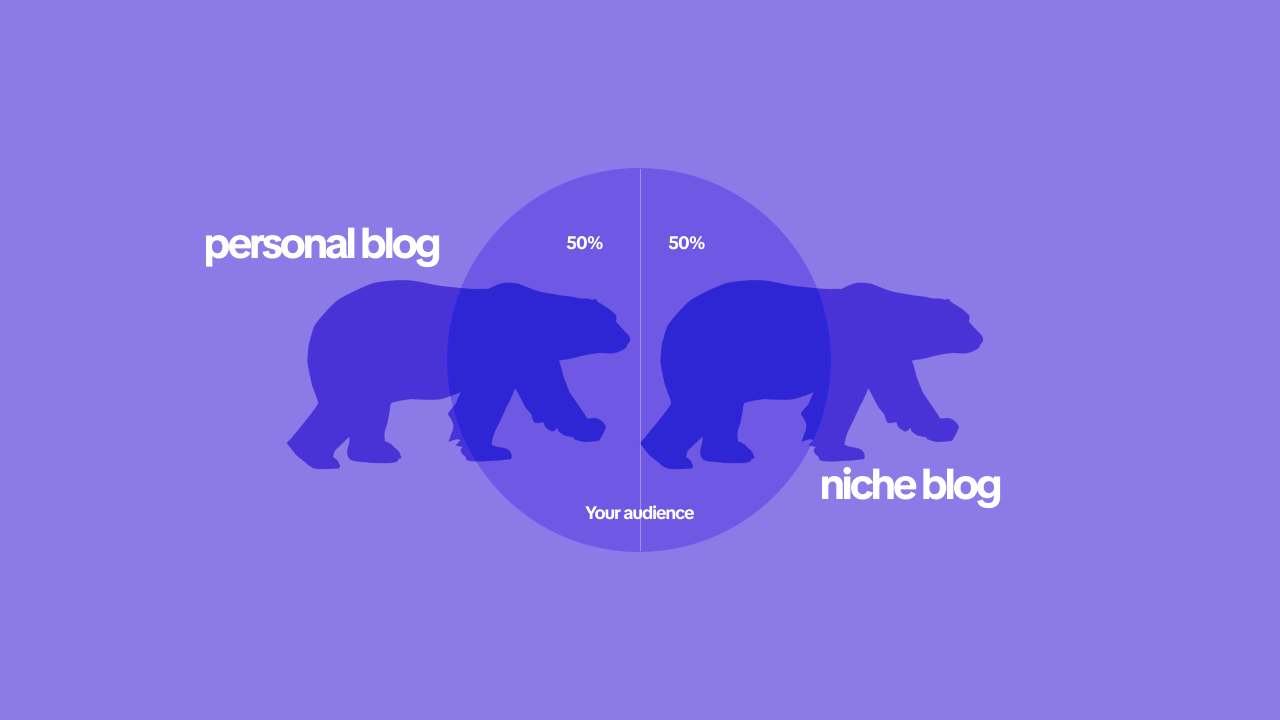
    That’s the real split. Not how long the articles are, not the monetization method, not even the domain name. It comes down to: is the blog about a subject, or is it about a point of view?

    Both work. But they work differently, and they fail differently.

    The case for a niche blog

    If you want the fastest path to search traffic, a niche blog has a structural advantage.

    Google’s ranking systems reward topical authority (as per my experience, I’ve seen it), the idea that a site covering one subject deeply is more trustworthy on that subject than a site that covers many things loosely.

    A blog that only writes about home espresso equipment will outrank a lifestyle blog’s espresso article almost every time, even if the lifestyle blog has more total traffic.

    Niche blogs are also easier to monetize early.

    Affiliate programs are topic-specific.

    Display ad RPMs vary by niche, finance and software blogs earn more per thousand visitors than general interest blogs.

    If revenue is the primary goal and you’re starting from zero, a well-chosen niche gives you a tighter line between content and income.

    The tradeoff is real though.

    You’re staking the brand on a subject staying relevant, staying interesting to you, and staying within the boundaries you defined when you started.

    That works often enough. But when it doesn’t, when the topic shifts, when you burn out on it, when a platform change kills your traffics – you’re rebuilding from scratch.

    The brand didn’t transfer. The audience followed the subject, not you.

    The case for a personal brand blog

    The Owl Logic covers automation, productivity tools, solo builder mindset, Obsidian, Blogging, marketing, workflows, and whatever else I’m genuinely working through.

    Those aren’t random.

    They’re all connected by the same underlying logic: thinking clearly, building things that work, and not wasting time on complexity you don’t need.

    That’s the niche, in a sense, but it’s expressed through a perspective, not a subject boundary.

    This is what personal brand blogs actually are when they work. Not “I write about whatever I feel like.” More like: every post is a different angle on the same set of problems I care about.

    The reader follows because they trust how you think, not just what you know about one thing.

    The big advantage is flexibility.

    When I started covering Obsidian alongside n8n, that wasn’t a pivot, it was natural.

    Both tools are about building better thinking systems.

    The audience didn’t blink because the connection was obvious.

    A niche blog can’t do that cleanly. Adding a new subject area on a niche site feels like a category mistake.

    On a personal brand blog, it’s just the next thing you’re into.

    The tradeoff here is that it takes longer to build. You’re not just building topical authority – you’re building trust in a person.

    That requires consistency of voice and a genuine point of view that readers can identify and return to. You can’t fake that with volume.

    What actually matters when you’re choosing

    Here are the three questions worth answering honestly before you decide,

    Do you have a strong, specific point of view ?

    If you have a defined expertise in one area and you’re not sure yet if you want to be “the face” of something, start niche.

    If you have opinions that cut across multiple areas and you naturally connect things other people keep separate, personal brand fits better.

    How do you feel about content boundaries?

    Niche blogs require discipline.

    You can’t write the interesting tangent just because it’s interesting to you.

    Personal brand blogs reward curiosity. If staying on-topic feels like a creative constraint you’d constantly fight, a niche blog will exhaust you.

    What’s your timeline for results?

    Niche blogs can rank faster because topical authority compounds quickly in a tight domain.

    Personal brand blogs often take longer to gain traction because you’re building trust in a person, which requires more exposure.

    If you need results in 6 months, niche is more predictable. If you’re building something for 3–5 years, personal brand has more ceiling.

    The mistake most people make

    They treat this as a permanent, irreversible choice.

    It isn’t.

    A niche blog can evolve into a personal brand blog as the writer develops a recognizable voice.

    A personal brand blog can narrow into something more niche-focused if the writer finds their strongest topic over time.

    Tim Ferriss started with “4-hour” everything, productivity hacks, body optimization, learning systems. That’s a niche. It evolved into a personal brand because his voice became the draw.

    What you can’t easily do is go from broad and unfocused to anything coherent. “Personal brand” doesn’t mean “I’ll write about whatever.”

    It means your perspective is consistent enough that readers can predict how you’ll approach new topics, even ones you haven’t covered yet.

    The Owl Logic works as a personal brand blog because everything here comes from the same operating philosophy.

    Remove that thread and it’s just a pile of unrelated posts. The thread is what makes it a brand.

    Which one should you start?

    If you’re building something you want to monetize quickly and you have a specific subject you can write about for two years without getting bored – start niche.

    If you have genuine cross-domain expertise, a clear point of view, and you want the freedom to grow in directions you can’t fully predict yet – build a personal brand blog from the start.

    And if you’re not sure? Start with a tighter focus than you think you need.

    You can always expand outward. Expanding inward, trying to retrofit focus onto a scattered blog – is much harder.

    The name, the domain, the design, those matter less than you think.

    What matters is whether the first ten posts could only have been written by you.

    If yes, you’re building a personal brand. If anyone with the same research could have written them, you’re building a niche site.

    Neither is wrong. But knowing which one you’re building changes every decision that comes after it, what you publish, how you promote it, how you measure whether it’s working, and how you grow it when the initial strategy stops being enough.

    Pick one, understand what it asks of you, and build accordingly.
  • How to Write a Blog Post That Gets Read (And Ranks) in 2026

    How to Write a Blog Post That Gets Read (And Ranks) in 2026

    When I started writing posts for The Owl Logic, my intention wasn’t to rank. It was to write something a reader could trust.

    I’d been through the other version of blogging – padding posts to hit word counts, adding sections because competitors had them, writing introductions that sounded like every other introduction in the niche.

    The content looked complete. It checked the boxes. And it didn’t do much, because it wasn’t written for anyone in particular. It was written for an algorithm’s idea of what a post should contain.

    What changed my approach wasn’t an SEO insight. It was cutting everything that felt fabricated and watching what happened when I wrote naturally from real experience with no fluff, being honest about what I knew and what I didn’t.

    The posts that came out of that approach got read. Readers stayed. Some of them shared. Some of them reached out.

    The rankings followed. Not instantly. But they followed.

    I’ve put the same philosophy on my about page – the full production system, transparent, no mystification. Experience core from me, research and structure from AI tools, multiple rounds of fact-checking before anything goes live.

    That transparency isn’t marketing. It’s the actual reason readers trust what they’re reading.

    The Short Answer

    A blog post that gets read and rank in one written to be useful to a specific person, not optimized for a search engine first.

    Write from real experience or genuine research, cut everything that doesn’t move the reader forward, answer the questions directly near the top, and format for someone who skims before they commit to reading.

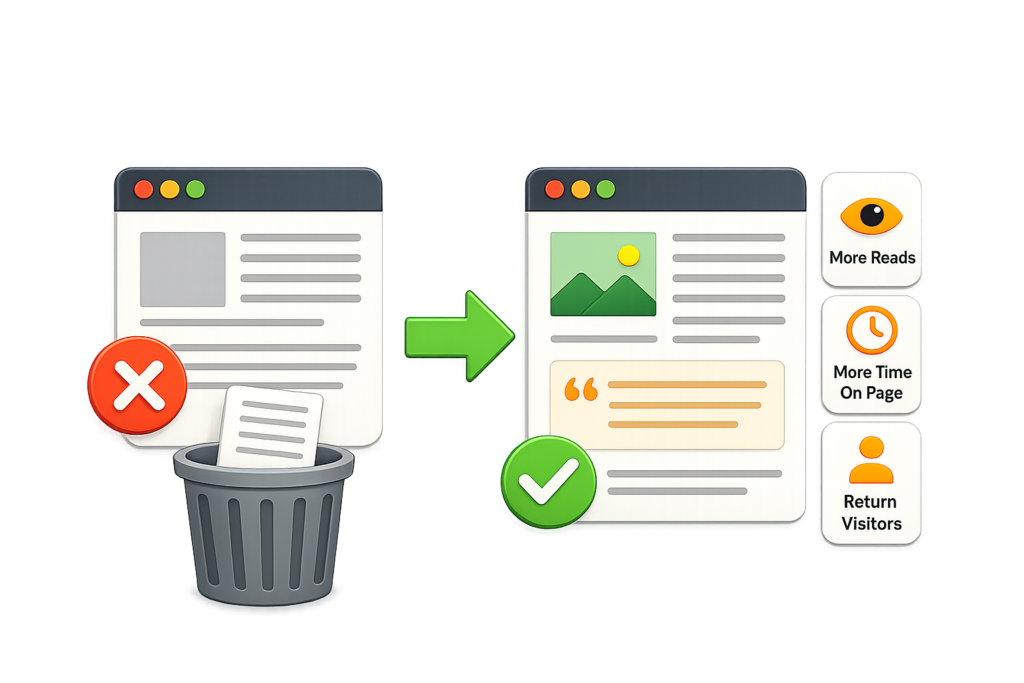
    The ranking signals, time one page, low bounce rate, shares – are downstream effects of a post that actually delivers what it promises. Get the readability right first.

    The SEO follows from that, not the other way around.

    Why Most Posts Don’t Get Read

    The honest reason most blog posts fail isn’t keyword targeting or backlinks. It’s that they’re not written for a reader. They’re written to look like a blog post.

    You can spot them immediately.

    • The introduction spends two paragraphs establishing that the topic is important.
    • The sections cover every subtopic a competitor covered, in roughly the same order.
    • The conclusion summarizes what the post just said. The whole thing is technically complete and practically empty.

    There’s no point of view, no real experience, no specific insight that couldn’t have been generated by someone who’d never done the thing they’re writing about.

    That kind of post gets clicks and immediate bounces.

    The reader lands, scans the first few paragraphs, finds nothing that suggests the author knows more than they do, and leaves.

    Google sees that. Bounce rate, time on page, return visits, these are all signals that tell search engines whether a post actually served the person who clicked it.

    Fluff doesn’t fool those signals. It just produces bad numbers.

    The posts that get read are the ones where the reader gets three sentences in and thinks: this person has actually been through this.

    That trust signal established fast, in the opening – is what keeps someone reading past the introduction. Everything else is secondary.

    Write for One Person or Audience, Not for Traffic

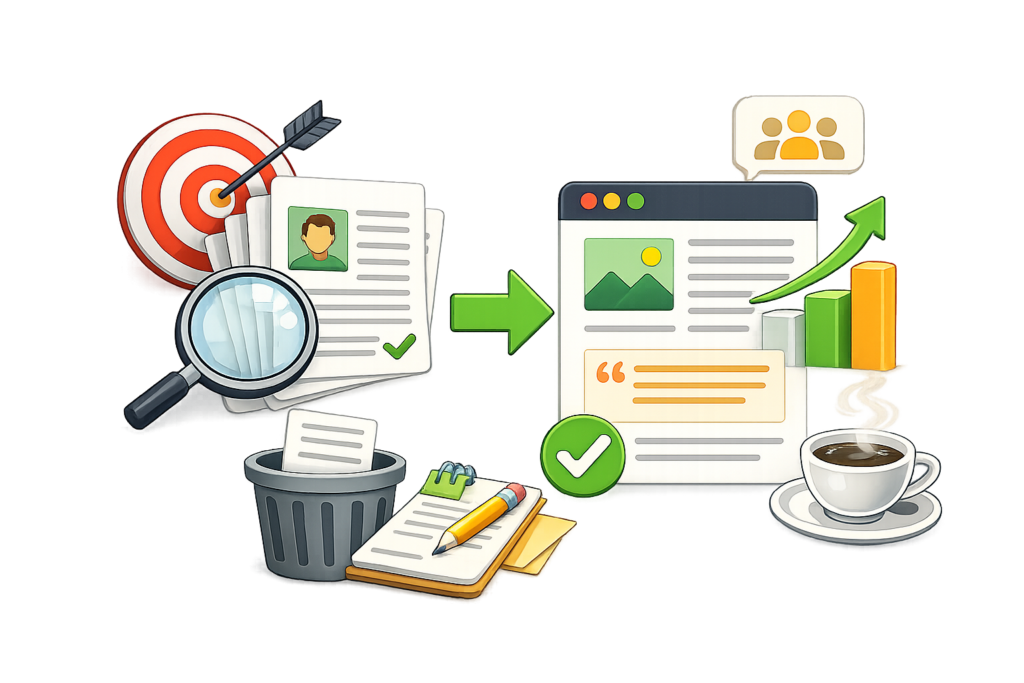
    Every post that works was written with a specific reader in mind. Not a demographic. Not a keyword. A person with a specific problem who is looking for something real.

    Before writing anything, I try to get that person clear.

    • What have they already tried?
    • What level of knowledge are they coming in with?

    The answers to those questions determine everything, the depth of explanation, the vocabulary, the examples used, the level of detail in code or process walkthroughs.

    Writing for one person isn’t a limitation.

    It’s what makes a post feel like it was written for the reader personally, even when thousands of people with the same problem end up reading it.

    Generic posts try to speak to everyone and connect with no one.

    A post written for a specific problem, at a specific depth, for a specific kind of reader, gets shared by that reader because it feels like something they found rather than something they were served.

    This is also what creates the behavioral signals that matter for ranking.

    When a post genuinely matches what someone was looking for, they read it.

    They don’t bounce in eight seconds.

    Some of them click through to related posts. Some bookmark it. Those are not tricks, they’re the natural behavior of a reader who got what they came for.

    The Readability Layer That Most Writers Skip

    Good writing and SEO-friendly writing are not in conflict. They’re the same thing described differently.

    Short paragraphs aren’t an SEO tactic – they’re easier to read on a phone screen, which is where most of your readers are.

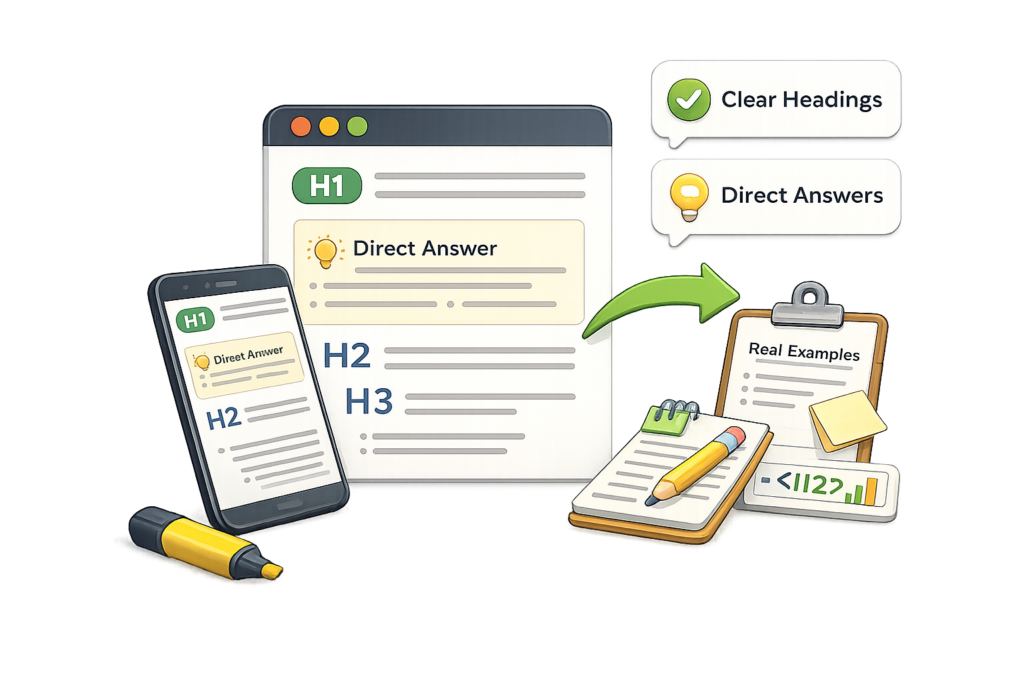
    Headers aren’t just for crawlers – they let a reader scan the post and decide if it’s worth their full attention before they commit.

    A direct answer near the top isn’t just good for AI citations, it respects the reader’s time and builds trust immediately.

    The formatting choices that help posts rank are the same ones that make posts readable.

    The reason to make them isn’t to manipulate an algorithm.

    It’s to make the post as easy to use as possible for the person reading it.

    Concretely, this means:

    • One idea per paragraph. When a paragraph contains three ideas, readers lose the thread and start skimming.
    • No sentences that only exist to transition. “Now that we’ve covered X, let’s look at Y” is a sentence that does nothing. Cut it.
    • No section that exists because a competitor had it. Every H2 should pass the “so what” test – if you can’t explain in one sentence why the reader needs this section, it shouldn’t be there.
    • No fabricated examples. If you haven’t done the thing you’re describing, say so. If you have, use the actual details, the specific numbers, the actual failure, the real outcome. Invented scenarios read like invented scenarios.

    That last one is the one most people skip.

    Fabricated examples are the main way fluff enters a post that otherwise has good bones.

    Real examples, even small ones, are the difference between a post that feels like journalism and one that feels like content.

    How Ranking Actually Happens (From the Reader Side)

    Nobody ranks a post by writing it for Google.

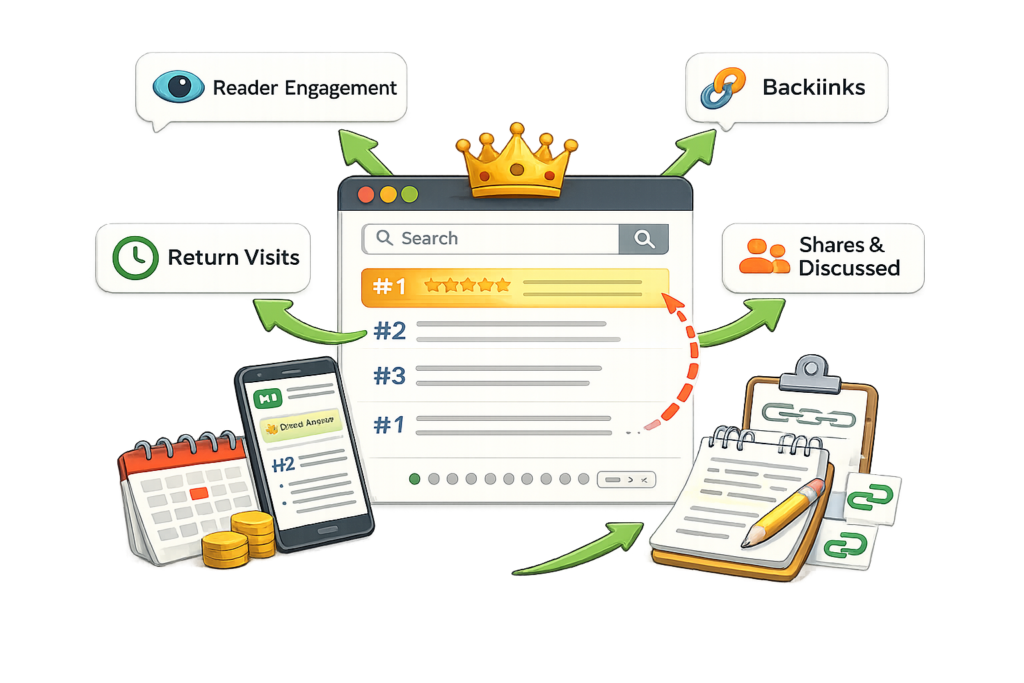
    They rank it by writing something Google’s users find useful enough to stay, backlinks, share, and return to.

    The mechanics work like this,

    • A post that keeps readers on the page signals that it delivered on the promise of the headline.
    • A post that gets linked to from other sites signals that people found it worth referencing.
    • A post that earns return visits signals that the reader trusted the source enough to come back.

    All of those signals accumulate over time, not instantly, but steadily, and they’re what move a post from page two to page one.

    This is why the ranking often doesn’t come immediately after publishing. A post needs to be found, read, and validated by real readers before the algorithmic signals are strong enough to move it.

    That process takes weeks or months depending on the domain authority, the competition, and how much distribution the post gets outside of search.

    Patience is not optional here. It’s structural.

    What you can control in the meantime: write the post so that when it does get traffic, those readers stay and find it worth sharing. A post that earns a 15% bounce rate and three organic backlinks in month three will outperform a keyword-optimized post that gets clicks and immediate exits every time.

    The One Thing That Actually Differentiates a Post

    Most posts on any topic cover roughly the same information.

    The ones that rank consistently have something the others don’t: a genuine point of view.

    Not an opinion for the sake of being contrarian. A real position on the topic, earned through experience or deep research, that the reader couldn’t get from reading five other posts on the same subject.

    That point of view is what makes a post quotable.

    It’s what makes someone share it with a note rather than just a link. It’s what makes a reader remember which site they found it on, and come back when they have the next question.

    Write the thing. Make it real. Cut what’s fake. The rest takes care of itself, eventually.

  • Why Solo Builders Build Forever and Launch Never

    Why Solo Builders Build Forever and Launch Never

    I built an Android app in a week.

    It worked. It did exactly what I planned. And instead of submitting it to the Play Store (and, I didn’t have $25 at that time to publish), I kept going. Better architecture. Cleaner code. One more feature that would make it “ready”. Then another. Then a refactor that made the first version look embarrassing by comparison with other huge recognized apps.

    A few weeks later, someone else published the same app. Same core idea. Rougher around the edges than mine, honestly, But it was out there. People were installing it. The numbers were real. And I was still tinkering.

    That was money I left on the table. Not because I was lazy. Not because I didn’t care. Because I convinced myself that more engineering was the same thing as more progress.

    It wasn’t.

    The Real Reason You’re Not Shipping

    overengineering is a trap

    Most solo builders don’t fail to ship because they’re stuck. They fail to ship because building feels like progress – and it is, right up until it isn’t.

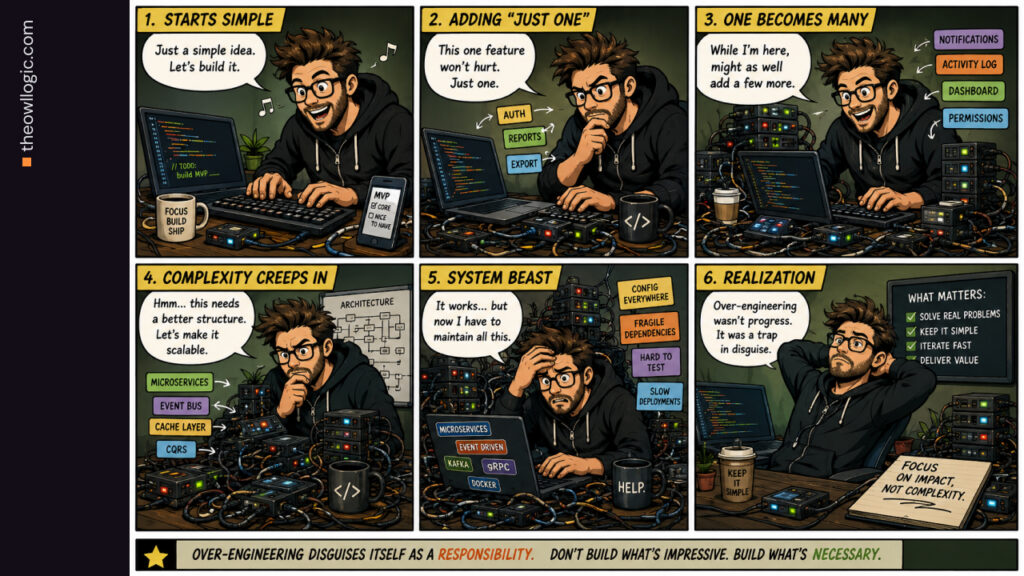
    Over-engineering is a specific trap that gets the sharpest and most talented builders. It disguises itself as a responsibility. You’re not procrastinating, you’re being thorough. You’re not avoiding launch, you’re making sure it’s done right. But the result is identical to just not shipping: your product doesn’t exist in the world, and someone else’s does.

    The real reason most solo builders never ship is that they never define what “done” actually means. Without a clear finish line, building expands to fill all available time – and there’s always something that could be better. The problem isn’t your work ethic. It’s that you’re optimizing a product that no one is using yet.

    Ship the version that works. Everything else is future you’s problem.

    Why Over-Engineering Feels Productive (But Isn’t)

    When you’re building alone, there’s no one to tell you the authentication flow you spent three days redesigning was already fine. No PM cutting scope. No deadline that isn’t self-imposed. Just you, your laptop, and growing list of improvements that feel completely justified.

    This is what makes over-engineering so dangerous for solo builders specifically. In a team setting, someone eventually says “that’s good enough, ship it” Solo, that voice has to come from you though – and you’re too close to the thing to hear it clearly.

    There’s also a psychological comfort to building. The product is perfect in your head right up until users get it and tell you it’s not. Staying in build mode delays that moment indefinitely. It’s not conscious, but it’s real: the longer you build, the longer you don’t have to find out whether people actually want what you made.

    I understand this more clearly now looking back at that Android app. The “improvements” I was making weren’t for users. There were no users. They were for me – because I wanted to feel ready before I was exposed to the verdict.

    The MVP Boundary Test

    Here’s the thing about MVPs that gets lost in the way people talk about them: minimum viable doesn’t mean minimal effort. It means minimum scope. The features in your MVP should work well. But the list of features should be ruthlessly short.

    Before building anything new, I now ask one question: does a user need this to get value from the product?

    Not “would this be nice” Not “would this impress someone”. Does a real user need this specific thing to accomplish the core reason they downloaded or signed up?

    If the answer is no, it doesn’t go into v1. Full Stop. I actually write a short list of feature I’m explicitly not building for launch and keep it visible while I work. It’s easier to say no to scope creep when you’ve already decided in advance that those things don’t belong in this version.

    The goal of v1 isn’t to make something perfect. It’s to get your idea into contact with reality. Everything you learn from real users in the first two weeks is worth more than anything you could have added in those two weeks of extra building.

    What “Done” Actually Means for a Solo Builder

    Done means: someone who isn’t you can use this and get value from it.

    That’s it. Not “it’s architected the way I’d want a production system to be”. Not “I’ve handled every edge cases I can think of” Not “it’s something I’d be proud to show a senior staff or engineer”

    Can a stranger us it? Does it do the one core thing it’s supposed to do? Is it live somewhere they can reach it?

    If yes – It’s done enough to ship. The rest comes after.

    This is the mindset shift that actually changes things. You’re not launching a finished product. You’re launching the first version of something you’ll improve based on what you learn. The architecture can evolve. The features can expand. But none of that happens until it’s out.

    The builder who ships a rough v1 and iterates will always beat the builder who ships a perfect v3 two months later – because by then, the person with rough v1 has two months of real feedback, real users, and real signal.

    The Practical Habit That Actually Helps

    One thing that helped me break out of the over-engineering loop: timeboxing the build, not the features.

    Instead of deciding what’s in v1 and building until it’s done, I flip it. I pick a ship date, usually 1 – 2 weeks out – and then decide what’s possible within that window. The date is fixed. The scope adjusts.

    This work because it forces a different kind of decision making. Every feature request your brain generates get evaluated against a real constraint: does this fit before the date? If no, it goes on the v2 list. Having a v2 list is useful too – it makes cutting scope feel less like giving up and more like planning ahead.

    The App Already Has Installs. Ship Yours.

    Right now, somewhere, someone is using a version of what you’re building. Maybe it’s rougher than yours. Maybe it’s missing two features you consider essential. But it’s out, and yours isn’t – and that gap compounds every day.

    The cost of not shipping isn’t just opportunity. It’s motivation. Every week a project sits unshipped, it gets a little heavier. The longer you wait, the more the gap between what you have and what you imagine grows. Until one day you either force-ship something or quietly abandon it.

    The app I built in a week was good enough. The person who shipped theirs in a week got the installs. I got a lesson.

    Build enough to work. Ship it. Learn from real people using real software. Then build more. That’s the only sequence that actually moves anything forward.