Tag: Content Creation

  • How to Write Blog Introductions That Hook Readers

    How to Write Blog Introductions That Hook Readers

    I’ve written blog intros two ways.

    The first is experience-led, I open with something that actually happened to me. A specific failure, a moment something clicked, a result I didn’t expect.

    The second is the generic approach: set the context, state the problem, promise what the article covers. Clean, functional, does the job.

    I know which one works better because my analytics tell me.

    When I open with a real experience, readers stay. Time on page goes up. Bounce rate drops.

    When I open with the generic version, even on posts I think are solid, people leave before they’ve given the article a real chance.

    That gap in behavior, visible in the data, changed how I think about introductions entirely.

    It’s not about writing technique. It’s about giving the reader a reason to trust you in the first eight seconds, and experience does that faster than any formula.

    The Short Answer

    • Open with a specific, real moment – maybe a failure, results, or honest experience. Skip generic setups.
    • State exactly what the post covers in plain language. Don’t overpromise
    • Keep it 3 – 5 short paragraphs. If a reader can skim it in 20 seconds and know it’s worth their time, it works.

    Why Generic Introductions Lose Readers

    Most blog introductions follow the same structure.

    State that the topic is important.

    Acknowledge that the reader probably has this problem.

    Promise that this article will solve it.

    Preview what’s coming.

    It’s not wrong. It’s just invisible.

    Readers have seen that pattern so many times that their brain skips it. They’re not reading it,they’re scanning for the part where something real starts.

    The reason experience-led introductions work is dead simple because specificity signals credibility.

    When you open with “I built a workflow that scraped product data and stopped at 5:12 AM because I never handled errors,” the reader immediately knows you’ve actually done this.

    You’re not explaining a concept, you’re recounting something that happened.

    That’s a fundamentally different signal than “error handling is one of the most important skills in automation.

    Both sentences are about error handling. One of them earns trust in under three seconds. The other doesn’t.

    The generic intro also has a structural problem: it delays the point. By the time the reader reaches the actual substance of the article, they’ve already had to sit through setup that didn’t give them anything.

    Every sentence that doesn’t move them forward is a sentence that gives them permission to leave.

    The Two-Part Structure That Actually Works

    A good introduction has two jobs. Get the reader to trust you, and tell them what they’re about to read. That’s it.

    Part one: The hook.
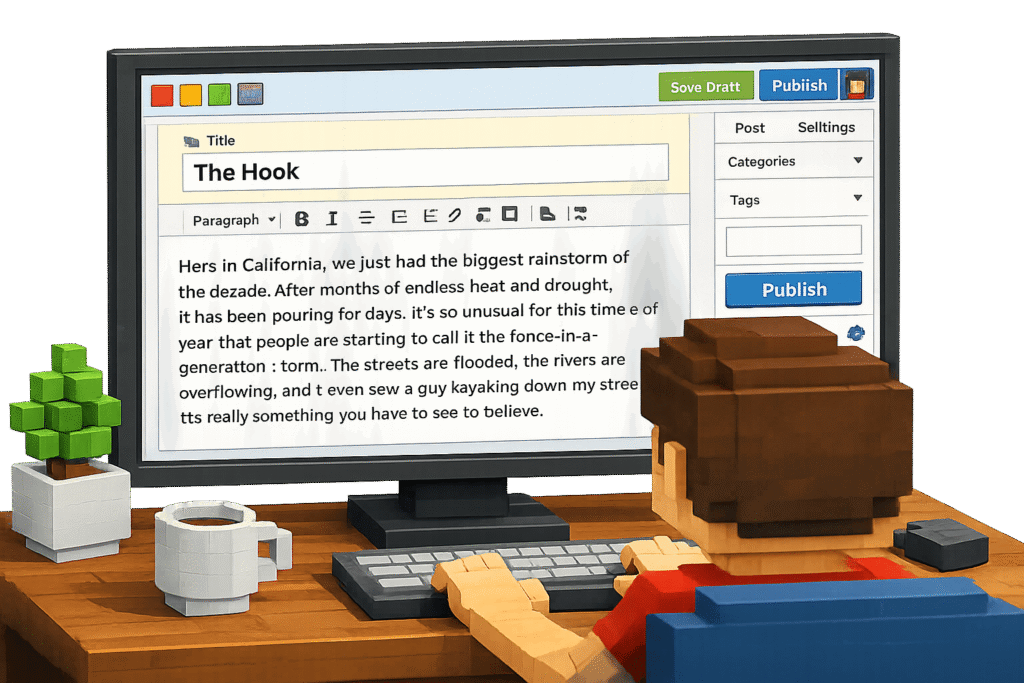
    a user is writing his hook

    This is your opening, 2–3 short paragraphs built around something real.

    A specific moment. A failure. A result that surprised you. A pattern you noticed that changed how you approach something.

    The specifics are what make it land. It took me a few hours to figure this out” is a hook. “I struggled with this concept” is not, it’s vague, and vague doesn’t build trust.

    You don’t need a dramatic story.

    You need an honest one.

    A small concrete detail carries more weight than a big emotional claim.

    If the experience you’re describing isn’t dramatic, don’t make it dramatic. Match the actual stakes of what happened.

    Part two: The promise.

    the hook for posts

    After the hook, tell the reader exactly what the post covers. Not what they’ll “discover” or “unlock that similars to open the sesame”, what they’ll actually walk away knowing or being able to do.

    One or two sentences, plain language, no inflated claims.

    If the post covers three approaches to writing introductions, say that. If it covers one approach in depth, say that.

    The promise isn’t a thesis statement the way your English teacher meant it.

    It’s a contract.

    The reader decides to keep reading based on whether that contract sounds worth their time.

    Keep it honest and specific, and the people who need what you wrote will stay.

    Why the Experience Hook Outperforms Everything Else

    the promise you deliver after the hook

    The question versus statistic versus bold claim approaches to introductions all get recommended in writing guides.

    They work sometimes. But they share a weakness: they’re easy to fake.

    A question like “Have you ever wondered why your blog posts aren’t getting traffic?” could have been written by anyone.

    It requires no real knowledge of the topic.

    A statistic pulled from a Google search doesn’t tell the reader anything about whether you actually understand the subject.

    A bold claim – “Everything you know about introductions is wrong”, is a pattern readers have seen so many times it’s become noise.

    An experience, told honestly, can’t be faked the same way. It has details that only come from having actually done the thing.

    The 5:12 AM workflow failure. The analytics showing a clear drop-off pattern.

    The week it took to realize the problem was in the introduction, not the content.

    Those specifics aren’t decorative, they’re the thing that separates “someone who’s been through this” from “someone who researched this.”

    That’s what your reader is actually trying to figure out in the first paragraph: is this person worth listening to? Experience answers that question faster than any other approach.

    This is also why the experience hook holds up in 2026 specifically.

    AI can generate a hook, a statistic, a provocative question.

    It can’t generate your actual story, your analytics data, your specific failure at a specific time. That’s yours. And readers, who are increasingly good at recognizing AI-generated pattern matching, notice the difference.

    When You Don’t Have a Relevant Experience

    Not every post you write will have a personal story attached to it.

    Sometimes you’re covering a topic you’ve researched but haven’t lived. That’s fine, as long as you don’t fake it.

    The alternative to experience is directness.

    Open with the actual problem the reader is facing, stated plainly and concretely. Not “many bloggers struggle with introductions” that’s vague and third-person.

    Try: “The last three blog posts I wrote on [topic] all had the same problem: the introduction was doing nothing.”

    Or: “Here’s what I found when I started looking into how introductions actually affect time on page.”

    First person, concrete observation, honest framing.

    It won’t have the same immediate credibility signal as a real story, but it’s significantly more trustworthy than a manufactured anecdote.

    Readers can tell when a “personal story” is a template with the blanks filled in. Don’t do that.

    A clean, direct problem statement built from research is worth more than a fabricated emotional opening.

    The one rule: don’t apologize for not having a story. Just write the most honest version of the opening you can, given what you actually know.

    The Practical Test

    Before you publish any introduction, read it and ask:

    does this make the reader feel like the person writing knows what they’re talking about?

    If yes, does it tell them what they’re actually going to read, specifically, not vaguely?

    If yes to both, publish it.

    If the answer to either is no, you have one of two problems.

    Either the hook is too generic, replace it with something more specific, even if the specifics are small.

    Or the promise is inflated, dial it back to what the post actually delivers.

    The bounce rate problem most blogs have with their introductions isn’t a writing quality problem.

    It’s a trust problem.

    The reader doesn’t believe, in the first 20 seconds, that staying is worth their time.

    Fix that, and everything else the post has to offer actually gets read
  • How to Write a Blog Post That Gets Read (And Ranks) in 2026

    How to Write a Blog Post That Gets Read (And Ranks) in 2026

    When I started writing posts for The Owl Logic, my intention wasn’t to rank. It was to write something a reader could trust.

    I’d been through the other version of blogging – padding posts to hit word counts, adding sections because competitors had them, writing introductions that sounded like every other introduction in the niche.

    The content looked complete. It checked the boxes. And it didn’t do much, because it wasn’t written for anyone in particular. It was written for an algorithm’s idea of what a post should contain.

    What changed my approach wasn’t an SEO insight. It was cutting everything that felt fabricated and watching what happened when I wrote naturally from real experience with no fluff, being honest about what I knew and what I didn’t.

    The posts that came out of that approach got read. Readers stayed. Some of them shared. Some of them reached out.

    The rankings followed. Not instantly. But they followed.

    I’ve put the same philosophy on my about page – the full production system, transparent, no mystification. Experience core from me, research and structure from AI tools, multiple rounds of fact-checking before anything goes live.

    That transparency isn’t marketing. It’s the actual reason readers trust what they’re reading.

    The Short Answer

    A blog post that gets read and rank in one written to be useful to a specific person, not optimized for a search engine first.

    Write from real experience or genuine research, cut everything that doesn’t move the reader forward, answer the questions directly near the top, and format for someone who skims before they commit to reading.

    The ranking signals, time one page, low bounce rate, shares – are downstream effects of a post that actually delivers what it promises. Get the readability right first.

    The SEO follows from that, not the other way around.

    Why Most Posts Don’t Get Read

    The honest reason most blog posts fail isn’t keyword targeting or backlinks. It’s that they’re not written for a reader. They’re written to look like a blog post.

    You can spot them immediately.

    • The introduction spends two paragraphs establishing that the topic is important.
    • The sections cover every subtopic a competitor covered, in roughly the same order.
    • The conclusion summarizes what the post just said. The whole thing is technically complete and practically empty.

    There’s no point of view, no real experience, no specific insight that couldn’t have been generated by someone who’d never done the thing they’re writing about.

    That kind of post gets clicks and immediate bounces.

    The reader lands, scans the first few paragraphs, finds nothing that suggests the author knows more than they do, and leaves.

    Google sees that. Bounce rate, time on page, return visits, these are all signals that tell search engines whether a post actually served the person who clicked it.

    Fluff doesn’t fool those signals. It just produces bad numbers.

    The posts that get read are the ones where the reader gets three sentences in and thinks: this person has actually been through this.

    That trust signal established fast, in the opening – is what keeps someone reading past the introduction. Everything else is secondary.

    Write for One Person or Audience, Not for Traffic

    Every post that works was written with a specific reader in mind. Not a demographic. Not a keyword. A person with a specific problem who is looking for something real.

    Before writing anything, I try to get that person clear.

    • What have they already tried?
    • What level of knowledge are they coming in with?

    The answers to those questions determine everything, the depth of explanation, the vocabulary, the examples used, the level of detail in code or process walkthroughs.

    Writing for one person isn’t a limitation.

    It’s what makes a post feel like it was written for the reader personally, even when thousands of people with the same problem end up reading it.

    Generic posts try to speak to everyone and connect with no one.

    A post written for a specific problem, at a specific depth, for a specific kind of reader, gets shared by that reader because it feels like something they found rather than something they were served.

    This is also what creates the behavioral signals that matter for ranking.

    When a post genuinely matches what someone was looking for, they read it.

    They don’t bounce in eight seconds.

    Some of them click through to related posts. Some bookmark it. Those are not tricks, they’re the natural behavior of a reader who got what they came for.

    The Readability Layer That Most Writers Skip

    Good writing and SEO-friendly writing are not in conflict. They’re the same thing described differently.

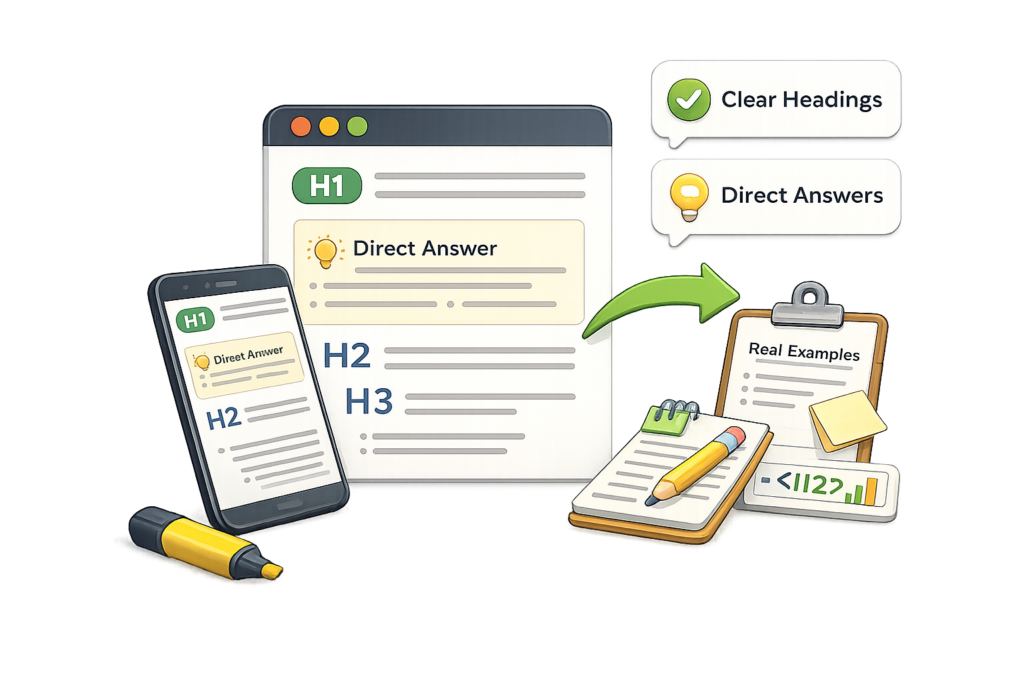
    Short paragraphs aren’t an SEO tactic – they’re easier to read on a phone screen, which is where most of your readers are.

    Headers aren’t just for crawlers – they let a reader scan the post and decide if it’s worth their full attention before they commit.

    A direct answer near the top isn’t just good for AI citations, it respects the reader’s time and builds trust immediately.

    The formatting choices that help posts rank are the same ones that make posts readable.

    The reason to make them isn’t to manipulate an algorithm.

    It’s to make the post as easy to use as possible for the person reading it.

    Concretely, this means:

    • One idea per paragraph. When a paragraph contains three ideas, readers lose the thread and start skimming.
    • No sentences that only exist to transition. “Now that we’ve covered X, let’s look at Y” is a sentence that does nothing. Cut it.
    • No section that exists because a competitor had it. Every H2 should pass the “so what” test – if you can’t explain in one sentence why the reader needs this section, it shouldn’t be there.
    • No fabricated examples. If you haven’t done the thing you’re describing, say so. If you have, use the actual details, the specific numbers, the actual failure, the real outcome. Invented scenarios read like invented scenarios.

    That last one is the one most people skip.

    Fabricated examples are the main way fluff enters a post that otherwise has good bones.

    Real examples, even small ones, are the difference between a post that feels like journalism and one that feels like content.

    How Ranking Actually Happens (From the Reader Side)

    Nobody ranks a post by writing it for Google.

    They rank it by writing something Google’s users find useful enough to stay, backlinks, share, and return to.

    The mechanics work like this,

    • A post that keeps readers on the page signals that it delivered on the promise of the headline.
    • A post that gets linked to from other sites signals that people found it worth referencing.
    • A post that earns return visits signals that the reader trusted the source enough to come back.

    All of those signals accumulate over time, not instantly, but steadily, and they’re what move a post from page two to page one.

    This is why the ranking often doesn’t come immediately after publishing. A post needs to be found, read, and validated by real readers before the algorithmic signals are strong enough to move it.

    That process takes weeks or months depending on the domain authority, the competition, and how much distribution the post gets outside of search.

    Patience is not optional here. It’s structural.

    What you can control in the meantime: write the post so that when it does get traffic, those readers stay and find it worth sharing. A post that earns a 15% bounce rate and three organic backlinks in month three will outperform a keyword-optimized post that gets clicks and immediate exits every time.

    The One Thing That Actually Differentiates a Post

    Most posts on any topic cover roughly the same information.

    The ones that rank consistently have something the others don’t: a genuine point of view.

    Not an opinion for the sake of being contrarian. A real position on the topic, earned through experience or deep research, that the reader couldn’t get from reading five other posts on the same subject.

    That point of view is what makes a post quotable.

    It’s what makes someone share it with a note rather than just a link. It’s what makes a reader remember which site they found it on, and come back when they have the next question.

    Write the thing. Make it real. Cut what’s fake. The rest takes care of itself, eventually.