Category: Blogging

Learn to build a blog from scratch in 2026 – creating a brand, high-quality content, and AI structured pipeline that helps your goal

  • Micro Niche vs Broad Niche Blog: Which Actually Works in 2026?

    Micro Niche vs Broad Niche Blog: Which Actually Works in 2026?

    When I launched The Owl Logic, the niche was almost embarrassingly specific: n8n tutorials.

    Not automation broadly. Not no-code tools. Not “AI productivity.” Just one workflow builder that most people had never heard of.

    That specificity felt like a limitation. It wasn’t.

    The site found its footing. And while I was deep in building automations and writing tutorials, I kept running into something I wasn’t expecting – better methods for using AI inside content workflows.

    Things that worked in ways the generic “use AI for content” advice never covered. Gold methods, honestly. Stuff I’d discovered because I was building things from scratch and paying close attention.

    The blog you’re reading now is the proof.

    I didn’t stay in that tight n8n corner forever. I widened into blogging, content systems, AI for writers, and this site itself.

    But the expansion followed the logic. Each new category connected back to the core. The authority I’d built in the narrow space made the wider one credible – not just to Google, but to readers.

    That’s the model. Not micro vs broad as a permanent identity you pick once and live with. Width is a phase. You earn it.

    The short answer

    Start with a micro niche. When you’re new, narrow is far easier to rank for and build authority in – you become “the site about X” fast, instead of competing with giants on broad terms.

    You won’t run out of topics; a good micro niche has dozens of beginner questions you haven’t touched yet. Then, once you have traction, expand into adjacent topics.

    Broad niches only work if you already have authority or budget. So: micro now, broaden later. That’s not a compromise — it’s the sequence that actually works.

    Why narrow wins when you’re new to blogging

    When you’re a new blog with no domain authority, no backlinks, and no track record, you’re not competing on a level playing field.

    Broad niches mean going up against sites that have been publishing for years, have thousands of articles, and have accumulated trust signals that took time to build.

    You won’t outrank them on “productivity tips” or “how to make money online.” Not in year one. Probably not in year two.

    A micro niche changes the math entirely.

    When your entire site covers one specific thing – one tool, one skill, one clearly defined audience, every article you publish reinforces that you’re the source on that thing. That signal compounds fast.

    Google starts to understand your site. Readers do too.

    This is what topical authority means at the beginner level.

    It isn’t a technical trick.

    It’s just focus. The more tightly your content clusters around one topic, the clearer the signal, and the faster you start ranking for the terms your readers actually search.

    Spread too wide too early, and you’re telling every algorithm: “I write about all kinds of things.” That’s not a strong signal for anything.

    Narrow tells a specific story, and specific stories win the ranking race when you’re starting from zero.

    The other factor: micro niches naturally target longer, more specific keyword phrases. Lower competition. That means a newer domain can actually show up on page one, instead of getting buried by established sites chasing the same broad terms.

    A related question worth thinking through before you even pick a direction: How to Choose a Blog Niche – because the choice between micro and broad only matters once you’ve found a niche worth choosing. And if you’re still deciding whether a niche blog is even the right frame for what you want to build, personal blog vs niche blog covers that upstream question cleanly.

    But what if I run out of topics?

    This is the fear. I hear some version of it constantly: “My niche is too specific. I’ll write ten posts and have nothing left.”

    Here’s the honest answer: if you can’t find at least 30 beginner questions inside your niche, the niche isn’t too small – it’s too vague.

    A sharp, specific niche actually unlocks more topics, not fewer. Because you can go deep in a way a generalist site can’t.

    Think from the reader’s side. If your niche is “sourdough bread for beginners,” there’s a beginner asking how to start a starter, why their loaf is dense, what hydration means, how long fermentation takes, what tools they actually need, how to store it, what to do when the crust is too hard, and a dozen variations on each of those.

    You won’t run out. You’ll run out of time before you run out of ideas.

    The same dynamic played out at The Owl Logic.

    One automation tool produced more content ideas than I had hours to write.

    Every workflow, every common error, every “how do I actually do this” question – each one was an article.

    The constraint of the niche forced specificity, and specificity is exactly what beginners search for.

    Running out of topics is a fear, not a fact. The bloggers who actually run dry picked a topic they didn’t know well enough – not a topic that was too narrow.

    When to expand, and how to do it right

    Expanding your niche doesn’t mean starting over. It means growing outward from what you built, along the connections that already exist.

    Here’s the signal I used: when readers started asking me about things adjacent to the core material, not just “how do I build this workflow” but “how do I use it for content, how do I organize the output, how do I write better prompts for this” that was the expansion moment.

    The audience was pulling me outward because the original content had earned their trust.

    I hadn’t run out of ideas. I’d built enough credibility that new territory was mine to claim.

    That’s the right time to widen. Not month two, when you’re anxious and impatient. Not whenever you’re bored with your original topic.

    When you’re ranking for things, people are sharing posts, you’re getting questions you can’t fully answer yet – that’s the signal.

    And the expansion works when it follows the logic, not just the traffic opportunity. I didn’t pivot to a lifestyle blog.

    I moved to content strategy, blogging systems, AI workflows things that connected directly to what a reader who learned automation from me would naturally want next.

    The through-line stayed intact. That’s not accidental. That’s the point.

    Before adding a new topic cluster, run this test: would a reader of your existing content naturally want this? If yes, you’ve found a real expansion.

    If the connection feels like a stretch, it is one. Stretches dilute the authority you built. Logical extensions compound it.

    One catch: your domain has to let you

    There’s a prerequisite to “broaden later” that almost nobody mentions, and it’s locked in on day one: your domain name has to allow it.

    The Owl Logic could widen because it’s a personal brand.

    The name isn’t welded to any single topic – automation, content, AI workflows, blogging all sit under it without anything feeling off.

    The brand stretched because it was built to stretch.

    Now imagine I’d done the “smart SEO” thing and registered an exact-match niche domain instead, something like specific-tool-tutorial.com. Early on, that name might win a sliver of keyword relevance.

    But the day I wanted to write about anything beyond that one tool, the brand would fight me.

    Every broader article would read as off-topic on a site whose name promises one narrow thing.

    You can’t grow into a wider niche when your domain is shouting a narrower one. The name boxes you in, and you can’t rename your way out without throwing away everything you built.

    So if there’s any chance you’ll broaden later, and if the plan is micro-now-broaden-later, there is – pick a brandable domain over an exact-match niche one.

    Exact-match buys you a little early relevance and locks the door behind you.

    A flexible brand costs you nothing and leaves the door open. The narrow niche is the phase. The domain is the thing you don’t get to redo.

    What topical authority actually means for a beginner

    You’ll hear “topical authority” used like it’s an advanced SEO concept. For a new blogger, it’s simpler than that.

    Topical authority means: Google and your readers think of you as a reliable source on a specific subject. You earn it by covering that subject thoroughly at the beginner level – not by writing thousands of posts, but by leaving no obvious beginner question unanswered.

    The depth matters more than the volume.

    A micro niche makes this achievable. A broad niche makes it nearly impossible until you’re big enough to staff it.

    The most common mistake isn’t going too narrow.

    It’s going narrow on the surface while publishing inconsistently, two posts on the core niche, three on something adjacent, one on something else entirely.

    That breaks the topical signal before it has a chance to compound. Commit to the niche. Cover it properly. Then expand.

    Micro isn’t the destination. It’s the mechanism that gets you to broad without wasting years competing on terms you can’t win yet.

    Frequently asked common questions

    Will I run out of topics in a micro niche?

    Almost certainly not, if you picked a topic with real beginner interest. The narrower the niche, the deeper you can go on each subtopic, and beginners generate more specific questions than generalists ever do. Map out 30 potential article ideas before you commit to a niche. If you can hit 30 without straining, you have more than enough runway.

    Can I expand my niche later?

    Yes, and that’s the plan. Starting micro doesn’t lock you in forever. Once your site has real traction (you’re ranking, you have readers, you’ve built topical authority in your starting cluster), you expand outward into adjacent territory.

    The key is that the expansion follows logical connections, not just traffic opportunities. Authority travels along content that makes sense together.

    Is a broad niche bad for a new blog?

    Not bad, just very difficult. Broad niches work when you already have domain authority, budget for volume, or an existing audience.

    Without those, you’re competing against sites that have years of head start.

    A new blog in a broad niche will struggle to rank for anything meaningful early on, which makes it hard to build momentum. Start narrow, earn the authority, then broaden. That sequence works. The reverse rarely does.

  • How to Choose a Blog Niche in 2026 (Without Overthinking It)

    How to Choose a Blog Niche in 2026 (Without Overthinking It)

    When I was working out what The Owl Logic would be about, I didn’t start from a list.

    No spreadsheet of profitable niches. No trending-topics rabbit hole.

    I started from the other direction, what had I actually spent the last 15+ years doing online? Writing contents with grammarly, building mini-tools for businesses, marketing, and the tools I build with and the problems I solve every week. That’s where the site started.

    The logic wasn’t complicated: pick things I know well enough to be useful, pick things I genuinely won’t abandon six months in, and pick a space where people actually spend money. Automation and productivity tools aren’t a charity sector, there’s real commercial activity there. I had real experience. I won’t get bored.

    Most posts you’ll read about choosing a niche don’t work that way.

    They hand you 100 ideas and call it help. The result is more paralysis, not less, because now you have 100 doors and no key. What you need isn’t more options. You need a filter.

    The 3-Part Filter (My Specialized Filter)

    Choose the intersection of three things:

    • A topic you won’t quit in six months
    • A space where people spend money
    • Something genuinely useful you can say

    Not perfect at all three. Just clearing all three.

    Passion without commercial signal is a journal, meaningful for you, hard to build anything on.

    A profitable niche you have nothing real to say about produces thin content that doesn’t last. And if you pick something you’ll drop in three months, the whole project collapses before it has a chance to matter.

    Good-enough beats perfect here. You can narrow a niche. You can pivot later. What you can’t do is start a blog you won’t write.

    Before you get deep into niche research, it’s worth knowing what kind of blog you’re actually building – if you’re torn between a personal brand and a niche site, personal blog vs. niche blog is worth reading first, because that decision shapes how you apply the filter.

    Passion vs. Profit: You’re asking wrong question?

    Most beginners frame this as a binary: do I follow my passion, or do I follow the money?

    That’s not the question. The real question is whether you can clear both gates at once.

    The passion gate isn’t asking whether you’re obsessed with a topic. It’s asking whether you’ll still be writing about it when the traffic is flat and the results are slow – which, at the start, they will be.

    Consistency is the actual input. If you need excitement to keep going, pick something that generates it naturally.

    The profit gate isn’t asking whether you can slap affiliate links on anything. It’s asking whether the audience you’re writing for buys things.

    Personal finance is a good example – people spend money on budgeting apps, courses, and financial products.

    Vintage TV trivia isn’t – most people in that space aren’t buyers. You might love the topic. That doesn’t make it commercial.

    Here’s the reframe: passion vs. profit is the wrong axis. You’re looking for the overlap. If you can’t find it, you haven’t run out of passion or profit – you haven’t found the right niche yet.

    How narrow is narrow enough?

    Most beginners either go too broad (“health,” “finance,” “technology”) or get so specific they box themselves into a corner before they’ve written ten posts.

    The practical answer: start at the right level of specificity. Broad enough that you have six months of content ideas without stretching. Narrow enough that your ideal reader recognizes themselves immediately.

    “Personal finance” is too broad. “Personal finance for recent college graduates” works. “AI tools for small businesses” works. “Parenting” is too broad. “Screen-free activities for toddlers under 3” works – it’s specific without being a dead end.

    Running the Filter – Real Examples

    Here’s what the 3-part filter looks like applied:

    Passes all three gates:

    • Personal finance for beginners – high commercial intent, and if you’ve managed debt or saved through a tough stretch, you have something genuine to say
    • Productivity and tools – strong commercial signal, sustainable if you’re actually into systems
    • Budget travel – commercial (flights, gear, accommodation), and real experience beats researched advice every time

    Fails the filter:

    • Celebrity gossip – low commercial intent, and “something useful you can say” is near-zero unless you’re a journalist with insider access
    • Your hobby of collecting vintage video games – passion, but thin commercial signal and a small buyer pool

    The filter doesn’t tell you the right niche. It tells you whether a candidate niche is worth committing to. Run it on two or three candidates. The one that clears all three gates most cleanly is your answer.

    You can pivot. but that’s not a reason to stall.

    One reason beginners overthink the niche decision is they’re treating it like it’s permanent.

    It isn’t.

    Plenty of successful blogs started in one space and drifted – or deliberately shifted – as the writer’s authority and interests evolved.

    What you pick at the start sets your first six months of content. That’s it. If the niche turns out to be wrong, you’ll know it from the inside after writing it, not from a list you read before you started.

    The cost of picking wrong is months of learning. The cost of not picking at all is infinite.

    Apply the filter. Pick the one that clears all three gates. Start writing.

    If you’re still asking whether blogging is even worth attempting right now, that question is worth settling first – here’s the honest breakdown.

    Frequently asked common questions

    What is the best blog niche for beginners?

    There isn’t a single best niche, there’s a best niche for you, and it’s the one that clears all three gates: topic you won’t quit in six months, audience that spends money, something genuinely useful you can say. That said, niches with strong beginner commercial activity include personal finance, productivity and tools, budget travel, and home improvement. Any of these work if you actually have something real to contribute. None of them work if you don’t.

    Can I change my niche later?

    Yes, and more bloggers do than they admit. A niche isn’t a contract. If you’ve built content and an audience in one space, shifting takes thought – you’ll lose some readers, but it happens.

    The honest reason not to lean on this: “I can always pivot” becomes a reason to never commit. Pick something you can commit to now, knowing you have the option to adjust later. Don’t pick something you’re already planning to abandon.

    Should I pick a niche I’m passionate about or a profitable one?

    Both. Not one or the other.

    A niche that’s only passionate is a journal. A niche that’s only profitable produces content you’ll stop writing the moment results get slow.

    The filter exists precisely because you need both, plus something genuine to say. If you can’t find the overlap right away, keep looking. It exists.

    Once you’ve picked your niche, the next question is what to actually do with it. How to write a blog post is where to go from here.

  • Realistic Blogging Goals: What to Actually Expect in Year One

    Realistic Blogging Goals: What to Actually Expect in Year One

    When I launched my blog, the early weeks were super quiet – exactly the way everyone warns you they’ll be. And the traffic that did trickle in early? It didn’t come from Google. It came from going out and getting it myself.

    That’s year one. Not a launch that takes off.

    A slow ramp that stays flat longer than feels fair, then bends upward late, and the traffic you get before the bend is mostly traffic you went out and earned by hand.

    If you’re reading this because you’re staring at your own stats wondering am I behind, or is this normal or Do I need to change my perspective on Blogging goals? – that’s the exact question this post answers.

    The honest answer for your blogging goals

    Little traffic for the first few months, SEO starting to compound around months 6–12, and often little or no income until late in the year. The real win in year one isn’t money – it’s publishing 20–40 solid posts and building the habit.

    If you expect viral traffic or quick income, you’ll quit. Expect a slow, compounding curve and you’ll still be here when it pays off.

    The shape of a normal year one

    These are honest ranges, not promises – your niche, your effort, and how much you promote swing them hard. But this is the curve most new blogs actually ride:

    • Months 1–3: Near silence from Google. A new site has earned no trust, so search sends almost nothing, a trickle on a good day. Income is effectively zero. This is where most people quietly conclude they’re failing. They’re not. The engine just hasn’t warmed up.
    • Months 4–6: The first signs of life. A few posts start ranking for low-competition terms, search traffic creeps from a trickle to a thin but real stream, and maybe you see your first few dollars. Still mostly flat, but no longer dead.
    • Months 7–12: Compounding starts to show. Older posts climb, new posts rank a little faster because the site has some trust now, and traffic that crawled to hundreds can start reaching into the thousands. Income often shows up here too, but realistically it’s small. First-real-money territory, not replaces your 9-5 salary.
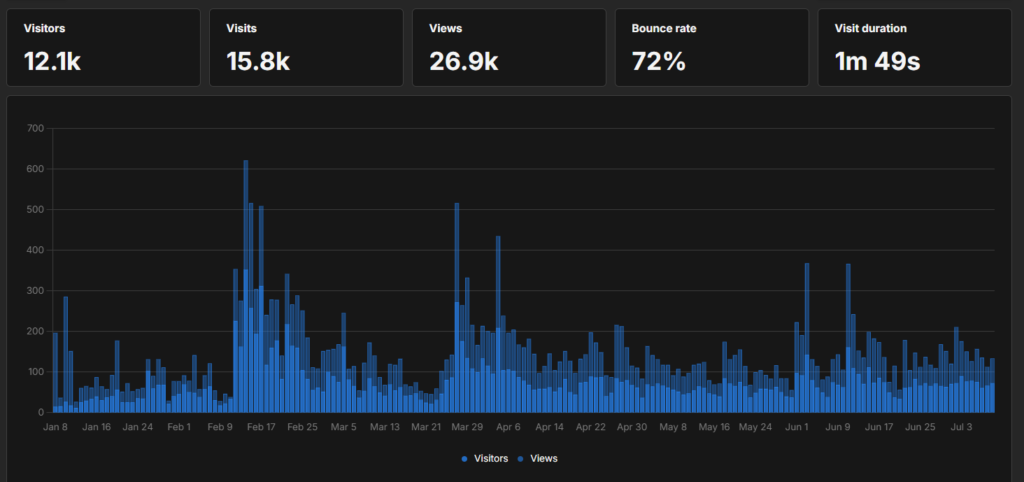
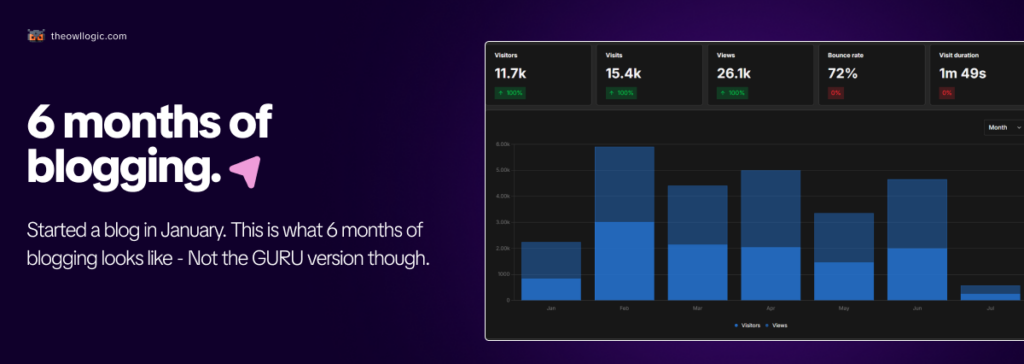
    6 months of blogging

    Now the part that’s the whole lesson. The traffic I had in those early months was above what a typical Google-only year-one blog sees – and the reason is simple: (check the above stats)

    I didn’t wait for search. I went and got the traffic myself, from communities like Reddit, facebook, bluesky and etc, while the SEO compounded quietly underneath.

    So if your search numbers look like “Months 1–3” up there, you are not failing. You’re dead-on the normal curve. You can choose to beat it the same way.

    Why it’s slow? and why slow isn’t the problem

    Blogging is slow by game with lots of hard work.

    Google has to learn it can trust your site, and that trust is earned over months of consistent, useful content – never bought with one big burst of effort.

    So the early curve stays flat no matter how talented you are.

    Slow isn’t the failure. Expecting fast is.

    When you walk in expecting traffic by week three, the normal slow ramp reads as proof you’re bad at this, and you quit during the exact stretch that was about to pay off.

    That’s the number-one way new blogs die; I broke it down in why most blogs fail in year one. Right expectations aren’t a nicety here.

    They’re the thing that keeps you in the game long enough to reach the compounding. (And if you’re still asking whether the payoff is even real, that’s is blogging worth it in 2026.)

    In year one, money is the wrong scoreboard

    Here’s the reframe that changes how the whole year feels: if you measure year one by income, you’ll feel like a failure for ten months straight because the income mostly isn’t there yet, and that’s normal, not personal.

    So measure the things you actually control and that actually build the asset:

    • Publish 20–40 solid posts. This is the real year-one target. It’s the content base everything else compounds on top of.
    • Build the habit. A publishing rhythm you can hold for a year is worth more than any single post that pops. The habit is the engine.
    • Learn your reader. By month twelve you should understand what your audience actually wants far better than you did on day one. That knowledge compounds too.

    Hit those three and the traffic and money arrive in year two — paid out of the trust you spent year one earning.

    “Am I behind?” – almost certainly not

    The anxious question under all of this is is my slow progress normal, or am I just failing? In nearly every case: normal. Barely any traffic for the first few months, near-zero early income, a handful of posts that go nowhere – that’s the standard experience, not a red flag.

    You’re only genuinely behind in one situation: you’ve stopped publishing, or you’re a year in with no consistent body of content.

    Slow growth on a blog you’re still feeding is just blogging working as designed. Stay in it.

    Frequently asked common questions

    How much traffic should a blog get in the first year?

    From Google alone, honestly very little for the first several months – often only tens to low hundreds of visits a month until SEO begins compounding around months 6–12. By the end of year one, somewhere from a few hundred to a few thousand monthly visitors is a realistic range, swinging heavily on niche and effort.

    You can go well beyond that by promoting outside Google – early on, communities like Reddit can bring in real readers while your search traffic is still building.

    When does a blog start making money?

    Usually late in year one at the earliest, and even then it’s typically small. Meaningful income generally lands in year two, once you have enough ranking content and traffic to monetize properly. Expecting real money in the first few months is the fastest route to disappointment, and quitting.

    Is slow blog growth normal?

    Yes , it’s the default. A blog’s traffic curve stays flat for months, then bends upward as SEO compounds. Slow early growth almost never means you’re failing; it means the engine hasn’t warmed up yet. The only real failure is quitting during the flat stretch, right before it starts to climb.

  • Should You Blog Anonymously or Use Your Real Name?

    Should You Blog Anonymously or Use Your Real Name?

    When I started The Owl Logic, I almost hid.

    I wasn’t a famous expert. Nobody knew who I was. And there I was, about to put my name on advice and publish it where anyone could read it and judge it.

    The thought was super-loud: who am I to be telling people anything? For a moment, blogging anonymously felt safer.

    A pen name. No face. Nothing to be embarrassed about if it flopped.

    I put my real name on it anyway, Shajid Shafee. And looking back, the urge to hide had almost nothing to do with privacy. It was fear of being judged dressed up as a privacy question.

    If that’s the feeling pulling you toward an anonymous blog, read this first because hiding is usually the wrong fix for it.

    The honest answer

    Use your real name if you want authority, networking, and a personal brand; you build credibility by showing up, not by waiting until you’re an expert. Blog anonymously or under a pen name only for genuine reasons privacy, a sensitive niche, or separating it from your career.

    That’s legitimate and just know anonymous blogs work harder to earn trust and are tougher to monetize as a personal brand.

    The question most posts skip

    Most articles on this topic go straight to a pros/cons table. Anonymous: privacy. Real name: trust. Pick your side.

    That’s not wrong. But it misses the reason most beginners are actually asking.

    The real driver isn’t privacy, it’s credibility anxiety.

    It’s the voice that says I haven’t earned the right to be seen yet. 

    Going anonymous is the brain’s attempt to solve that.

    You take your name off it, and if people judge the work, at least they’re not judging you.

    The question isn’t really “anonymous or real name?” It’s “do I have the right to say anything at all?”

    I know this because I felt it when I started.

    “I’m not an expert. Nobody knows me. Who am I to give advice?” That’s imposter syndrome, and anonymity feels like the cure.

    Here’s the problem: it isn’t. Anonymity doesn’t fix the fear. It just removes the thing that would’ve made the work pay off.

    Why hiding backfires

    A blog earns money and opportunity through trust (I always think blogging as a business).

    Not the kind of trust that comes from credentials or follower counts, the simpler kind.

    Readers need to believe there’s a real, accountable person behind what they’re reading.

    Take the name away and you’ve made that harder. A faceless site has to work twice as hard to feel credible, and most don’t get there.

    Then there’s the personal brand problem.

    The connections, the networking, the people who reach out because they read your stuff and want to hire you, collaborate with you, or follow what you do next – none of that happens to “Anonymous Blog #4192.”

    Your name is the thing those opportunities stick to. It’s the same reason I’d argue for building around a person rather than a pure content site – the person is the asset.

    Strip the person out and you’ve got a directory, not a brand. (I covered that tension in more detail in personal brand blog vs. niche blog.)

    The trade-off is worse than it sounds on paper. You avoid a little discomfort now and forfeit most of the upside later. That’s a bad deal.

    The right (I’d say proper) fix: document, don’t teach

    Here’s the reframe, and it’s the whole point of this post.

    You don’t need to be an expert to write.

    You just need to be one honest step ahead of the person reading.

    Most beginners assume they need to teach from authority. Which means waiting until they’re qualified. Which means never starting. Which means the blog never exists.

    The shift that actually works: stop trying to teach and start documenting.

    Write what you’re learning, not what you’ve mastered.

    “Here’s what I tried. Here’s what happened. Here’s what I’d do differently.”

    That’s not a lower standard, it’s harder to fake than performed expertise, and readers can smell the difference.

    You don’t wait until you’re an expert and then start publishing. You publish your way into authority.

    Consistently showing up, being honest about where you are, and writing one step ahead of someone who hasn’t started yet, that’s what builds trust.

    And it builds around you, not around a pen name that can’t shake a hand or do a podcast or take credit for a result.

    If you’re still weighing whether any of this is worth the effort at all, I covered that in is blogging worth it in 2026. Short answer: yes, but how you show up matters more than the volume.

    When anonymous or a pen name actually makes sense

    Anonymity isn’t always the wrong call. It’s the wrong call when fear is driving it. It’s the right call when the reason is real.

    Decide by your goal, not your nerves.

    • Privacy or safety is a genuine concern. You don’t want your full identity, your home life, or your family tied to a public presence. That’s a personal, legitimate choice, and the trade-off is worth it when the need is real.
    • The niche is sensitive. Mental health, personal finance struggles, relationship issues, adult topics, there are subjects where attaching your name creates real professional or social risk. A pen name makes sense here, and plenty of serious blogs operate this way.
    • You need to separate it from your career. You have a day job or an existing professional reputation you don’t want this blog surfacing next to, at least for now. Some people run two things separately until the blog is established, then decide whether to connect them.

    These are all valid reasons, and anonymous blogs can absolutely work. But go in clear-eyed: an anonymous blog earns trust more slowly, and it’s tougher to monetise around you specifically.

    You can still build authority around a brand name, it just has a lower ceiling if the plan ever involves anything personal-brand shaped such as consulting, speaking, a name people follow rather than a site they bookmark.

    The question to ask yourself honestly,

    “Am I hiding for a real reason, or am I hiding because I’m scared?” One of those gets easier with time. The other doesn’t.

    Common questions

    Can you blog anonymously and still make money?

    Anonymous works if you’re monetizing through ads, affiliates, digital products , income attached to the content. It breaks down if you’re monetizing yourself – consulting, direct offers, personal-brand deals. Those need people to know who’s behind the work. So: ad/affiliate model, anonymous is fine. Personal-brand model, use your name.

    Is it better to use your real name on a blog?

    Real name builds trust faster and turns the blog into an asset that follows you. Exceptions: genuine privacy needs, sensitive niches, or wanting distance from your career. Otherwise, if fear of judgment is the only thing stopping you, use your real name. The discomfort passes, the decision compounds.

    How do I blog anonymously safely?

    Pen name from day one. Domain privacy protection at registration (verify current cost with your registrar). Separate email and social accounts for the blog. Watch for identifying details in photos, locations, personal stories, one slip connects the dots. Only worth the discipline if you have a real reason to stay anonymous, not just nerves.

  • Should You Start One Blog or Multiple Blogs? (2026)

    Should You Start One Blog or Multiple Blogs? (2026)

    I’ve been venturing around the internet for over fifteen years.

    In that time I picked up experience across several different but connected things such as automation, productivity, the tools I build with, writing.

    On paper those look like separate niches.

    In practice they’re all the same thread: one person’s way of thinking about building things online.

    So when I started The Owl Logic, the choice was right in front of me. Spin up a separate blog for each topic, or put everything under one roof.

    I went with one domain and multiple categories – a personal brand, not a single-topic site. That was a deliberate decision.

    Most “one blog vs many” advice gives you a blanket rule and moves on.

    The real answer depends on a single test, and once you see it, the decision makes itself.

    The honest answer

    Start with one blog. As a beginner, running multiple sites splits your time, budget, and authority across blogs that each need years to grow – so they all stagnate together.

    If your interests connect by a common thread, put them as categories under one domain instead of separate sites; that concentrates your authority and still lets you cover everything.

    The only time separate blogs make sense is when your topics are genuinely unrelated — and even then, master one first before starting a second.

    Focus beats diversification when you’re new.

    Why one blog wins when you’re starting out

    Every blog is a separate mouth to feed. Its own domain, its own hosting, its own year-long climb to earn Google’s trust, its own pile of content before it ranks for anything.

    Run one and that’s already a serious commitment.

    Run three and you’ve tripled the workload while cutting the attention each one gets down to a third.

    The authority problem is worse, though.

    When you publish consistently on one site, every post strengthens the whole thing – your best articles lend credibility to your newest ones, and the domain as a whole gets stronger over time.

    Split that across three separate sites and each one starts from zero, alone, fighting for trust on its own.

    You’ve taken the one advantage that compounds and divided it by three. but it comes up with a risk well, I have explained why in below section.

    For a beginner, that math is how all three blogs stall at once.

    There’s a cost angle too. Three domains, three hosting plans, three sets of tools, or three free plans stretched thin.

    It adds up fast before any of them are earning. One domain lets you put every resource into one thing until it’s working.

    The real test: are your niches actually connected?

    Here’s where the blanket advice falls apart. “Always run one blog” isn’t the full answer either.

    The real question is whether your topics share a thread.

    Mine do. Automation, productivity, writing, the tools I use – they’re different categories, but they point at the same kind of person doing the same kind of thing: building something online, mostly solo, trying to be efficient about it.

    A reader who comes for one of those topics could plausibly care about the rest, because it’s all the same world.

    The thread isn’t the topic. It’s the perspective.

    (I went into this in depth over at personal brand blog vs niche blog – worth reading alongside this one if you’re trying to figure out what shape your site should take.)

    Now picture the opposite: a food recipe blog and a personal finance blog under one domain.

    Those don’t connect. There’s no shared reader, no shared thread, no perspective that makes them belong together.

    A visitor lands and can’t tell what the site is about. Neither can Google. That’s not a broad blog, that’s two unrelated projects stapled together.

    Those deserve separate homes.

    (But I got your thought here, Maybe food recipe blog, can create partial financial type of blog because shopping advice, and yeah that may sounds like a worth shot – Yes. PERSPECTIVE)

    So here’s the test: could one reader plausibly care about all of it?

    Yes → one blog with categories.

    No → separate projects.

    It’s a blunt test. That’s what makes it useful.

    One domain, many categories – how to do it

    If your topics pass the connection test, categories are the move.

    You cover everything you care about, all of it builds a single compounding pile of authority, and none of your energy escapes to a site that starts over from zero.

    The key is keeping the categories tight enough that the site still has an identity.

    A personal brand can hold several topics as long as you’re the obvious thread.

    Your perspective is what makes “automation” and “blogging” belong on the same domain, not a rigid topic rule, but your specific way of thinking.

    Lead with that, and the breadth becomes a strength instead of a smell.

    When multiple blogs actually make sense

    Two situations earn a second blog.

    The topics genuinely don’t connect

    If you’re serious about two worlds with no shared reader the food-and-finance problem separate sites are honestly the right call.

    Forcing them together dilutes both. The reader who finds your recipes doesn’t want a budgeting guide in their feed, and Google reads the mismatch. Build them separately.

    You’ve already mastered the first one

    Once a blog is established, earning, and running well, a second becomes a real option rather than a distraction.

    Not before. Starting three sites at once is three slow failures.

    Starting one, earning the right to expand, and then building a second from a position of experience and income – that’s how it actually works.

    Frequently Asked Common questions

    Can I have multiple niches on one blog?

    Yes, if they connect. The test is whether a single reader could plausibly care about all of them.

    If they share a thread (your topic, your audience, your perspective), run them as categories under one domain.

    That concentrates authority instead of splitting it.

    The only time multiple niches don’t belong together is when they’re genuinely unrelated – no shared reader, no shared thread.

    Is it bad to run multiple blogs?

    For a beginner, usually yes. Each blog needs its own time, budget, and years of authority-building, so running several splits your effort and they tend to stall together.

    Multiple blogs can make sense once you’ve mastered one and have the bandwidth, or when your topics are so unrelated they genuinely can’t share a site.

    How many blogs should a beginner start?

    One. Put all your time, energy, and content into a single site until it’s working.

    Cover multiple interests as categories under that one domain if they connect.

    A second blog is something you earn by making the first one work – not something you start alongside it.

  • Why Most Blogs Fail In Year One (And How to Avoid It)

    Why Most Blogs Fail In Year One (And How to Avoid It)

    I failed at blogging for years. Not once or twice like 10+ blogs, launched with some version of enthusiasm, pushed for a few weeks or a few months, watched nothing happen, walked away.

    I’d done it so many times I’d basically forgotten what a blog was even for. It became a thing I started and abandoned, not a thing I ran.

    Then I started one more blog. And for the first time, it didn’t die but it grew.

    Nothing about me changed in between.

    I didn’t get smarter, better at writing, or more talented.

    I changed one thing: I stopped waiting for Google to notice me and went and got the traffic myself, mostly from social channels like Pinterest, Quora, Reddit and etc, while the SEO slowly started to compound in the background.

    And I didn’t quit.

    That’s the entire difference between the blogs that failed and the one that didn’t.

    That’s what this post is really about. Because most blogs don’t fail because the person wasn’t good enough.

    They fail for a reason that’s far more boring, and far more fixable.

    The honest answer

    Most blogs fail for one core reason:

    People quit in the first 6–12 months, right before SEO traffic compounds. It’s almost never talent.

    Under that sit the fixable causes, no clear niche, ignoring what searchers actually want, posting inconsistently, and never promoting outside Google.

    The fix is two-part: treat blogging as a 12–18 month slow game so you don’t quit during the slow stretch, and drive early traffic yourself, relevant communities, places your readers already are – instead of sitting and waiting for Google to find you.

    Survive the compounding gap and you’ve already beaten most blogs.

    The real reason: you quit right before it works

    Here’s the part nobody frames honestly. A new blog earns almost nothing for months. Not because the content is bad. Because Google has to learn to trust it, and that trust builds slowly – over a year, not a weekend.

    Months 1 through 6 feel like shouting into an empty room.

    You publish, you wait, not much happens.

    Then months 6 through 12 arrive, and that’s where most people, exhausted and quietly convinced it’s never going to work, walk away.

    The cruel part: they quit right before the compounding kicks in.

    the hockey stick journey in a nut shell in blogging

    The traffic curve on a blog isn’t a straight line. It’s flat, flat, flat — then it bends upward (like a hockey stick).

    That bend happens somewhere in the 9–18 month window for most sites, depending on how competitive the niche is and how consistently they’ve been publishing.

    Quit during the flat part and you’ll swear blogging is dead.

    It wasn’t dead. You left early.

    So the thing everyone calls “blogging failure” isn’t really a talent problem. It’s a survivorship problem.

    The blogs that “made it” aren’t necessarily better, they’re the ones still standing when the curve finally bent.

    I wrote about this specific dynamic in is blogging worth it in 2026, the short version is that it works, if your approach does. But approach starts with not quitting.

    The fixable mistakes sitting underneath

    Quitting is the meta-reason.

    But people quit because of things that are completely fixable, problems that make the slow stretch feel hopeless when they didn’t have to.

    No clear niche

    A blog about everything is a blog about nothing – to readers and to Google.

    You can’t build trust with an audience that doesn’t know what you’re about, and you can’t rank for topics you haven’t earned authority in.

    Pick a lane narrow enough that someone can actually describe what your blog is for in one sentence.

    Ignoring search intent

    This is writing what you feel like instead of what people actually search for.

    If nobody’s looking for your topic, nobody finds it. Ranking in search isn’t about writing quality alone, it’s about matching real questions that real people type and then answering them better than what’s currently sitting at the top.

    Most of how to write a blog post that ranks comes down to this one thing.

    Inconsistency

    Three posts in week one, then silence for a month, then a burst, then silence again.

    The compounding only works if you keep feeding it. Publishing is the input; traffic is the delayed output.

    A steady, modest pace, one post a week, even one a fortnight, beats a heroic burst followed by a ghost town every time.

    No promotion

    Publishing and waiting for Google is the slowest possible path, especially in year one when Google doesn’t trust you yet.

    You need to bring the traffic yourself while the SEO builds.

    Reddit, forums, communities, email, places where your future readers already are.

    None of these require talent. They require knowing they’re the traps before you fall into them.

    How to avoid it (what actually worked)

    Two things kept The Owl Logic alive where my earlier blogs died. Neither of them was a secret.

    Commit to the timeline before you start. I decided before launching that this was a 12–18 month game, not a 12-week one.

    That single expectation change is what stops you from quitting in month 8 when results feel slow.

    You can’t be crushed by slow results you already planned for. The people who quit aren’t weaker, they just expected a different timeline.

    Set the right one at the start and the slow stretch stops feeling like failure.

    Drive your own traffic instead of waiting. This is the bigger one.

    A brand-new blog usually sees near-zero traffic for months, but you don’t have to accept that.

    I went where my readers already hang out, Reddit threads, conversations already happening around the topics I was writing about, and brought them in directly.

    That early traffic does two jobs at once: it gives you real readers and real momentum (which is what actually keeps you going), while Google slowly warms up to your site in the background.

    By the time the SEO starts compounding, you’re not starting from zero. You’ve already got proof the thing works.

    You don’t have to white-knuckle your way through a silent first year.

    Manufacture the early signs of life yourself, stay long enough for the compounding to take over, and you’ve already done what most bloggers couldn’t.

    Frequently asked common questions?

    What percentage of blogs fail?

    Most blogs die from neglect, not competition – the person just stops.

    There’s no reliable stat for how many (online numbers are mostly unsourced guesswork), but the large majority quit within the first year. That’s a fixable problem, unlike losing a search ranking war.

    Why do new bloggers quit?

    Because the early months demand real effort while paying almost nothing back, and the compounding that makes blogging worth it doesn’t show up until months 6–12.

    People quit during the flat stretch – right before the curve bends. Add in unrealistic expectations (expecting traffic in week three, expecting Google to find you immediately) and the gap between hope and reality is what burns people out.

    It’s rarely that the blog was bad. It’s that they didn’t know how the timeline actually worked.

    How long before a blog gets traffic?

    From Google alone, often 6–12 months before meaningful, compounding search traffic arrives.

    Sometimes longer in competitive niches.

    But you don’t have to wait that long for any traffic – by promoting in relevant communities such as reddit, quora, facebook from from day one, you can pull real readers in the first few months while SEO builds underneath.

    That early traffic matters more than most people think, because it’s often what keeps a new blogger going long enough to reach the compounding stage. The two strategies aren’t competing. They’re layered.

  • Personal Brand Blog vs Niche Blog: Which One Should You Start?

    Personal Brand Blog vs Niche Blog: Which One Should You Start?

    When I was figuring out what The Owl Logic would be, I kept running into the same question, what is this blog, exactly?

    It covers n8n automation. But also productivity. Obsidian. Solo building. Digital tools.

    The occasional thing I’m genuinely curious about and want to understand better by writing about it.

    That doesn’t sound like a niche. And honestly, it isn’t, not in the traditional sense.

    The Owl Logic is a personal brand blog.

    Everything here connects back to how I think, what I’m building, and what I’m learning. The thread isn’t a topic.

    It’s a perspective.

    I made that call deliberately.

    And if you’re about to start a blog and stuck on this same question, this is the clearest breakdown I can give you, what each approach actually means, what it costs you, and which one fits where you are right now.

    What’s the actual difference?

    A niche blog is built around a subject.

    The subject is the brand.

    Someone searching for “best espresso machines under $200” lands on your coffee gear blog, reads your review, maybe buys through your affiliate link.

    They don’t care who wrote it. They care whether the answer is right.

    A personal brand blog is built around a person – their expertise, their perspective, their voice.

    The subject can shift as long as the person stays consistent. Readers follow you, not just the topic.

    That’s the real split. Not how long the articles are, not the monetization method, not even the domain name. It comes down to: is the blog about a subject, or is it about a point of view?

    Both work. But they work differently, and they fail differently.

    The case for a niche blog

    If you want the fastest path to search traffic, a niche blog has a structural advantage.

    Google’s ranking systems reward topical authority (as per my experience, I’ve seen it), the idea that a site covering one subject deeply is more trustworthy on that subject than a site that covers many things loosely.

    A blog that only writes about home espresso equipment will outrank a lifestyle blog’s espresso article almost every time, even if the lifestyle blog has more total traffic.

    Niche blogs are also easier to monetize early.

    Affiliate programs are topic-specific.

    Display ad RPMs vary by niche, finance and software blogs earn more per thousand visitors than general interest blogs.

    If revenue is the primary goal and you’re starting from zero, a well-chosen niche gives you a tighter line between content and income.

    The tradeoff is real though.

    You’re staking the brand on a subject staying relevant, staying interesting to you, and staying within the boundaries you defined when you started.

    That works often enough. But when it doesn’t, when the topic shifts, when you burn out on it, when a platform change kills your traffics – you’re rebuilding from scratch.

    The brand didn’t transfer. The audience followed the subject, not you.

    The case for a personal brand blog

    The Owl Logic covers automation, productivity tools, solo builder mindset, Obsidian, Blogging, marketing, workflows, and whatever else I’m genuinely working through.

    Those aren’t random.

    They’re all connected by the same underlying logic: thinking clearly, building things that work, and not wasting time on complexity you don’t need.

    That’s the niche, in a sense, but it’s expressed through a perspective, not a subject boundary.

    This is what personal brand blogs actually are when they work. Not “I write about whatever I feel like.” More like: every post is a different angle on the same set of problems I care about.

    The reader follows because they trust how you think, not just what you know about one thing.

    The big advantage is flexibility.

    When I started covering Obsidian alongside n8n, that wasn’t a pivot, it was natural.

    Both tools are about building better thinking systems.

    The audience didn’t blink because the connection was obvious.

    A niche blog can’t do that cleanly. Adding a new subject area on a niche site feels like a category mistake.

    On a personal brand blog, it’s just the next thing you’re into.

    The tradeoff here is that it takes longer to build. You’re not just building topical authority – you’re building trust in a person.

    That requires consistency of voice and a genuine point of view that readers can identify and return to. You can’t fake that with volume.

    What actually matters when you’re choosing

    Here are the three questions worth answering honestly before you decide,

    Do you have a strong, specific point of view ?

    If you have a defined expertise in one area and you’re not sure yet if you want to be “the face” of something, start niche.

    If you have opinions that cut across multiple areas and you naturally connect things other people keep separate, personal brand fits better.

    How do you feel about content boundaries?

    Niche blogs require discipline.

    You can’t write the interesting tangent just because it’s interesting to you.

    Personal brand blogs reward curiosity. If staying on-topic feels like a creative constraint you’d constantly fight, a niche blog will exhaust you.

    What’s your timeline for results?

    Niche blogs can rank faster because topical authority compounds quickly in a tight domain.

    Personal brand blogs often take longer to gain traction because you’re building trust in a person, which requires more exposure.

    If you need results in 6 months, niche is more predictable. If you’re building something for 3–5 years, personal brand has more ceiling.

    The mistake most people make

    They treat this as a permanent, irreversible choice.

    It isn’t.

    A niche blog can evolve into a personal brand blog as the writer develops a recognizable voice.

    A personal brand blog can narrow into something more niche-focused if the writer finds their strongest topic over time.

    Tim Ferriss started with “4-hour” everything, productivity hacks, body optimization, learning systems. That’s a niche. It evolved into a personal brand because his voice became the draw.

    What you can’t easily do is go from broad and unfocused to anything coherent. “Personal brand” doesn’t mean “I’ll write about whatever.”

    It means your perspective is consistent enough that readers can predict how you’ll approach new topics, even ones you haven’t covered yet.

    The Owl Logic works as a personal brand blog because everything here comes from the same operating philosophy.

    Remove that thread and it’s just a pile of unrelated posts. The thread is what makes it a brand.

    Which one should you start?

    If you’re building something you want to monetize quickly and you have a specific subject you can write about for two years without getting bored – start niche.

    If you have genuine cross-domain expertise, a clear point of view, and you want the freedom to grow in directions you can’t fully predict yet – build a personal brand blog from the start.

    And if you’re not sure? Start with a tighter focus than you think you need.

    You can always expand outward. Expanding inward, trying to retrofit focus onto a scattered blog – is much harder.

    The name, the domain, the design, those matter less than you think.

    What matters is whether the first ten posts could only have been written by you.

    If yes, you’re building a personal brand. If anyone with the same research could have written them, you’re building a niche site.

    Neither is wrong. But knowing which one you’re building changes every decision that comes after it, what you publish, how you promote it, how you measure whether it’s working, and how you grow it when the initial strategy stops being enough.

    Pick one, understand what it asks of you, and build accordingly.

  • Is Blogging Worth it In 2026 – Or Did AI Kill it?

    Is Blogging Worth it In 2026 – Or Did AI Kill it?

    I’ve been around blogging for over a decade.

    I’ve watched it go through every “death” cycle imaginable, social media was supposed to kill it, YouTube was supposed to kill it, podcasts were supposed to kill it. None of them did. Now AI.

    Then I stopped blogging myself.

    Not because I thought it was dead.

    Just because I couldn’t stay consistent. Life, client work, building products – the blog always lost when something else needed attention.

    A while back I came back to it.

    Not one blog but several. And what I found wasn’t a ghost town at all.

    It was targeted traffic hitting pages I wrote months ago. Leads coming in through posts I’d almost forgotten about.

    Real traction, not viral spikes, the slow, compounding kind that actually builds something.

    I also started using AI in the production process. Not to replace the writing, but to make the process smooth enough that I could actually stay consistent this time. That distinction matters, and I’ll get to it.

    The people saying blogging is dead aren’t wrong that things have changed. They’re wrong about what changed and what it means.

    The Short Answer

    Blogging is still worth it in 2026? The model where you write generic informational posts, collect organic traffic, and monetize with ads is mostly broken.

    What still works is blogging with a specific audience, a real point of view, and a distribution strategy that doesn’t rely entirely on Google.

    Used that way, a blog compounds. It builds authority, generates leads, attracts the right people, and creates assets that keep working long after you publish.

    The question isn’t whether blogging works, it’s whether your approach to blogging works.

    Why the “Blogging Is Dead” Crowd Has the Wrong Angle

    blogging is dead

    You’ll hear this from two kinds of people.

    The first is the creator who tried blogging, got no traffic in three months, and pivoted to short-form video.

    The second is the SEO commentator watching Google Search Console numbers drop across info-heavy sites and calling it a trend.

    Both of them are looking at a specific problem and naming it the whole story.

    The specific problem: AI Overviews now appear on roughly 48% of all queries, and for informational how-to searches, that number exceeds 70%. When an AI Overview shows up, the click-through rate for the first organic result drops from around 1.76% to 0.61%. That’s a real hit to a specific type of content – the kind written primarily to answer a question that AI can now answer for free at the top of the page.

    If your entire blog was built on ranking for “what is X” and “how does Y work”, those articles, yes, are losing traffic. That’s not blogging dying. That’s one blogging strategy hitting its limit.

    The counter-signal that rarely gets mentioned: blog posts and articles still generate the most LLM referrals by raw session count.

    Users who arrive at your site through an AI citation convert at up to 23 times the rate of a standard search visitor. The traffic is smaller. The intent is dramatically higher.

    That’s not a dying medium. That’s a medium being recalibrated toward quality.

    What Actually Changed (And What Didn’t)

    Here’s the honest breakdown based on my past experiences,

    What changed:

    Thin informational content is cooked. If the answer to your article’s core question can be handled in two sentences by an AI Overview, writing 2,000 words about it won’t save you.

    That content category, broad how-tos, definition posts, beginner explainers on heavily covered topics, and getting eaten from the top of the SERP.

    Traffic volume for info-heavy blogs is down 30–40% in many niches. That’s real and it’s not coming back.

    What didn’t change:

    A blog post that reflects genuine expertise, a real opinion, or lived experience still does things AI summaries can’t.

    • It builds a specific kind of trust.
    • It attracts the reader who wants more than an answer, they want to know if the person writing actually knows what they’re talking about.
    • It creates a reason to subscribe, follow up, buy something, or reach out.

    That kind of content doesn’t get replaced by AI Overviews. It gets cited by them.

    The HubSpot State of Marketing 2026 still ranks blogs and SEO as the number one ROI-driving channel for B2B. 44.2% of AI citations in search results are pulled from the first 30% of an article.

    The medium isn’t dying, the bar for what earns attention inside it just got higher.

    How I’m Actually Using AI in the Process

    There’s a version of “AI-powered blogging” that’s killing the space: auto-generating 50 posts a month or perhaps a day, publishing them at scale, waiting for traffic.

    That approach is producing content that looks like content but reads like nothing.

    Google is getting better at identifying it.

    Readers bounce immediately. It creates noise, not traction.

    That’s not what I’m doing.

    My blogs have a defined audience, a specific niche, and a content system.

    What AI does is help me move through that system faster, research synthesis, outline review, rough draft acceleration, while the actual thinking, the real opinion, the specific examples from experience stay mine.

    The result is higher-quality output at a cadence I can sustain, rather than either burning out trying to write everything manually or publishing slop at volume.

    Consistency was the thing that killed my earlier blogging attempts.

    Not the writing itself, but the gap between “I want to publish weekly” and “I have capacity to publish weekly while also running client work and building products.”

    AI closed that gap for me. It didn’t replace the voice or the judgment, it removed the bottlenecks that made consistency impossible.

    If you’re using AI to generate posts you wouldn’t stand behind with your name on them, you’re doing it wrong, and it’ll show.

    If you’re using AI to help you produce more of your actual thinking more efficiently, that’s a legitimate edge.

    The Blogging Strategy That’s Still Working

    The approach that’s producing results right now, across my own blogs and from what I’ve watched others build – follows a consistent pattern.

    Narrow the audience.

    A blog for “everyone interested in productivity” competes with thousands of sites. A blog for solo builders navigating the gap between building and shipping – that’s a different conversation.

    Specificity is not a limitation. It’s how you build a reader who actually comes back.

    Write things AI can’t summarize away.

    Opinions, specific experiences, genuine trade-offs, honest takes on what works and what doesn’t – this is the content that earns trust and gets cited.

    Not because it’s contrarian, but because it’s real.

    An AI Overview can answer “what is n8n”, it can’t replicate an honest breakdown of where n8n breaks down from someone who’s been using it for months.

    Stop relying on Google as your only distribution.

    A blog that only grows through organic search is fragile in 2026.

    Email list, Reddit presence, building in public on social, these aren’t optional extras.

    They’re the infrastructure that protects you when an algorithm shifts.

    The blogs that are winning right now treat their blog as the content hub and everything else as distribution.

    Think in assets, not posts.

    A good post keeps working.

    The article you write today about a specific problem your audience has will still be pulling in traffic, leads, and citations twelve months from now.

    A short-form video you post today has a 48-hour window.

    Both have a place, but one compounds and the other doesn’t.

    This is the part the “blogging is dead” crowd consistently underweights.

    The Consistency Problem Is Still the Actual Problem

    Everything above is strategy. The reason most blogs fail has nothing to do with strategy.

    The real killer is the same thing that’s killed every side project, every blog, every ambitious plan that made sense on paper – the inability to keep going when nothing is happening yet.

    Blogging is a slow game. The traffic doesn’t come in week two. The leads don’t come in month one.

    You write posts that get twelve views, and you have to decide whether to write the next one anyway.

    Most people don’t. Not because they gave up on blogging as a concept, but because the gap between effort and visible result is long enough that something else always wins the time.

    I’ve been in that gap.

    I’ve been the person who stopped.

    What changed when I came back wasn’t motivation, it was a production system that made the next post easier to start than to skip.

    AI is part of that system for me.

    So is having a clear content calendar, a defined audience, and knowing exactly what I’m trying to say before I sit down to say it.

    The work still has to be good.

    The system just has to make doing the work the path of least resistance.

    If that combination is in place, blogging is absolutely worth it in 2026.

    Not as a passive income machine or a quick traffic strategy, but as an asset-building exercise with compounding returns.

    The blogs that are winning right now aren’t the ones that cracked an algorithm.

    They’re the ones that kept going when everyone else stopped.

    That’s always been the edge. It just matters more now.

  • How to Write Blog Introductions That Hook Readers

    How to Write Blog Introductions That Hook Readers

    I’ve written blog intros two ways.

    The first is experience-led, I open with something that actually happened to me. A specific failure, a moment something clicked, a result I didn’t expect.

    The second is the generic approach: set the context, state the problem, promise what the article covers. Clean, functional, does the job.

    I know which one works better because my analytics tell me.

    When I open with a real experience, readers stay. Time on page goes up. Bounce rate drops.

    When I open with the generic version, even on posts I think are solid, people leave before they’ve given the article a real chance.

    That gap in behavior, visible in the data, changed how I think about introductions entirely.

    It’s not about writing technique. It’s about giving the reader a reason to trust you in the first eight seconds, and experience does that faster than any formula.

    The Short Answer

    • Open with a specific, real moment – maybe a failure, results, or honest experience. Skip generic setups.
    • State exactly what the post covers in plain language. Don’t overpromise
    • Keep it 3 – 5 short paragraphs. If a reader can skim it in 20 seconds and know it’s worth their time, it works.

    Why Generic Introductions Lose Readers

    Most blog introductions follow the same structure.

    State that the topic is important.

    Acknowledge that the reader probably has this problem.

    Promise that this article will solve it.

    Preview what’s coming.

    It’s not wrong. It’s just invisible.

    Readers have seen that pattern so many times that their brain skips it. They’re not reading it,they’re scanning for the part where something real starts.

    The reason experience-led introductions work is dead simple because specificity signals credibility.

    When you open with “I built a workflow that scraped product data and stopped at 5:12 AM because I never handled errors,” the reader immediately knows you’ve actually done this.

    You’re not explaining a concept, you’re recounting something that happened.

    That’s a fundamentally different signal than “error handling is one of the most important skills in automation.

    Both sentences are about error handling. One of them earns trust in under three seconds. The other doesn’t.

    The generic intro also has a structural problem: it delays the point. By the time the reader reaches the actual substance of the article, they’ve already had to sit through setup that didn’t give them anything.

    Every sentence that doesn’t move them forward is a sentence that gives them permission to leave.

    The Two-Part Structure That Actually Works

    A good introduction has two jobs. Get the reader to trust you, and tell them what they’re about to read. That’s it.

    Part one: The hook.

    a user is writing his hook

    This is your opening, 2–3 short paragraphs built around something real.

    A specific moment. A failure. A result that surprised you. A pattern you noticed that changed how you approach something.

    The specifics are what make it land. It took me a few hours to figure this out” is a hook. “I struggled with this concept” is not, it’s vague, and vague doesn’t build trust.

    You don’t need a dramatic story.

    You need an honest one.

    A small concrete detail carries more weight than a big emotional claim.

    If the experience you’re describing isn’t dramatic, don’t make it dramatic. Match the actual stakes of what happened.

    Part two: The promise.

    the hook for posts

    After the hook, tell the reader exactly what the post covers. Not what they’ll “discover” or “unlock that similars to open the sesame”, what they’ll actually walk away knowing or being able to do.

    One or two sentences, plain language, no inflated claims.

    If the post covers three approaches to writing introductions, say that. If it covers one approach in depth, say that.

    The promise isn’t a thesis statement the way your English teacher meant it.

    It’s a contract.

    The reader decides to keep reading based on whether that contract sounds worth their time.

    Keep it honest and specific, and the people who need what you wrote will stay.

    Why the Experience Hook Outperforms Everything Else

    the promise you deliver after the hook

    The question versus statistic versus bold claim approaches to introductions all get recommended in writing guides.

    They work sometimes. But they share a weakness: they’re easy to fake.

    A question like “Have you ever wondered why your blog posts aren’t getting traffic?” could have been written by anyone.

    It requires no real knowledge of the topic.

    A statistic pulled from a Google search doesn’t tell the reader anything about whether you actually understand the subject.

    A bold claim – “Everything you know about introductions is wrong”, is a pattern readers have seen so many times it’s become noise.

    An experience, told honestly, can’t be faked the same way. It has details that only come from having actually done the thing.

    The 5:12 AM workflow failure. The analytics showing a clear drop-off pattern.

    The week it took to realize the problem was in the introduction, not the content.

    Those specifics aren’t decorative, they’re the thing that separates “someone who’s been through this” from “someone who researched this.”

    That’s what your reader is actually trying to figure out in the first paragraph: is this person worth listening to? Experience answers that question faster than any other approach.

    This is also why the experience hook holds up in 2026 specifically.

    AI can generate a hook, a statistic, a provocative question.

    It can’t generate your actual story, your analytics data, your specific failure at a specific time. That’s yours. And readers, who are increasingly good at recognizing AI-generated pattern matching, notice the difference.

    When You Don’t Have a Relevant Experience

    Not every post you write will have a personal story attached to it.

    Sometimes you’re covering a topic you’ve researched but haven’t lived. That’s fine, as long as you don’t fake it.

    The alternative to experience is directness.

    Open with the actual problem the reader is facing, stated plainly and concretely. Not “many bloggers struggle with introductions” that’s vague and third-person.

    Try: “The last three blog posts I wrote on [topic] all had the same problem: the introduction was doing nothing.”

    Or: “Here’s what I found when I started looking into how introductions actually affect time on page.”

    First person, concrete observation, honest framing.

    It won’t have the same immediate credibility signal as a real story, but it’s significantly more trustworthy than a manufactured anecdote.

    Readers can tell when a “personal story” is a template with the blanks filled in. Don’t do that.

    A clean, direct problem statement built from research is worth more than a fabricated emotional opening.

    The one rule: don’t apologize for not having a story. Just write the most honest version of the opening you can, given what you actually know.

    The Practical Test

    Before you publish any introduction, read it and ask:

    does this make the reader feel like the person writing knows what they’re talking about?

    If yes, does it tell them what they’re actually going to read, specifically, not vaguely?

    If yes to both, publish it.

    If the answer to either is no, you have one of two problems.

    Either the hook is too generic, replace it with something more specific, even if the specifics are small.

    Or the promise is inflated, dial it back to what the post actually delivers.

    The bounce rate problem most blogs have with their introductions isn’t a writing quality problem.

    It’s a trust problem.

    The reader doesn’t believe, in the first 20 seconds, that staying is worth their time.

    Fix that, and everything else the post has to offer actually gets read

  • How to Write a Blog Post That Gets Read (And Ranks) in 2026

    How to Write a Blog Post That Gets Read (And Ranks) in 2026

    When I started writing posts for The Owl Logic, my intention wasn’t to rank. It was to write something a reader could trust.

    I’d been through the other version of blogging – padding posts to hit word counts, adding sections because competitors had them, writing introductions that sounded like every other introduction in the niche.

    The content looked complete. It checked the boxes. And it didn’t do much, because it wasn’t written for anyone in particular. It was written for an algorithm’s idea of what a post should contain.

    What changed my approach wasn’t an SEO insight. It was cutting everything that felt fabricated and watching what happened when I wrote naturally from real experience with no fluff, being honest about what I knew and what I didn’t.

    The posts that came out of that approach got read. Readers stayed. Some of them shared. Some of them reached out.

    The rankings followed. Not instantly. But they followed.

    I’ve put the same philosophy on my about page – the full production system, transparent, no mystification. Experience core from me, research and structure from AI tools, multiple rounds of fact-checking before anything goes live.

    That transparency isn’t marketing. It’s the actual reason readers trust what they’re reading.

    The Short Answer

    A blog post that gets read and rank in one written to be useful to a specific person, not optimized for a search engine first.

    Write from real experience or genuine research, cut everything that doesn’t move the reader forward, answer the questions directly near the top, and format for someone who skims before they commit to reading.

    The ranking signals, time one page, low bounce rate, shares – are downstream effects of a post that actually delivers what it promises. Get the readability right first.

    The SEO follows from that, not the other way around.

    Why Most Posts Don’t Get Read

    The honest reason most blog posts fail isn’t keyword targeting or backlinks. It’s that they’re not written for a reader. They’re written to look like a blog post.

    You can spot them immediately.

    • The introduction spends two paragraphs establishing that the topic is important.
    • The sections cover every subtopic a competitor covered, in roughly the same order.
    • The conclusion summarizes what the post just said. The whole thing is technically complete and practically empty.

    There’s no point of view, no real experience, no specific insight that couldn’t have been generated by someone who’d never done the thing they’re writing about.

    That kind of post gets clicks and immediate bounces.

    The reader lands, scans the first few paragraphs, finds nothing that suggests the author knows more than they do, and leaves.

    Google sees that. Bounce rate, time on page, return visits, these are all signals that tell search engines whether a post actually served the person who clicked it.

    Fluff doesn’t fool those signals. It just produces bad numbers.

    The posts that get read are the ones where the reader gets three sentences in and thinks: this person has actually been through this.

    That trust signal established fast, in the opening – is what keeps someone reading past the introduction. Everything else is secondary.

    Write for One Person or Audience, Not for Traffic

    Every post that works was written with a specific reader in mind. Not a demographic. Not a keyword. A person with a specific problem who is looking for something real.

    Before writing anything, I try to get that person clear.

    • What have they already tried?
    • What level of knowledge are they coming in with?

    The answers to those questions determine everything, the depth of explanation, the vocabulary, the examples used, the level of detail in code or process walkthroughs.

    Writing for one person isn’t a limitation.

    It’s what makes a post feel like it was written for the reader personally, even when thousands of people with the same problem end up reading it.

    Generic posts try to speak to everyone and connect with no one.

    A post written for a specific problem, at a specific depth, for a specific kind of reader, gets shared by that reader because it feels like something they found rather than something they were served.

    This is also what creates the behavioral signals that matter for ranking.

    When a post genuinely matches what someone was looking for, they read it.

    They don’t bounce in eight seconds.

    Some of them click through to related posts. Some bookmark it. Those are not tricks, they’re the natural behavior of a reader who got what they came for.

    The Readability Layer That Most Writers Skip

    Good writing and SEO-friendly writing are not in conflict. They’re the same thing described differently.

    Short paragraphs aren’t an SEO tactic – they’re easier to read on a phone screen, which is where most of your readers are.

    Headers aren’t just for crawlers – they let a reader scan the post and decide if it’s worth their full attention before they commit.

    A direct answer near the top isn’t just good for AI citations, it respects the reader’s time and builds trust immediately.

    The formatting choices that help posts rank are the same ones that make posts readable.

    The reason to make them isn’t to manipulate an algorithm.

    It’s to make the post as easy to use as possible for the person reading it.

    Concretely, this means:

    • One idea per paragraph. When a paragraph contains three ideas, readers lose the thread and start skimming.
    • No sentences that only exist to transition. “Now that we’ve covered X, let’s look at Y” is a sentence that does nothing. Cut it.
    • No section that exists because a competitor had it. Every H2 should pass the “so what” test – if you can’t explain in one sentence why the reader needs this section, it shouldn’t be there.
    • No fabricated examples. If you haven’t done the thing you’re describing, say so. If you have, use the actual details, the specific numbers, the actual failure, the real outcome. Invented scenarios read like invented scenarios.

    That last one is the one most people skip.

    Fabricated examples are the main way fluff enters a post that otherwise has good bones.

    Real examples, even small ones, are the difference between a post that feels like journalism and one that feels like content.

    How Ranking Actually Happens (From the Reader Side)

    Nobody ranks a post by writing it for Google.

    They rank it by writing something Google’s users find useful enough to stay, backlinks, share, and return to.

    The mechanics work like this,

    • A post that keeps readers on the page signals that it delivered on the promise of the headline.
    • A post that gets linked to from other sites signals that people found it worth referencing.
    • A post that earns return visits signals that the reader trusted the source enough to come back.

    All of those signals accumulate over time, not instantly, but steadily, and they’re what move a post from page two to page one.

    This is why the ranking often doesn’t come immediately after publishing. A post needs to be found, read, and validated by real readers before the algorithmic signals are strong enough to move it.

    That process takes weeks or months depending on the domain authority, the competition, and how much distribution the post gets outside of search.

    Patience is not optional here. It’s structural.

    What you can control in the meantime: write the post so that when it does get traffic, those readers stay and find it worth sharing. A post that earns a 15% bounce rate and three organic backlinks in month three will outperform a keyword-optimized post that gets clicks and immediate exits every time.

    The One Thing That Actually Differentiates a Post

    Most posts on any topic cover roughly the same information.

    The ones that rank consistently have something the others don’t: a genuine point of view.

    Not an opinion for the sake of being contrarian. A real position on the topic, earned through experience or deep research, that the reader couldn’t get from reading five other posts on the same subject.

    That point of view is what makes a post quotable.

    It’s what makes someone share it with a note rather than just a link. It’s what makes a reader remember which site they found it on, and come back when they have the next question.

    Write the thing. Make it real. Cut what’s fake. The rest takes care of itself, eventually.